Isadorables
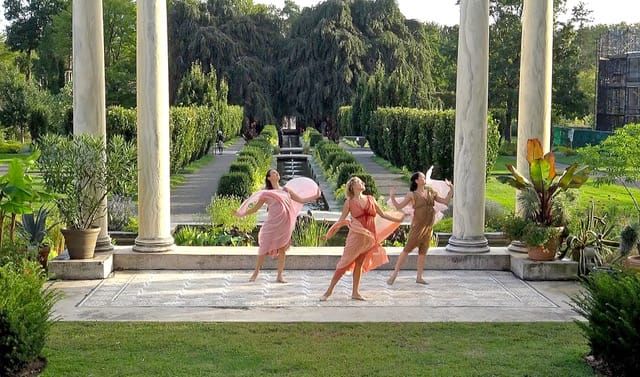
Lori Belilove and the Isadora Duncan Dance Company
Lori Belilove, Artistic Director
Hayley Rose, Emily D'Angelo, Faith Kimberling, Caroline Yamada
Untermyer Gardens, Yonkers NY
September 26, 2020
A flock of Monarch butterflies –- stopping for the night in the Hudson Valley on their way to Mexico – greeted early arrivals Saturday in Untermyer Park and Gardens, high above the river in Yonkers. Their visit was unscheduled, but no more an accident than the gust of wind which an hour later lifted the silken wings of three dancers to Chopin’s “Butterfly Etude,” nor the shaft of light from the setting sun that illumined Gluck’s “Bacchanal.” Isadora planned it that way.
Nearly a century after Isadora Duncan’s dancers performed in Samuel Untermyer’s open-air amphitheater in 1923, Lori Belilove and her Isadora Duncan Dance Company returned for an encore. And if Isadora was ahead of her time, her self-anointed successor Belilove is right on time with this revival.
Nothing seems more right for this weary, chaotic age than dance that is formal but not fussy, emotionally direct, earthy yet full of joy. No setting could be better for this Pandemic autumn than a garden full of classic columns and floral breezes. And no performer could be more refreshing than Hayley Rose, dancing as if she’d peeled herself from the frieze on a Grecian urn and thrown herself to the winds.
Belilove’s Duncan technique draws attention to the arms, and uses every twist and turn those arms are capable of to transmit the idea of the dance. Fingers flash, hands unfurl, wrists twirl and turn inside out to clap like castanets. Elbows drop to bring the hands delicately close to the torso, or bend overhead to frame the face. Shoulders extend to bear the arms like wings. Unlike contemporary ballet with its fixation on long legs and sculpted feet, the upper body here is not the icing on the cake, but the cake itself.
Put another way: legs and feet are like engine and wheels. Human expression comes from the heart, and radiates through the arms, hands and face. In this way Belilove respects her dancers – all female – as artists, not objects. The four women brought individual shapes, sizes, and souls to the choreography, and this made their ensemble passages multi-faceted, gave the audience a choice of focus. Caroline Yamada charmed with petite, exquisite variations, spiraling upward. But my eyes usually wound up resting on Emily D’Angelo’s long, soaring gestures, or a mischievous trick of Hayley Rose – flopping un-classically over her sternum only to snap back into a flying arch. These “Isadorables” also dance with their eyes. From the top of the amphitheater I was able to see the wild glow in Rose’s, the flash in Yamada’s, and briefly the dark intense gaze of Belilove herself, playing Isadora – a mother grieving her lost children.
The program was a selection of recreated Duncan dances to Chopin, Gluck, and Schubert, plus originals by Belilove to Sibelius, Rachmaninoff et al. (If they differ, it is in Belilove’s romantic streak, a step past the passionate classicism of Duncan.) The evening hit its stride just after intermission, with a string of Chopin dances -- that windswept “Butterfly Etude,” followed by a billowing “Harp Etude” for D’Angelo, and a mad “Minute Waltz” for Faith Kimberling. It peaked with the Bacchanal, a chase around the green ending in a happy heap on the ground.
Along the way there were laments, slow marches, and communion among the dancers, drawing together to join hands in a chain, turning away in grief. Emotions flowed naturally, in the moment, in the body. Isadora’s vision was a grand reunion of art, architecture, and nature, open to chance and inspiration. Belilove and company give that vision an authentic new life, sorely needed in our present state.
copyright 2020 by Tom Phillips



