Holy Ground, Dirty Dancing
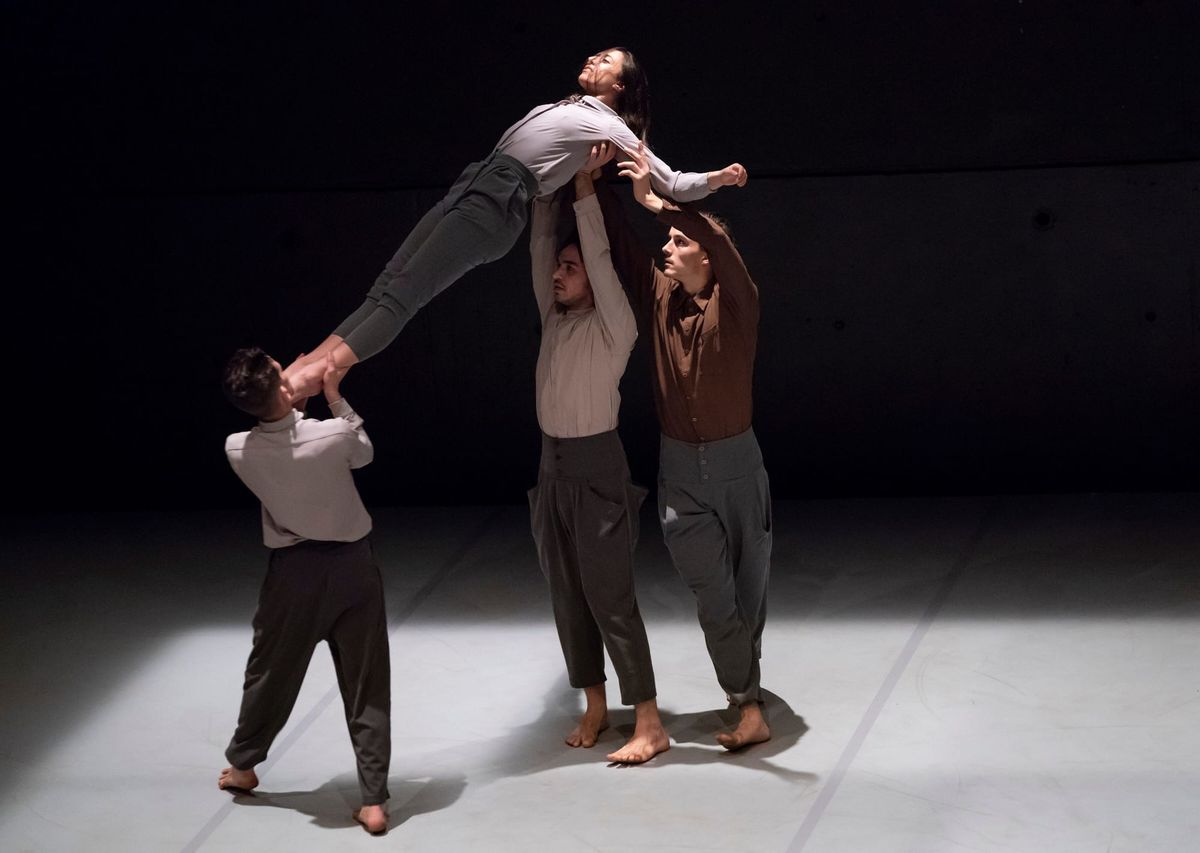
"One. One & One"
Vertigo Dance Company
Baryshnikov Arts Center, New York
March 6, 2019
Except for a neat row of dirt at the front of the stage, the opening section of “One. One & One” by Israel’s Vertigo Dance Company looks much like the closing elegy of George Balanchine’s “Serenade.” It’s a solemn communal idyll, to sonorous cellos in a minor key, with a motif of dancers leaning on each other for balance and support. They seem to be a close-knit group, working out complex tasks together –- as when three men braid the hair of a woman while she uses her long tresses to pull them across the stage.
The communal spirit stays as more dirt is spread in the rectangular, closed space. But the mood changes suddenly with the sound of a cannonade – big guns, firing in the distance. After that, the dirt and the dancers start to fly, and the communal idyll is transformed into what looks like an army boot camp, whipping troops into combat readiness. The motif here is “bring it on,” with dancers lining up on each side of the stage and charging at their opposite numbers, trying to breach their defenses. Every charge is repelled!
So much for “Serenade.” This looks more like Socialist Realism, the kind of state-sponsored art that Balanchine came to America to get away from. And if it reminds you of the modern history of Israel, as seen by the State of Israel, that’s just what it looked like to me.
Vertigo Dance Company is sponsored by The State of Israel. That’s not to say all is victory and light in “One. One & One.” The only drama comes late in the piece, when a woman seems to freak out over the demands of this regimen. She breaks for the non-existent exits, writhes and struggles, but is stopped and subdued at every turn by multiple mates, finally hauled off by the scruff of her shirt and guarded by a posse until she calms down. She’s back in formation for the closing elegy, with cellos deepening, still in that minor key.
The dancers deserve credit for grace, intensity and endurance, and choreographer Noa Wertheim’s combinations are inventive as well as athletic. But the world created by this dance is claustrophobic and completely one-sided. Danger and conflict are all around, but they never enter the space. Disembodied foes shoot guns in the distance; the response is to close ranks and work the troops into a frenzy. The dirt seems an obvious reference to the land of Israel, the object of turf wars since biblical times. The title evokes the presence of two nations on that holy ground, but the work shows only one. And what we see isn’t war, just endless readiness, mounting stress.
If that's what it’s like in Israel today, I’d freak out too.
Copyright 2019 by Tom Phillips



