Hip-hop Round-trip: London to New York
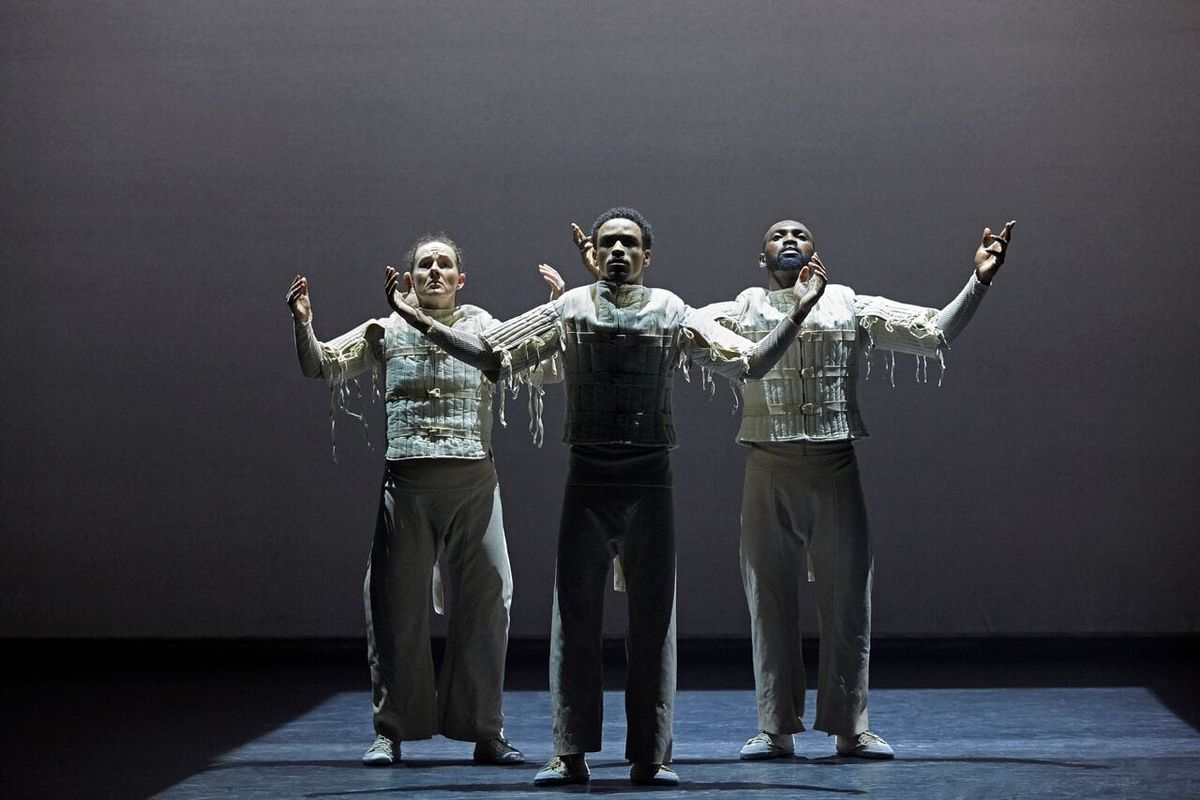
"Blak Whyte Gray"
Boy Blue
Michael "Mikey J" Asante, Creative Direction and Music
Kenrick "H2O" Sandy, Choreography
Gerald W. Lynch Theater at John Jay College
Lincoln Center White Light Festival
November 16, 2018
Members of Boy Blue held a post-performance chat last night after the US premiere of "Blak Whyte Gray," and it was a shock to hear their British accents. Their intense and acrobatic hip-hop dancing was straight from the streets of New York – having made a round trip from east London.
Flipping the usual progression from darkness to light, this young British troupe gives us a three-part journey of liberation that starts with "Whyte" and ends with "Blak." The progress is upward, from a kind of enslavement to a celebration of strength and freedom. But the opening depiction of present-day slavery seemed the most relevant to an American audience.
"Whyte" takes place in a square of white light, with a row of vertical shadows that look like prison bars. Two men and a woman – one black, one white, the third in between – move in lockstep, as if shocked by random currents. Their costumes look like straitjackets. Spasmodic movements and a jagged sound score suggest they are subjects in an experiment, controlled by an alien intelligence they can't see or avoid. In short, they are inmates in the virtual prison that is closing in on all of us, as technology takes over our wants and needs.
In "Gray," the second section, a larger troupe moves in dim light, as if searching for an unseen foe. In the style of a military patrol, they fire off some shots into the darkness. My American eyes immediately registered Vietnam, ambush, body bags. But here the enemy never appears.
After Intermission, "Blak" gives us a battle of sorts. A man faints and fails, but is repeatedly lifted up by his mates, then feels his strength returning. In a central solo he is clothed in royal red, leaps and rules. The ensemble returns for a celebration in the style of an African village festival.
In the post-performance chat, Director Mikey J said the "Blak" section was inspired by his visits to Ghana, where his mother's family has its roots. For him, it was about gathering strength from one's ancestors and their seminal culture. His story illustrates an important difference between Black culture in Britain and in the US. Like many Britons, Mikey Asante can trace his heritage to an African tribal nation with a history of its own. In America, African slaves were separated from their families and tribal groups, and any expression of African culture was suppressed. After a generation of slavery, most African-Americans had no knowledge of where they came from. And that cruel amputation distorts Black culture in America to this day.
"Blak" was a great crowd-pleaser and a giddy Mikey J said later it was "bonkers" to be dancing in New York. These Brits indeed have something to add to hip-hop -- the royal robes from the days when they were kings.
-- Copyright 2018 by Tom Phillips



