Happy Birthday
"Five Songs for Piano", "Les Neuf Danseuses", "Harmonic", "Serenade" (excerpt), "Troublemaker", "Diagnosis", "Blooming Bouquet"
Columbia Ballet Collaborative
Miller Theatre
New York, New York
April 15, 2017, matinee
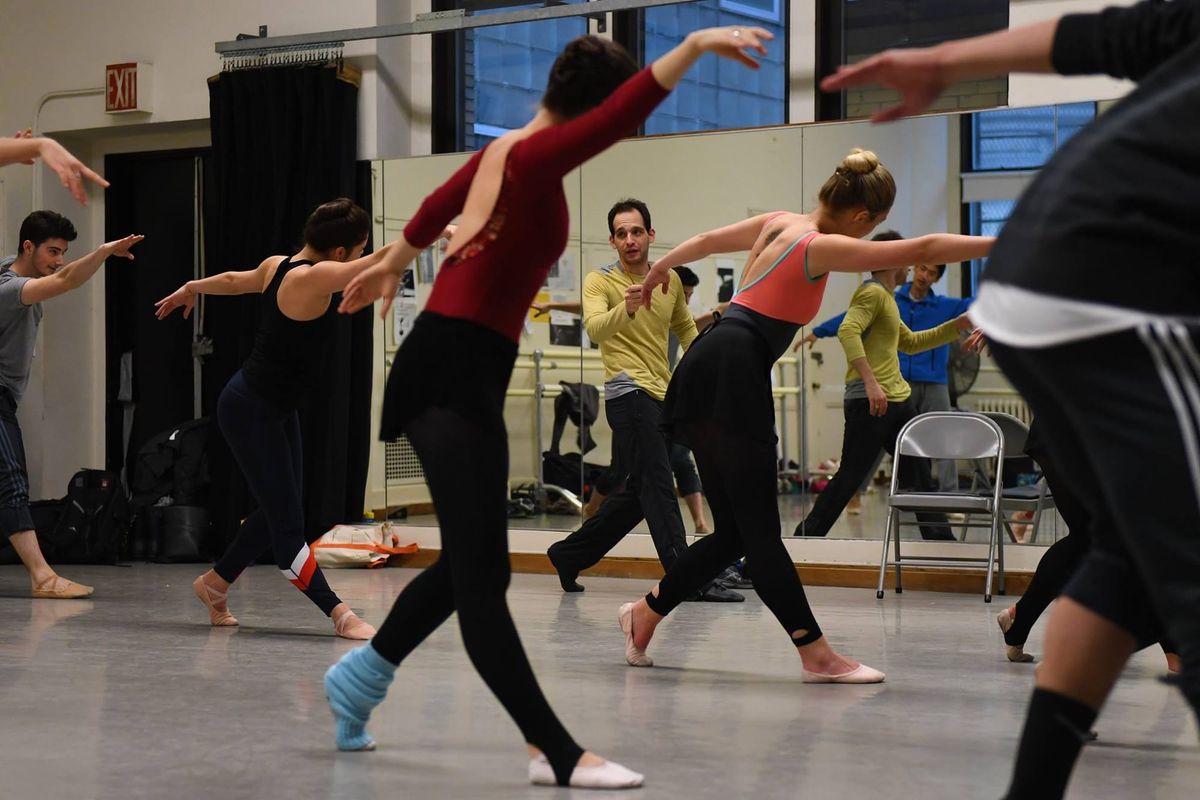
Ten years ago, a group of students at Columbia and Barnard, some of whom had danced professionally and all of whom had studied ballet seriously, decided to put on a show. Though these students have long since graduated, the Columbia Ballet Collaborative, run entirely by students, is thriving, offering classes, commissioning new works, and presenting programs. For their tenth anniversary concert, they danced two of their older works, an excerpt from Balanchine's "Serenade", and four new works, an ambitious program (and rehearsal schedule) which was presented with a professional sheen.
Not surprisingly, the best choreography was Balanchine's. The Collaborative danced the opening movement, which showed off the company's fervor, nuance, and dedication. It was staged by the former New York City Ballet dancer Amanda Edge which a fine attention to detail, and it was danced with care (the opening heads and arms moved as one unit) combined with a confident expansiveness which removed it from the classroom.
The music, understandably, was taped Only the opening ballet, Emery LeCrone's 2010 "Five Songs for Piano", set to Mendelssohn's "Lieder Ohne Worte," had live music, played by Melody Fader (who also plays for the musically sophisticated New Chamber Ballet). When new, the ballet for five women had a haunting power, a sense of mourning, as different women stepped forward from the group. This performance, though scrupulously danced, missed some of the communal feeling, and the emphatic and often unmusical arm swirling seemed more about poses than emotions.
There was also a great deal of posing in three other works, Claudia Schreier's 2013 "Harmonic", Richard Isaac's new "Troublemaker", and Barry Kerollis' "Diagnosis", also new. They all had somewhat ambiguous titles, dark lighting, and minimalist music that avoided structure and variety, which meant that they did blend together, as the dancers twisted through the energetic, "Not your grandmother's ballet" steps (lots of flexed feet and over-arched backs); the dancers looked a bit like bendy straws blown around by the wind. Nicholas Rio and Holly Curran got a fine, fierce pas de deux in "Harmonic", and Rio (an impressive presence) also partnered a mysterious Clara Monk in "Diagnosis"; Monk and Ali Block helped give "Diagnosis" a fiery dramatic tinge in between a meandering corps.
Caitlin Dieck Locke's new "Les Neuf Danseuses", to the Adagio of Bach's "Violin Concerto No. 2," was danced by nine former members of the Collaborative returning to help celebrate the anniversary. It was an elegant classical exercise, dignified and serene, an exploration of shifting symmetries. The dancers were arranged in a semi-circle, with smaller groups emerging and melting back again and were led by Shoshana Rosenfield with her soft and graceful arms. Locke used her dancers well.
The final work, Craig Salstein's new "Blooming Bouquet", set to the bouncy overture of Rossini's "L'italina in Algeri," also showed a fine craftsmanship, as the twelve dancers, in black shorts and colorful tops against a rainbow colored backdrop bounded through some elegant petite batterie to the growing excitement of larger jumps. Much of the choreography looked like the dancers could have been wearing the peasant costumes from some nineteenth century ballet, but Salstein leavened the pastiche with witty, musically alert modern phrases, like unexpected punch lines. The piece was as tart and invigorating as a dish of Neapolitan sorbet.
Copyright © 2017 by Mary Cargill



