Hanging In There
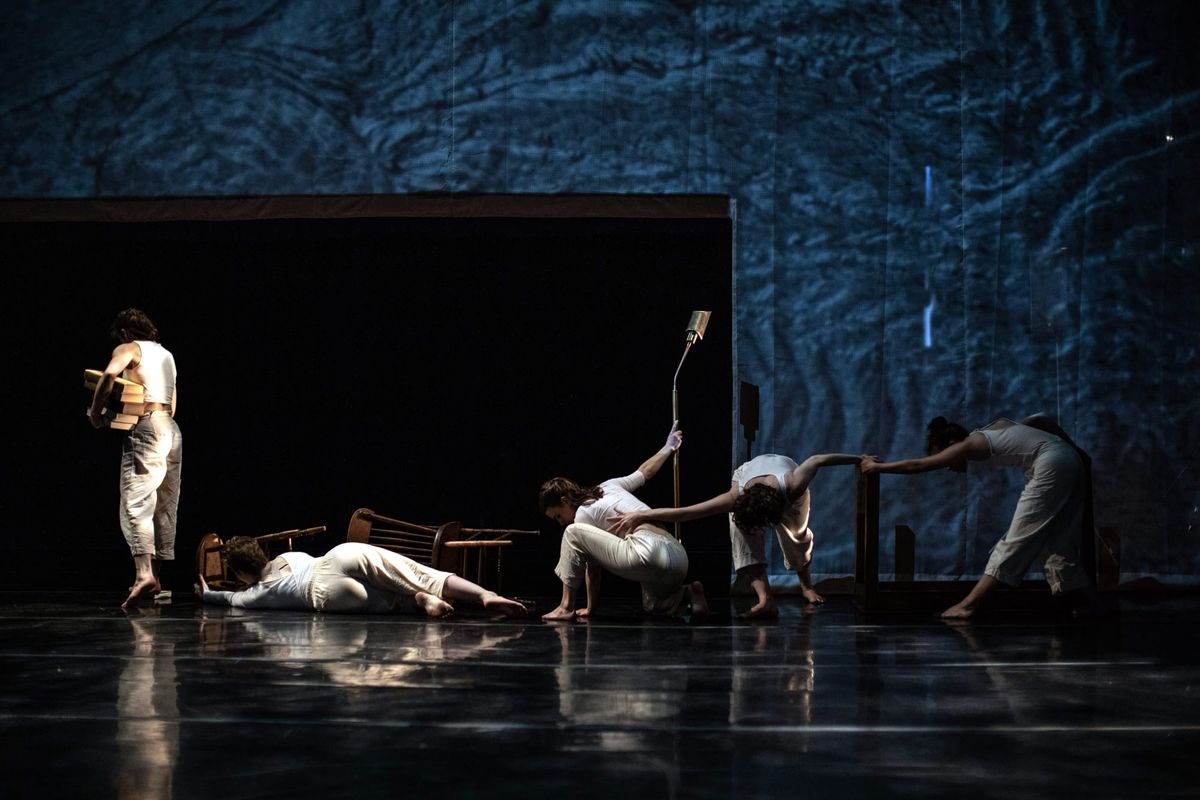
“Close the Door Slowly”
Liss Fain Dance
Z Space
San Francisco, CA
May 5, 2019
Clarity of vision is one of the characteristics of Liss Fain who has been making dance in the Bay Area since 1990. While for the time being she seems to have forgone proscenium performances in favor of installations, often combined with wandering poets and narrators, in this new show language is buried in stacks of books, which however, are barely consulted. “Close the Door Slowly” is a quiet, spare and, at time mesmerizing meditation on living and a sense of the inevitability of time passing and ending in death. Performed by a sextet of women, “Close” is as simple as its resonance is complex.
As she has for many years, Fain was working again with the extraordinary Matthew Antaky. His darkly lit design included two adjacent ceiling-high mesh walls with doors through them. The audience stepped through these into an empty performance space looking at huge entry into blackness through another mesh wall. The spectators sat along three sides. Dancers carried in the set piece by piece: two chairs, a desk, a floor lamp, and a stack of books. All of it looked used and dated.
Anna Greenberg, the company’s volatile technician, planted herself on a stool, a stiff-backed implacable observer. Later, when she had kicked the stool across the stage, she exploded into some of the most expressive dancing even she melded herself into the group. Looking, waiting, a sense of uncertainty but being supportive of each other, wove itself through fifty minutes of shifting units.
As the lights came up Sydney Franz lounged at the desk, bored, waiting, finally moving it around, but not finding what she, apparently, was looking for. What was an orderly “study” became a hunting ground for the dancers who wove themselves through chair rungs, climbed on and under the desk, created precarious pyramids and formed supports for other. Everyone seemed to be trying to make sense of something unknown, perhaps unknowable. High above them hung a huge picture frame with one part missing. I kept thinking that the idea was to finish that frame. Jordan Glenn’s telling score for strings and percussion, at times full of bell sounds but also fiercely raw strings, hung over the performance as if something from a different world.
At “Close’s” most mesmerizing, Keryn Breiterman-Loader and Sonja Dale engaged in a tangled duet, struggling but not aggressively so, as the rest of company stood in a wide circle around them. You only heard a loudly ticking clock; the dancers on the periphery rocked to its beat. But as time was slowing down, they began to wilt, never losing their rhythm until the clock stopped, and they had collapsed to the floor. It was an emotionally powerful moment, and yet so very simple. The two women were inexorably drawn to that black opening upstage, even as their companions desperately tried to hang on. The books became the stepping-stones into the unknown. Time had run out for them.
Eventually, all the dancers made their way towards that powerful image of death. That’s when “Close” missed its step. The dancers returned from the dark, each dragging and wearing a chain of lights behind them. Franz returned to her desk, now placed just barely inside that big opening. The idea, probably, was to suggest a sense of hope and perseverance despite the inevitable, but it rang hollow, with a sense of kitsch to it.
copyright © Rita Felciano 2019