Fresh Choreography--Always Welcome

"Room for Error" "The Bedroom" "It's Uncle" "Cloudless" "Silent Scream"
SFDanceworks
Cowell Theater
Fort Mason Center
San Francisco, CA
June 20, 2019
In its fourth season, Founder James Sofranko's SFDanceworks offered three world premieres by Laura O’Malley, Brett Conway, and Andrea Schermoly. Local premieres of Hubbart Street Resident Choreographer Alejandro Cerrudo’s “Cloudless” and Olivier Wevers’ 2018 “Silent Scream” for his Whim W’Him company made for a well danced, well curated evening of contemporary choreography. This was an intriguing program of dance that, though rooted in ballet, has grown beyond its confines. It was a win-win situation all the way round.
In her fine first choreographic effort (dramatic Lighting Design by David Elliot) O’Malley’s “Room for Error” featured an emotionally fractured Nicholas Korko, haunted by two different by equally tormenting pulls on him. David Calhoun was a ghost-like image of Korko’s self that popped in and out. Just as painful was Katie Lake's more physical presence as she yanked, embraced and climbed on him. "Room" was well timed, well performed and Korko impressed with the details of this turbulent conflict. The hodgepodge music, however, left something to be desired.
Conway’s “The Bedroom” was also his first choreographic essay. This novice choreographer had been a beautiful dancer with Alonzo King before heading for a stint with the Nederlands Dans Theater. Set on Dennis Adams-Zivolich, Katerina Eng, Babatunji Johnson and O’Malley -- each with individual recollections of the room -- this "Bedroom" could benefit from some serious redecorating despite excellent performances. To my eyes, the piece lacked a connective thread. Eng made spectacular use of her long limbs. In his extended solo Johnson imbued this space with a fierce presence both through dramatic leaps, turns and much quieter gestures. It brought the work to a stormy climax which I am not certain was earned. Yet I could have gladly watched more of this dancer.
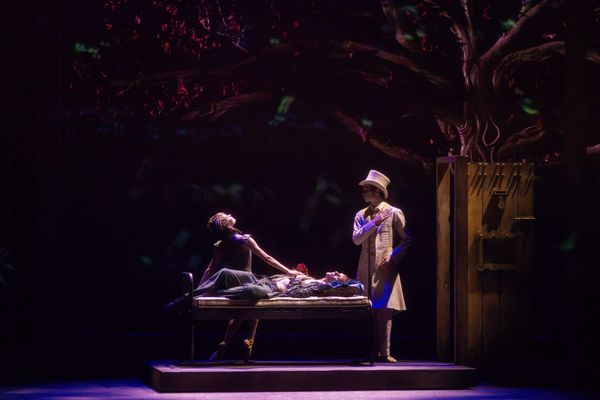
South African-born Schemoly’s puzzling “It’s Uncle” opened with a wildly slashing quartet whose members kept shouting for this “uncle”. Apparently he could be anywhere, including their own bobbing heads. More than anything the dancers — however divergent stylistically — seemed to be looking for perhaps a center, a focus. When Andrew Brader -- tall, lanky, thin as reed in a business suit -- walked in, he proved anything but calming. Stripped to his shorts his twitching, troubled slashing only grew in intensity when he partnered Lake. Theirs became a duet full of painful grasps, twitches, leaps and falls. "Uncle" remained perplexing at the very least.
Cerrudo’s “Cloudless” examined the relationship between Ana Lopez and O’Malley (the evening’s most contributing artist) in a highly formal engagement that started with the two dancers shaping their arms into what looked like a window. The way they shared space, intruded into each other’s area and interlocked limbs, allowed for a mutually supportive melding of bodies. They shared initiatives in pulsating give and takes that emphasized an unbreakable bond. Like a song's refrain, they confirmed over and over their togetherness with a tender but unusual gesture: they touched each other by way of their foreheads. With a return to the opening image, Cerrudo took an overly easy way to close the work.
Rarely does a dance open on a such entertaining note and ends with you gasping for air. Wevers' “Silent Scream” introduced us to the silent movie area in a huddle around a fake fireplace, some spotlights and a motley group that included a prisoner, a workman, a flapper and the little Tramp. They walked in formation, practiced kick lines, embraced the Charleston, jazz steps and multiple jives. Exceptional were Korkos' trocadero ballerina show off legs and turns. Amid the crowd was also a tiny Charlie Chaplin figure. He and the musical score opened memory of his masterpiece, “The Great Dictator.” Though energetically partnered, Tory Peil disappears into the group from which she is thrown and lifted until, stripped to her underwear, she emerges vulnerable, yet indomitable. Chaplin’s final speech from “The Great Dictator” becomes the score for her direct-address finale.That speech must have been chilling in 1940; it sent shudders down my spine in 2019.
copyright © Rita Felciano 2019