Find Help--Or Try To
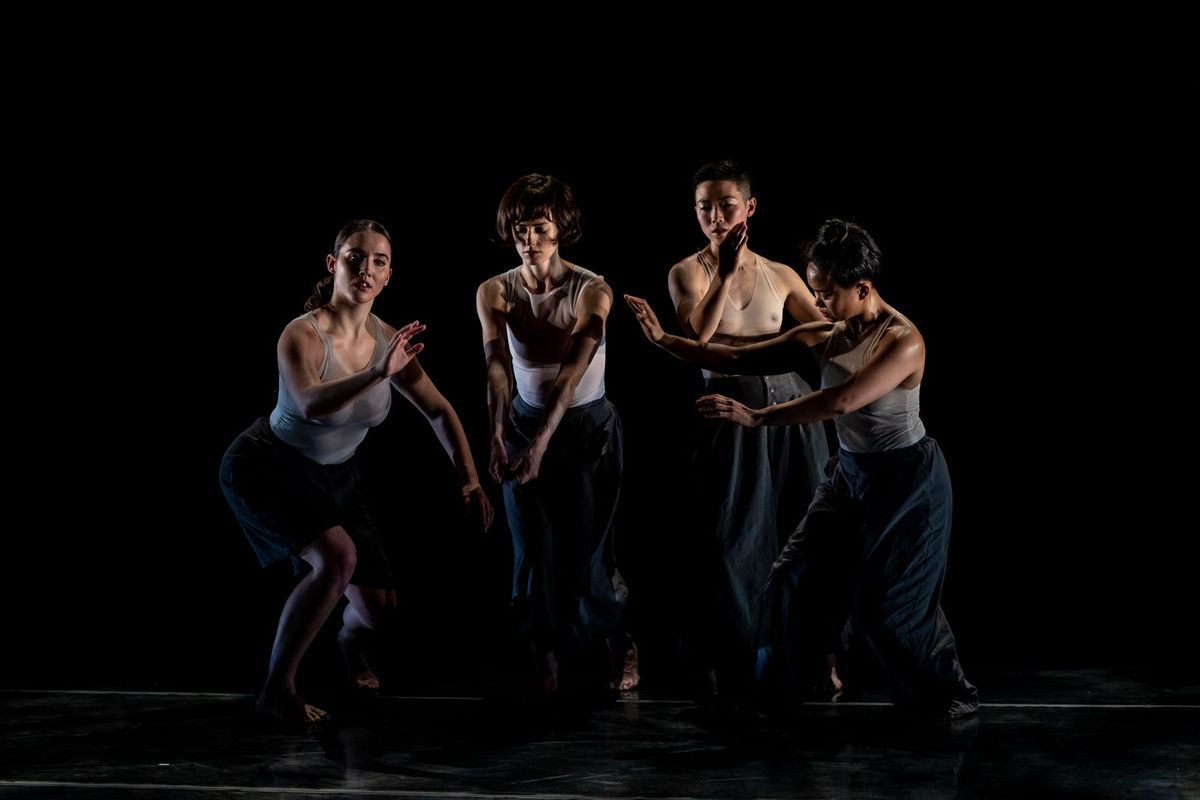
"Divining"
little seismic dance company
ODC Theater, San Francisco
February 16, 2019
The first time I saw Katie Faulkner’s choreography was when, as a member of AXIS Dance Company 2003-2007, she set “Decorum” on three dancers, a wheelchair and a sofa. It was one of those “where did she come from?" moments. For her own little seismic dance company, she has since made and performed dance films, solos on herself and for small groups. She also created the onsite choreography, “We Don’t Belong Here” for twenty professional dancers on San Francisco’s Union Square, Now, she has created her first full-evening, sixty-minute work for a quartet of women: Alex Carrington, Chinchin Hsu, Tara McArthur and Suzette Sagisi. And what a fine endeavor, “Divining” is.
The work is rich in its references both thematic and in its vocabulary, deftly dealing with the challenges that the quartet form’s symmetric pull suggests. Ben Juodvalkis’ electronic score that grows tightly out of the choreography shares much of the credit, and a couple of times amplifies it beyond the body’s capacity. Rare in contemporary dance, you cannot imagine one without the other. A special bravo to Faulkner for this.
She has said the inspiration for “Divining” came from the probably universal idea of people attempting to get an idea of what lies ahead of them. Ritual practices have evolved for one’s personal use, but also, particularly in parlous times, for the community at large. Native American danced for rain; Europeans went on pilgrimages to forestall cholera; Initiation dances are part of West African cultures guiding the young person into adulthood.
Faulkner stressed what is probably the essence of what is a ritual: they are communal endeavors. Dressed in identical black skirts and almost transparent tops, the dancers again and connected into unisons. “Divining” started with blackouts: a bent over figure, a woman supporting her, a third one offering delicate finger-to-finger support. From there the work grew; the first image, probably unnecessarily, returned for a circular structure.
The choreography whether it consisted of shaking heads, rolls on the floor, sitting on one’s knees, stomping with bent torsos or travelling in a beam of light, pulled the dancers together into a common effort. In some you could see existing practices: Islam’s prone torso, Christianity’s folded hands, whirling Dervishes and Plain Indians’ dances. A gesture might be started by one, but almost always became communal.
Juodvalkis' sound, often came from above as arms and gazes strained from below. An overhead quartet of whirling fans drew the dancers into both its sounds and shadows. Faulkner also honored individual performers. Hsu’s whipping solo with interlocking fingers seemed to pull her apart. Another shook ecstatically as if in the thralls of a fundamentalist spirit or in Haiti’s voodoo. The evening’s most spectacular solo was Sagisi’s breaking into hysterical, uncontrolled laughter to which Juodavlkis' score responded identically gasp-by-gasp. The passage built into a truly horrendous crescendo leading to everyone’s “death.” Remarkably, abandon –- yet controlled since this is dance — always emerged from inside the dancers’ bodies. So what could have looked pasted on became organic.
Towards the end the composer pulled all his stops. The tornado of steadily increasing sounds travelled across the room, suggesting nothing less than total human destruction. No surprise that it emptied the stage. And then, like a flower emerging from the ashes, Alex Carrington returned to the stage, bent over, her hands searching for something. I couldn’t quite believe it.
copyright @ 2019 by Rita Felciano