Female Voices
"Time is Money", "George Sand", "Dusty Old Dust", "Mary Tyrone", "Sonnet", "Lyric Suite", "Amanda", "A Point of Doctrine", "Kaddish", "Cante Flamenco", "Shadow of Her Sister"
The Deborah Zall Project: In the Company of Women
Martha Graham Studio Theater
New York, New York
May 13, 2017
Modern dance has a flourishing tradition of female choreographers, but also has traditionally looked forwards, not backwards. Deborah Zall, who danced with Martha Graham before establishing an independent career, bucks this a-historical trend by reviving older works, mainly solos, by the matriarchal pioneers, including, in this performance, works by Jane Dudley, Sophie Maslow, and Anna Sokolow. The program also included five of Zall's pieces, all portraits of women based on literary works, a rare contemporary narrative approach.
The historical pieces were Dudley's "Time is Money" (1932) and "Cante Flamenco" (1944), Maslow's "Dusty Old Dust" (1941) and "A Point of Doctrine" (1950), and Sokolow"s "Kaddish" (1945). (It was puzzling that Sokolow's "Lyric Suite", choreographed for a group of dancers in 1953, was listed as a solo from 1990.) Watching these was like taking a trip to the old Lower East Side, with its political and social seriousness and ethnic roots. "Time is Money", danced by Erica Dankmeyer to a poem by Sol Funaroff (a Lower East Side radical writer active in the 1930s), eulogized the garment workers exploited by the sweatshop system. Dudley used the meter of the poem ("skin to bone of workers", "Tick tock, time is money") to give ordinary moves – walking, running, crouching, staggering – an emphatic power the Dankmeyer made both personal and universal. Her "Cante Flamenco" danced by Nya Bowman, used flamenco's traditional carriage to express the pride and disdain of Dudley's reaction to the Fascist government of Spain, but despite Bowman's fierce attack, the anger remained a bit impersonal.
Maslow's "Dusty Old Dust", danced by Jennifer Conley, was superficially more upbeat, as the dancer stomped with an easy loose-limbed enthusiasm through Woodie Guthrie's "So Long, It's Been Good to Know You". The bitter humor of the song, with its matter-of-fact references to the dust storms, is an ironic illustration of the desperate optimism of the Okies forced to leave their farms for points west, and the dance, for all its hoe-down energy, was as angry as Dudley's overt protests.
"Point of Doctrine", danced by Kenneth Topping (the only male of the evening) and Carrie Ellmore-Tallitsch, was excerpted from Maslow's "The Village I Knew", a series of vignettes about Jewish life in Russia, undoubtedly scenes that many of the original audience would have recognized. It was the only truly light-hearted piece of the evening, an affectionate portrait of a nagging wife and a long-suffering husband, both dressed in stylized Orthodox costumes. The dancers' mime was clear and musical and it was funny without being cartoonish.
Sokolow's "Kaddish" was another glimpse of Jewish life, a moving dance to the haunting song "Kaddish" by Maurice Ravel (unfortunately, but understandably recorded, with an unidentified singer). Sokolow didn't compete with the music, and let the black-clad dancer (Dankmeyer) react to the soaring melodies of the prayer for the dead with restraint. As she stood with her head up and torso back, the music seemed to be coming from her soul and as she bowed down, knotted with grief, she seemed pulled by the melody.
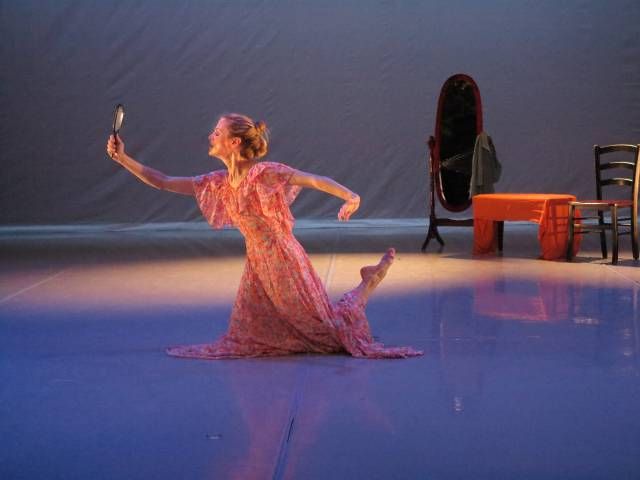
Zail's dancers were also portraits of women's grief, most vividly in "Mary Tyrone" (Bowman) and "Amanda" (Dankmeyer) based on characters from Eugene O'Neill's "A Long Day's Journey into Night" and Tennessee Williams' "The Glass Menagerie". Both of these women were damaged, finding happiness only in the past. Fall's choreography was vivid, using just a few props (Mary Tyrone's wedding dress and morphine syringe and Amanda Wingfield's mirror) to create their world. Her choreography does not excuse them or blame any one for their tragedies; these are not manifestos but sympathetic and understanding portraits of fragile, unhappy women.
There are plenty of unhappy women in Garcia Lorca's "The House of Bernarda Alba", and Zall, in "Shadow of Her Sister", choreographed the conflict between the eldest, Angustias (Lauren Newman) and the youngest, Adela (Caterina Rago). This was not as successful as her solos; the empty stage doesn't suggest the claustrophobic house and the complicated story wasn't clear. The dancers approached each other warily and their hatred was clear, though the reason wasn't -- there is a suitor in the play who doesn't appear. Newman seems too young and pretty for the bitter older sister, though the final scene, as she knelt to pray after apparently murdering her younger sister, was chilling.
Her other two works "George Sand" and "Sonnet", also treated unfortunate literary loves. Sand (Sandra Kaufmann) danced to Chopin (appropriately) with a red ribbon and a bench, struggling valiantly against despair and the anonymous woman in "Sonnet" (Carrie Ellmore-Tallitsch) danced to Edna St. Vincent Millay's Sonnet II ("Time Does Not Bring Relief"). The dancers gave an honesty to their despair, without anger or self-pity. The evening wasn't exactly uplifting (no "I am woman, hear me roar" heroics) but it was moving, vivid, historical, and, yes, heroic.
Copyright © 2017 by Mary Cargill



