Fanning the Flames
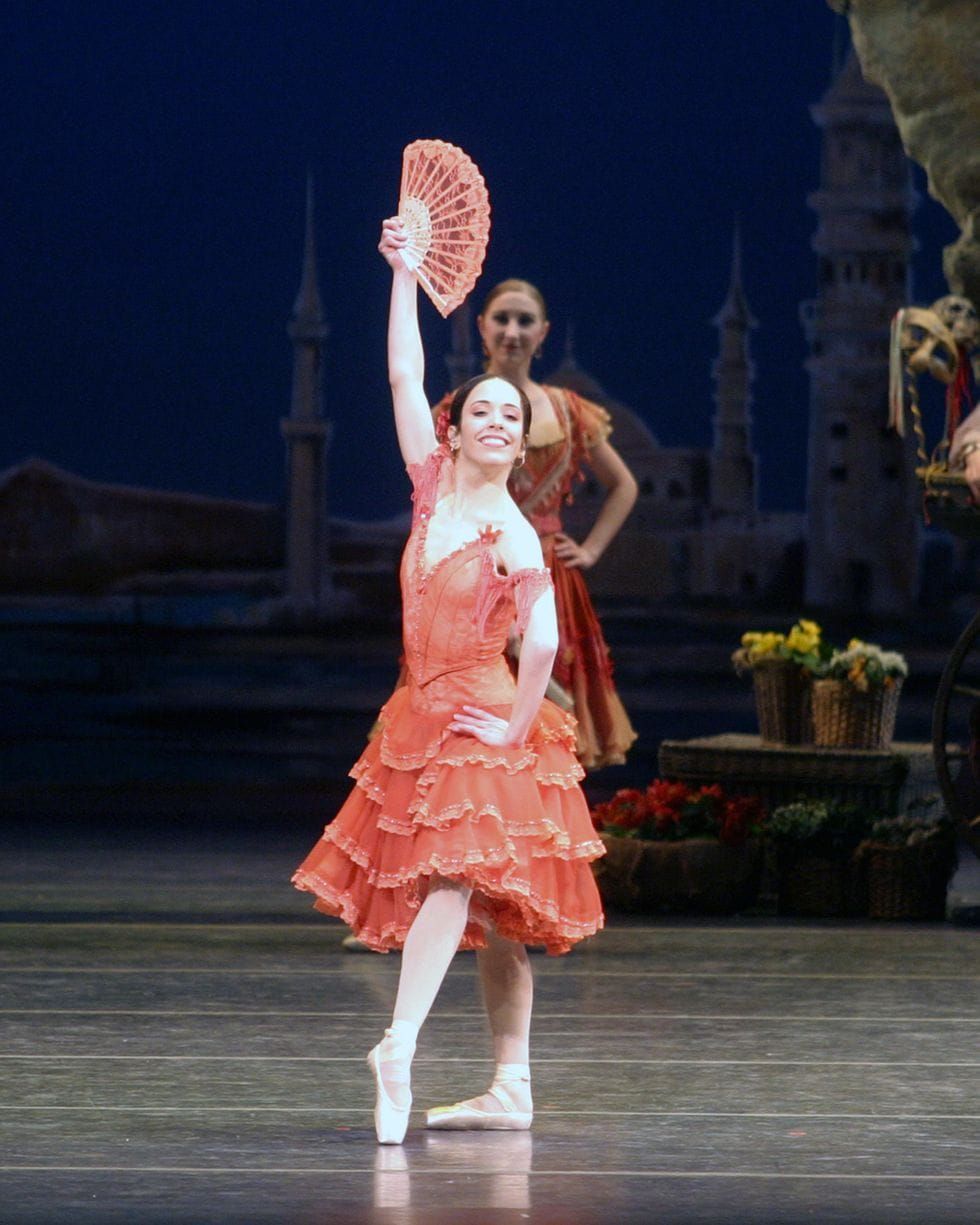
"Don Quixote"
[staged by Kevin McKenzie and Susan Jones]
American Ballet Theatre
Metropolitan Opera House
New York, NY
June 10, 2004
Xiomara Reyes and Angel Corella, who were so winning as Lise and Colas in last year’s La Fille Mal Gardée, danced together again in Don Quixote. Since they basically share the same story of young love outwitting greedy adults, their combination of technical fireworks and youthful joy was exhilarating, a refreshing and spicy drink of sangria.
Reyes has never struck me as a technical dynamo, but she negotiated the role with flair; the fouettés were done with fan in hand, held aloft during the frequent doubles. Her hops of point during the vision scene skimmed the floor, making her seem to float. Corella, of course, was in his element, jumping and turning, but there was no sense that his dancing was forced, and he never looked like he might loose control. He toned down some of the groping during the fake suicide scene, fortunately. The audience gave them a genuine (not a “let me stand up to put on my coat”) standing ovation.
Reyes was a very human Kitri, very gentle and loving. It would be nice if ABT could incorporate the Cuban Ballet’s idea (at least that is where I first saw it), of Kitri being kind to the gypsy girl in the first act, after Gamache has threatened her; it would round out her character a bit, and give the energetic gypsies a reason to help the couple out. I didn’t feel that Reyes had the complete measure of Petipa’s character—as in so many of his works, he has a sprightly first act, a misty vision, and a grand finale. Reyes tended to be the same charming person throughout, very there in the vision scene, and not truly grand in the final act. This did work well on a theatrical level, though, since for once it seemed that Kitri and Basilio would really live happily every after in their village, not that they were angling for a place in the Ballet Hall of Fame.
The theatrical angle of the Don was in good shape, though I thought Victor Barbee’s Don could have used a bit more quirky dignity—he seemed at times to be the Tin Man’s cousin. Julio Bragado-Young, who was so fine as the Bottom in the televised version of The Dream, was Gamache. He used his gangliness quite imaginatively, giving the impression of an awkward flirt, who realizes that perhaps he isn’t quite as irresistible as he hopes. The timing of the pratfalls was very good, and I found myself laughing out loud when he got smacked by that fish—yes, I knew it was coming, but it was still funny.
The character dancing, too, was very good—it may be that the character work on Raymonda carried over. The seguidilla had a smoldering flair, and the couples’ eyes seemed locked together—it wasn’t just shoulder shaking and flinging arms. Espada, Gennadi Saveliev, was terrific, and kept the Spanish accent.
On the classical side, the two flower girls, Maria Riccetto and Misty Copeland, despite a brief collision in the final act, sparkled. Anne Milewski seems to have made a specialty of Amour (can’t she dance anything else?), and used her airy jump and graceful upper body to avoid any feeling of coyness. Veronika Part, replacing Michele Wiles, was the Queen of the Dryads, and I do mean Queen. Her tall, lush body can control space, and her Italian fouettés, when she paused ever so slightly at the top of the movement, seemed to make time stand still. She is a very special dancer. And it was a very special evening.
copyright © 2004 by Mary Cargill



