Falling for Dance Not So Far From Home
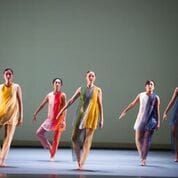
“New Work for Goldberg Variations (excerpt),” “Sleep Well Beast,” “Inner Voices,” “Promethean Fire”
Fall For Dance Festival Program 2
Pam Tanowitz Dance, Justin Peck and Patricia Delgado, Gemma Bond Dance, Paul Taylor Dance Company
New York City Center
New York, NY
October 4, 2018
For fifteen years Fall for Dance Festival has taken pride – rightly – in introducing a wide audience to a wide variety of dancers, dances and dance forms on each of its program. So it was surprising to realize just how homogeneous this program was, with four Anglo-American choreographers, all using Western music (including Bach twice), as well as quite traditional production values, and, whether ballet or modern dance, in pointe shoes, sneakers or barefoot, a formal, classical bent to communicate the pleasure of dancing.
"New Work for Goldberg Variations" is a collaboration between pianist Simone Dinnerstein and choreographer Pam Tanowitz entered into at Dinnerstein's behest. The version presented at Fall For Dance included a quarter or so or the full work. Perhaps the most thrilling aspect of the piece was the fact that the music and musician were literally in the center of the action, their presence never treated as an obstacle. Instead, sound and motion were simply, visibly at parity.
The tone is light and sprightly and re-enforced by the costumes (by Reid Barthelme and Harriet Jung) with their broad strokes of vibrant color and translucent material which renders the dancers' legs immaterial. And yet there is rigor in the straight backs of the dancers and restraint throughout. Grace notes, a wiggle of the shoulders, meetings of the three, or two or four, graces are tossed off gently and left to float away. At one point, Lindsay Jones sat down on the piano bench, back to back with Dinnerstein, and tapped to Bach barefoot. She then walked straight off stage. Neither woman acknowledged the other, or worse, pretended not to acknowledge each other; their restraint made the audience laugh with pleasure. And yet, seeing the work incomplete is like a seamstress before a bolt of brocade, and idea in mind, but the full gown still to come. Perhaps Tanowitz needs a gig all her own, alternating performances of "New Work for Goldberg Variations" in full with her newest "Four Quartets".
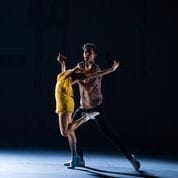
Justin Peck's "Sleep Well Beast", billed as a world premiere, looked familiar to those who have watched his music video for The National's "Dark Side of the Gym". His partner wass once again his fiancée and former Miami City Ballet principal, Jeanette Delgado. The costumes, credited to the dancers, were unchanged, but for a jacket (omitted here). The setting is no longer a gym awash in balloons but a dark dank industrial space (a marked contrast after the Tanowitz piece). Within, Peck and Delgado live out two relationships. The first implodes; the second (to "Dark Side of the Gym") just peters out as the dancers exit on opposite sides of the stage. They may, or may not, be two views of the same relationship.
In any case, the work is complete in and of itself and part of its appeal must spring from watching Peck and Delgado working together. Both came across as completely relaxed on stage – not always the case at their home companies – and happy to be dancing with each other. In a series of renversé turns, Delgado caught the music and let it push the step further and further into space. Peck repeatedly landed jumps in a stretched out arabesque with not a wobble to be seen, looking like a pure classicist with a wonderful sense of weight. The partnering – and there's a lot of it – did not come across as manipulation, a trap all to easy to fall into, but as mutual exploration. The use of sneakers all too often an attempt at being cool are here just footwear, not a self-conscious indication of attitude – another trap avoided. "Sleep Well Beast" was a surprise and a little gem, though whether it would survive a change of cast is up for grabs.
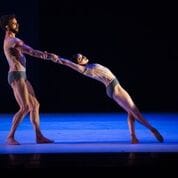
Like "Sleep Well Beast", Gemma Bond's "Inner Voices" is a world premiere, commissioned by Fall For Dance. Set to an unnamed score by Prokofiev, it has a cast of seven: Erez Milatin from the New York Theater Ballet and six dancers from throughout the ranks of Bond's home base, American Ballet Theatre: Cassandra Trenary, James Whiteside, Zimmi Coker, Stephanie Williams, Catherine Hurlin and Tyler Maloney. The costumes for the Trenary and Whiteside called to mind those for Kylian's "La Petit Mort" – costume as carapace. Everyone else was dressed (by Sylvie Rood) less restrictively in white with splotches of color. The point seemed to be showing off the dancers, all game and looking good. But "Inner Voices" lacked tension and structure, simply unfolding, rather than developing, and deriving sustenance from its score.
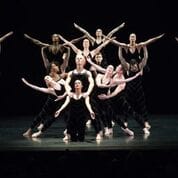
The evening ended with the Paul Taylor Dance Company performing not "Black Tuesday" as originally announced, but "Promethean Fire", the right work in the right place at the right time. It is the first, and perhaps only work by Taylor to use his entire company of sixteen dancers (here restaged to accommodate eighteen – the company is growing), so almost everyone was on stage. Its theme of renewal after, and triumph over, adversity resonated throughout the auditorium In this the first performance by the Company in its home city after Taylor's death. There will be no more Taylor dances but the company is here and dancing. The dancers responded by giving a performance intense, shared focus and gravitas. The lighting has never been more powerful, whether drenching gold or the orange of dangerously burning embers. That signature backward leap of the duet, literally one of faith into a partner's arms (here Parisa Khobdeh and Michael Trusnovec) has regained much of its daring, earning gasps for the first time in years. The company looked right on the stage of City Center, its former home, and the audience was ecstatically happy to welcome them back.
copyright © 2018 by Carol Pardo



