Edge of the Universe
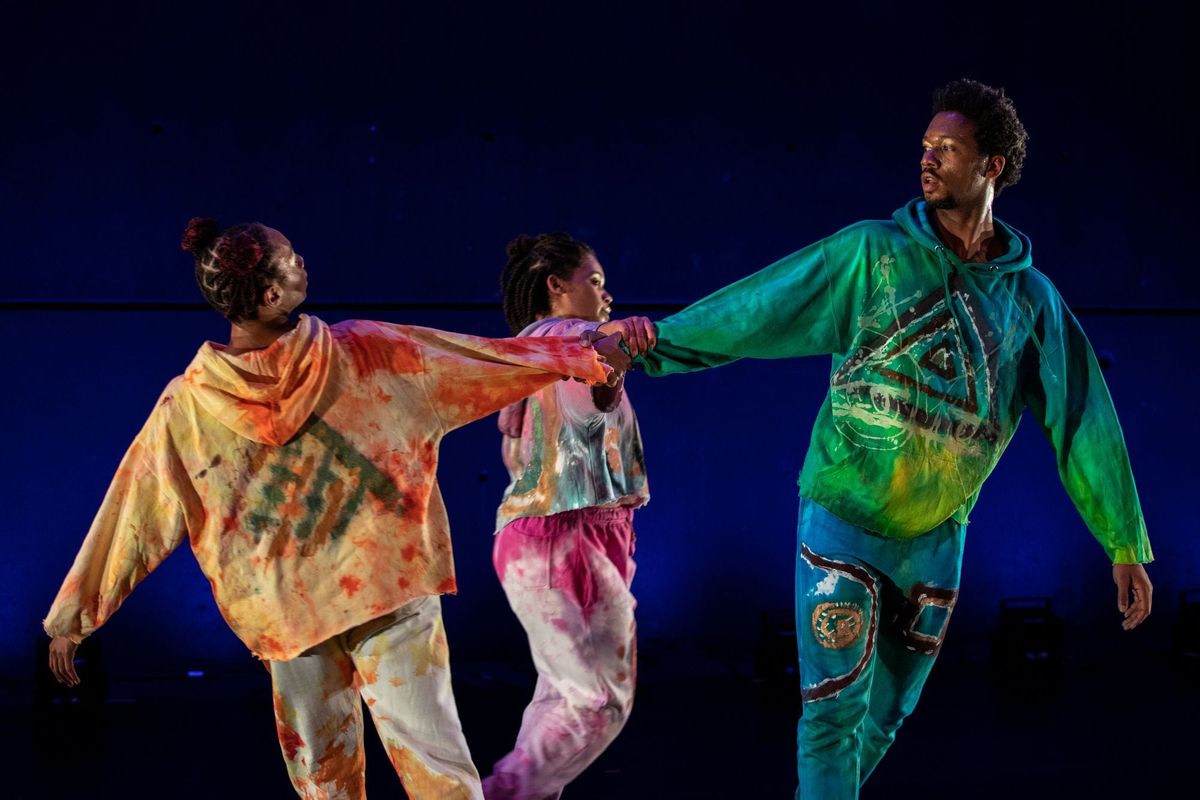
Kyle Marshall Choreography
"Stellar"
Baryshnikov Arts Center, New York
June 7-21, 2021 (online)
Which comes first, music or dance? In Kyle Marshall's choreography, it's neither. Music and dance are two sides of one art form, improvising against each other. Friction, ignition, liftoff, jazz. Marshall's new "Stellar" knits together city streets with the loneliness of deep space, and grounds them in the earth of Mother Africa. All in little more than twenty minutes.
"Stellar" is a video for three dancers---Marshall and two female partners, Bree Breeden and Ariana Speight, and a multi-instrumentalist composer-performer, Kwami Winfield. It begins with long, plaintive single notes from a cornet---the signature solo instrument of early jazz---and bodies shot in close-up, rising and swirling as they seem to grow out of the floor at the Baryshnikov Arts Center. They're wearing loose sweatpants and hoodies that look tie-dyed and painted. With hoods up they look like space suits.
The dancers walk, dip and dive in circular patterns around the bare stage, as if in orbit, held in their paths by invisible forces---gravity, family, tribe. They make music with hands and feet, stomping and clapping a syncopated beat while Winfield scratches out a background, rubbing and shaking bits of metal in his hands. This feels like ritual dance, waking up the earth. The two women then take center stage in turn, and execute a series of spectacular whole-body pirouettes, whipping around with torsos bent, feet flexed, legs flying -- tropical storms in human form. Marshall then launches into a broken break-dance, like a tree whipped in the wind, as the musician toggles from random notes on the keyboard to chaotic background sounds.
The section ends in a total blackout, long enough so you wonder what happened. When it lifts, the dancers are in outer darkness, scuttling along the perimeter of the stage, the edge of the universe. The music changes to buzzes, bleeps and bloops—the mysterious energy of the ether. Then the sound picks up density as the dancers gradually come together, then fall away. Last time I checked, the Big Bang theory had been replaced by the Bang-Bang theory—in which the expansion and contraction of the cosmos is a repetitive cycle. That's what happens in the dance. It ends with a traditional folk-dance figure, a three-hand star, which then explodes into the wings.
Marshall says the piece was inspired by the most ethereal kind of jazz—the cosmic mysticism of Sun Ra, and the legacy of John Coltrane's meditative trips. But it's still jazz, born of the earth and the streets. "Stellar" was created during a year of deadly racial turmoil and pandemic disease, but it makes no direct reference to either. This illustrates one legitimate way that artists, and notably Black artists, have dealt with the world's chronic state of crisis: Transcendence.
"Stellar" can be seen on demand through June 21. To view, click here.
copyright 2021 © by Tom Phillips



