Early Fireworks
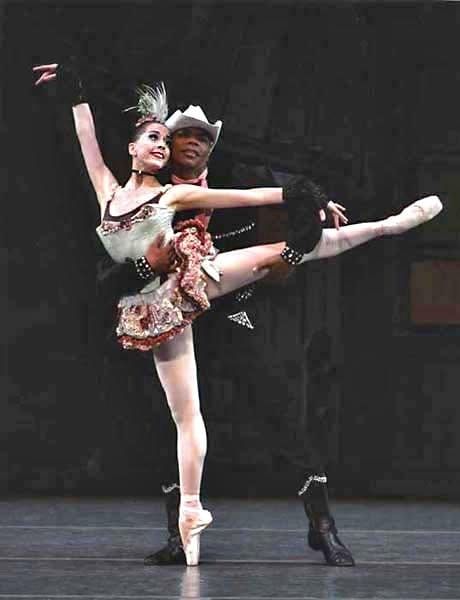
Who Cares?/Western Symphony/Stars and Stripes
New York City Ballet
New York State Theater
May 25, 2004
The Fourth of July came early this year, with three of Balanchine’s most rousing closing ballets on one program—not one of the most balanced of evenings, but, if it seemed like a meal of popcorn, it was applauded to the hilt by a very happy audience.
Who Cares? had two debuts, Ashley Bouder as the red girl, and Sofiane Sylve as the blue one. Miranda Weese danced the Patricia McBride role with Nilas Martins. Martins, while he will never be a romantic hero, had much of the loose-limbed flamboyance that brightened his Pearly King. Weese was fascinating; this was no squishy romantic reverie.
She began “The Man I Love” with a somewhat wary independence, stressing the little pulling away gestures, as if she were slightly jaded, not quite trusting love, which made the final rapturous turns all the more potent. She was as wry and bracing and grown up as a dry martini.
Bouder, with her hair in a pony tail, danced like an eager debutant, and flew through “Stairway to Paradise”, playing with the musical accents. Sylve was ore of the showgirls from the Folies Bergere, all legs and glamour. The somewhat dutiful corps could have used some of her spark.
Western Symphony had Jenifer Ringer’s debut as the dancehall girl in the first movement. Ringer is a little too ladylike for Destry to ride again, and unfortunately the trim on her costume began to unravel, which must have been very disconcerting. But as usual, her infectious charm and the pure beauty of her dancing gave the piece a sparkling dignity.
The dignity was completely missing from Albert Evans’ and Alexandra Ansanelli’s second movement. Though Evans has toned down his shtick somewhat, he still wipes his nose on his sleeve as he enters—the fact that he no longer wipes his sleeve on his tights does not excuse the gesture. Ansanelli, though the audience relished her, is numbingly coy; the choreography, with its allusions to Swan Lake, has real wit underneath its cowboy finery, which seemed to be smothered in mascara. Maria Kowroski, as the lady with the most beautiful hat, was all leggy charm in the third movement, and the finale was glorious.
Stars and Stripes, like Western Symphony, is rigorously classical, with those batons and trumpets substituting for those 19th century fans and tambourines. I suspect that, if the salutes changed to curtsies, and the hats to crowns, the orchestra could play Drigo and the audience would be transported to Europe. Bouder made her debut in the First Campaign, twirling a confident baton, and yet another role seems to have found its ideal interpreter.
Wendy Whelan is not really an ideal Liberty Bell—there is nothing transcendent about the part—and she had some trouble with the footwork, but she did not camp it up. (At the Wall to Wall Balanchine program at Symphony Space earlier this year, Merrill Ashley, coaching Bouder in the pas de deux, stressed that the role was a classical work, urging her to tone down some of the gestures, and Whelan seems to have listened.) Her beautifully stretched line, which seemed to sing, created some unforgettable images. Damian Woetzel was full of gusto as El Capitan; again, he danced it straight, if enthusiastically, and didn’t seem to be gawking at the audience demanding “Look at my flexed feet—I’m so cute!”
For all the American flavor (this program opened the so called American Festival), these works are vintage classical Balanchine, and there were some vintage performances.
copyright © 2004 by Mary Cargill



