Dancing Down Memory Lane
“Minimalism and Me,” “Eight Jelly Rolls,”
Twyla Tharp Dance
Joyce Theater
New York, NY
November 15, 2018
In a charming two-part evening at the Joyce Theater, Twyla Tharp has joined the parade of excellent retrospectives of post-modern giants who are being heralded at MoMA’s current Judson Dance exhibition. Although she took a turn at Judson, Tharp’s path was different than the Judson group (including Yvonne Rainer, Deborah Hay, Trisha Brown and others,) but, like them, she has quite a story to tell, and her deep impact on later generations of choreographers makes her story an important one to hear.
“Minimalism and Me,” the lecture/demonstration that Tharp offered as part of a double-bill is a straightforward telling of her personal history as a dancer, experimental choreographer, collaborator. Before her well-known adventures in ballet and Broadway, before she choreographed to the serenades of Frank Sinatra and Bob Dylan, she was a wide-ranging explorer. As she briskly narrated the story, film clips played of many of her own performances, and her great early collaborators like Sara Rudner (who also helped to stage the second half of this evening’s performance.)
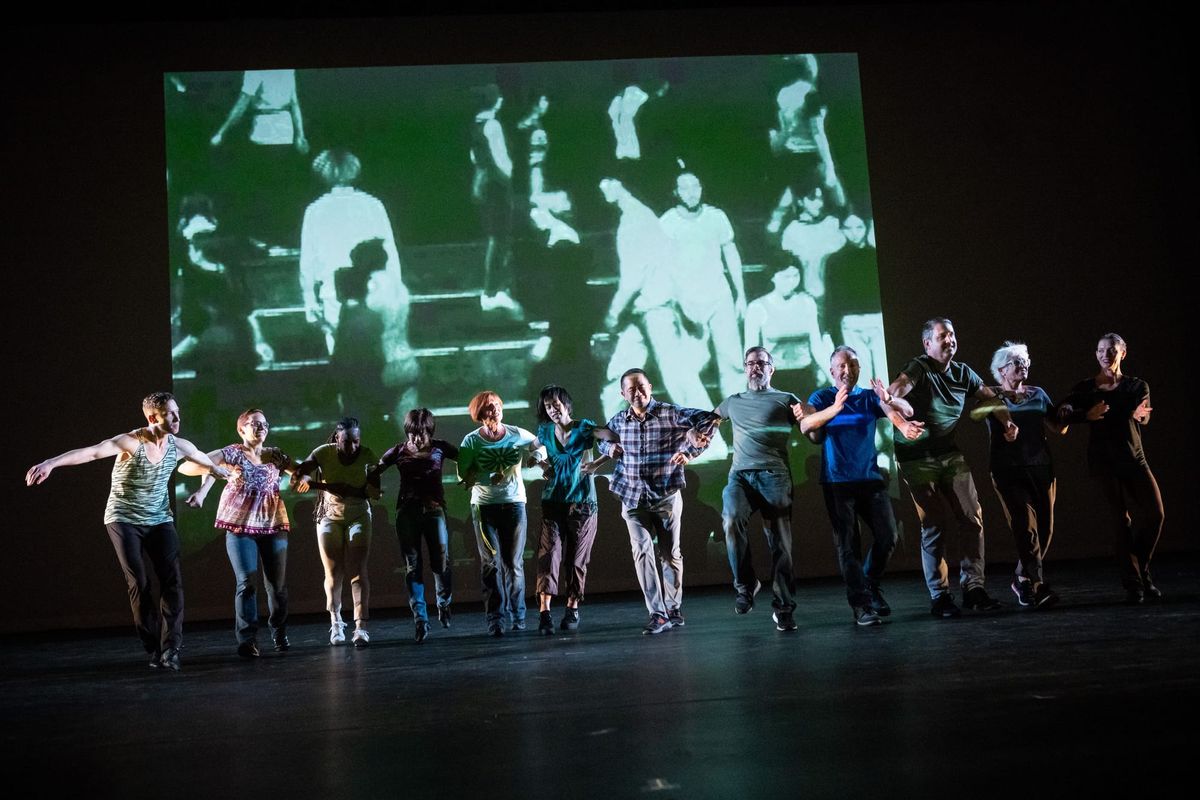
As she spoke from a lectern, Tharp’s six dancers trooped in and sat on folding chairs, a hokey representation of her early school friends, students, and original dancers. Later, a group of ten “volunteers,” representing audience members, were seconded into action along with the company. As the black and white films played on the back screen, the dancers offered brief segments of the filmed works live, taking on the parts originally played by Tharp, Rudman, Rose Marie Wright and others of Tharp’s originally all female troupe.
Now, men make up half of the cast, and Matthew Dibble was entirely at home playing Tharp’s roles, with the idiosyncratic pops, shrugs, and dips of her dance vocabulary (especially endearing as the “White Whale” – a very pregnant Tharp, whose filmed dance with her students was brought to life on stage by Dibble, festooned with a large belly pillow.)
For anyone who missed Tharp’s early years, she reminded the audience of the artistic milieu of the times, and the visual stars (minimalists Barnett Newman, Frank Stella, Agnes Martin, among many) who influenced her. Her first public performance was minimalist as they come: In “Tank Dive” (1965,) to the bouncy rhythm of Petula Clark’s “Downtown,” a dancer stood in second position en relevé, her arms spread high, a vertical mirroring of her legs and feet. As Tharp warned us, it lasted a long five minutes, and was both impressively disciplined and lightly comical – just the beginning of the quirky humor that is a dependable characteristic of Tharp’s dance. In “Re-Move” (1966,) Tharp’s “less is more” offering at Judson Church, the work was based on one simple movement, the dancer moving one foot ahead of the other in rolling locomotion.
As her choreographic history progressed, she moved to a phase of ideas – now “less was good,” and the artistic influences of Sol LeWitt and Frank Stella (“what you see is what you see.”) Tharp’s notes began to look like some of those artworks, complex patterns of columns and rows, indications of where dancers were to move, or mixed swirls of patterns that looked improvised but were, in fact, complicated intersecting relationships. In a grainy film of “Medley” (1969,) her (all-female, at the time) dancers raced through the grass, each one’s movement choreographed for her own particular qualities.
The dancing on-stage during the lecture was too fragmented to offer more than phrases of wriggling, loose Tharp movement, a way to add three dimensions to the historic films. The longest excerpt was more satisfying, as an extended fragment of “Fugue” (1970) unfolded. This was a seminal transition work for Tharp, which she described as offering “unity through counterpoint;” it was the dance that introduced the mature style we identify her with, and one of the early pieces that she has periodically revived.
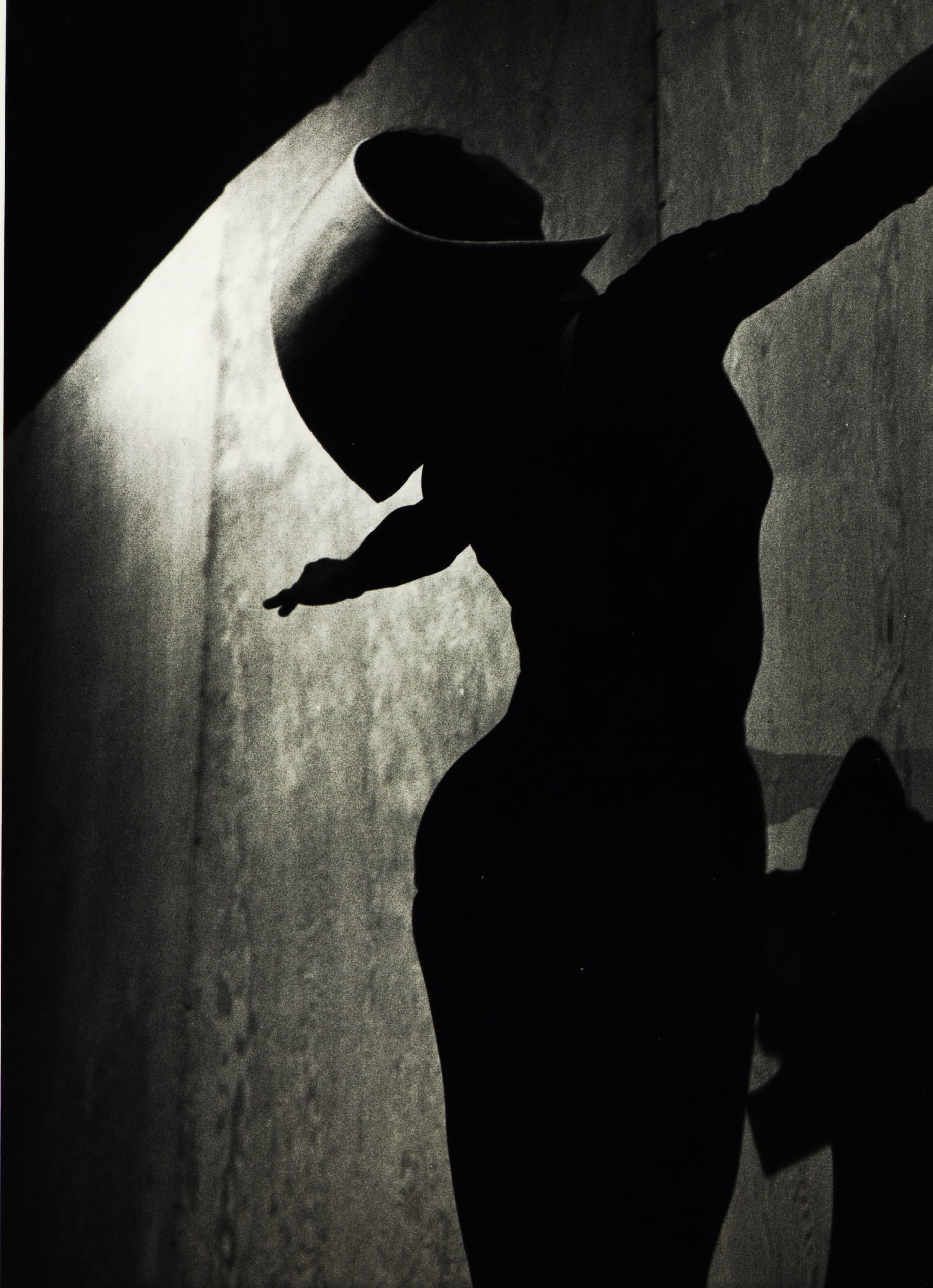
The company was smooth and beautifully in synch, creating rhythms with their feet and slapping thighs. Their rubber strong bodies flicked into balletic high kicks as casually as they shrugged their shoulders and wriggled their hips, a la Tharp. In one of Tharp’s original solos, known as “The Drunk,” Kara Chan tipsily moved around the stage in a precarious space between balance and collapse, a funny, virtuosic extended scene that never fails to please.
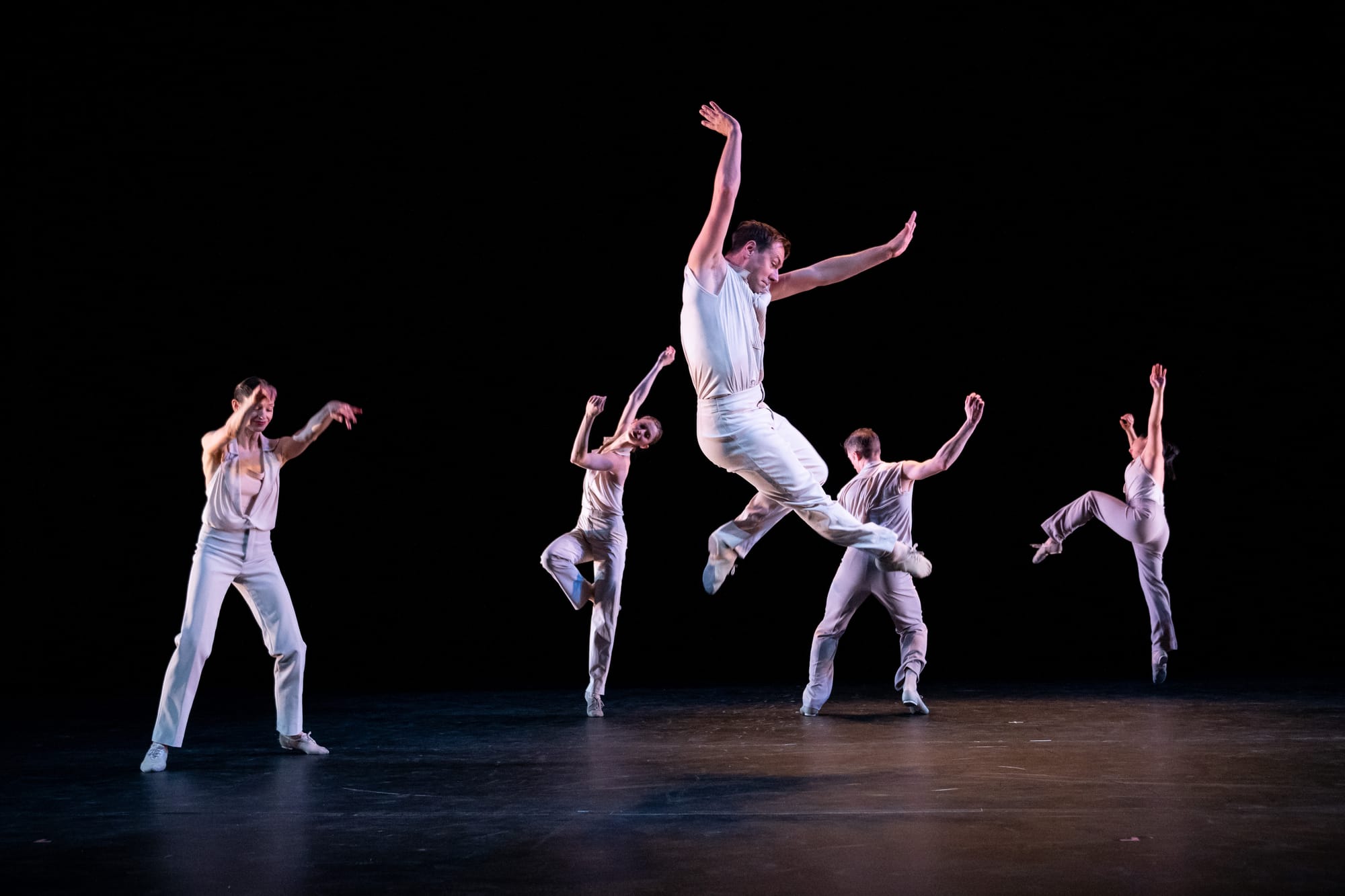
Although the history lesson was a satisfying, well-illustrated reminder of Tharp’s roots, the second half of the evening, a full performance of “Eight Jelly Rolls,” was a better demonstration than Tharp’s words in offering up her early special artistry. Set to classic Jelly Roll Morton tunes in 1971, Tharp made a soft-shoe creation that was all her own, using dancers’ bodies to speak the jazz great’s language of musical fluidity.
The shifting dynamic of the music offered Tharp marvelous opportunities to play with rhythm, pauses, and the contrasts of casual and virtuosic. The dances ranged from a dizzying tippiness to joyous, juicy slides and falls, hips popping and receding, and much impeccably danced general clowning. Arms moved like propeller blades, fingers twizzled at the end of extended hands, and propulsive movement suddenly arrested with a changed direction cracked sharply before returning to balance.
At the end of “Jelly Rolls,” Tharp added a “surprise” – a coda for herself. At 77, Tharp is still in great physical shape. It wasn’t a big surprise (she’d offered a similarly imagined 2017 duet with John Selye that fell sadly flat,) but this brief piece was more successful in finding a space for her. Even now, she inhabits those idiosyncratic body shivers and smooth, loose-footedness best of all. As Twyla chased her partner around the stage, the combination of comedy, self-control, and centeredness added a lightweight but saucy coda to this historical parade of exploration and risk taking. Rarely has history been so entertaining.
copyright © 2018 by Martha Sherman



