Dancing Ahoy
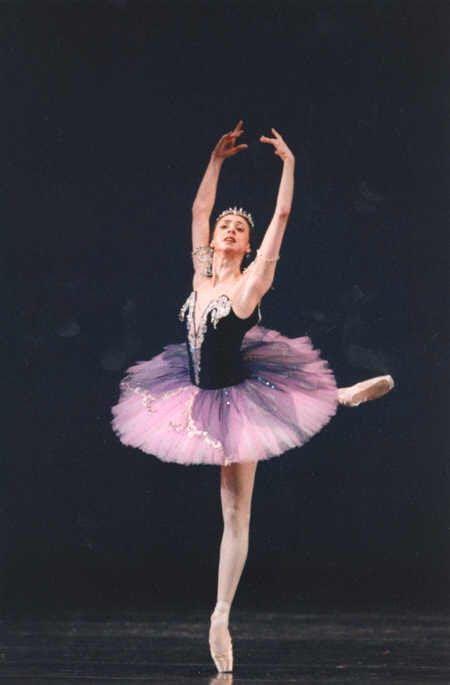
"Le Corsaire"
American Ballet Theatre
Metropolitan Opera House
New York, NY
May 27, 2009
"Le Corsaire" made its ABT debut in 1998, along with another ballet in the continuing full-length sweepstakes, Ben Stevenson's long-forgotten "The Snowmaiden", a completely unmemorable stab at a fairy tale, remarkable only for its stunning sets and the limpid performance of Nina Ananiashvili. "Le Corsaire", while its story is even less resonant than the poor Snowmaiden's, does have pockets of brilliant choreography, led, in one performance, by the ageless Ananiashvili, looking a young and almost as technically accomplished as she did all those years ago traipsing through Stevenson's choreography. The long-after Petipa choreography, though, shows off so brilliantly the many possible facets of female dancing; unfortunately the men's steps, many added, apparently, to give ABT's brilliant stable reason to wander around in Petipa's female world, tend to be unmusical, repetitious, and distracting. The original ballet was French, based very loosely on the Byron poem, and Petipa reworked it for the Maryinsky. It involves a somewhat complicated set of Barbary pirates, Greek captives, and Turkish pashas and is spectacularly preposterous. Basically, Medora, a Greek slave with a habit of being kidnapped, loves Conrad, a friendly pirate who trusts Bribanto, an unfriendly pirate, who tries to kill him and sell Medora back to the cowardly slave owner Lankendem, who sells nubile young women to the Pasha Seyd, who dreams of a beautiful garden populated by Medora and her equally kidnappable friend Gulnare, who are rescued by Conrad and his friendly slave Ali. But there is some serious dancing going on, and it requires serious dancers.
Quite a number of them, in fact, and one of the enduring glories of ABT's production is watching both old and new dancers revel in their chances. Ananiashvili sketched Medora with a light but sure hand, not hamming up her reactions, but gently varying her moods; loving towards Conrad, playful with the Pasha, and eloquently fearful when confronted by Birbanto; she also got to show off her fouettes. She has announced her retirement at the end of the season, so each performance this year is really a farewell tour, and the audience roared its gratitude for so many wonderful performances but she never played to that audience, dancing in her own serene world of beauty. Marcelo Gomes was Conrad; he swaggered convincingly and looked unbelievably handsome in his beard, but the choreography on steroids that is his role makes Conrad the least interesting person in the ballet. The best male choreography goes to his slave Ali, danced by Jose Manuel Carreno in one of his too few roles this season. He gets the most interesting steps in the famous pas de deux for three (where Conrad is forced out of his essentially danseur noble role to complete in the jumping department), and Carreno was forceful, dynamic, and exotic. There is a weight, a gravitas, to use an old fashioned term, to his dancing that contrasts with his forceful jumps and gives his dancing an unmistakable shape and individuality.
Birbanto, the heavy, is also a role whose effect has been reduced as the dancing component has been ramped up. He now does the basic make turns and jumps to music and in a situation that call for some forceful and magnificently powerful miming (imagine how threatening the High Brahmin from "La Bayadere" would look doing split jetes). Craig Salstein frowned with the best of them, but instead of inciting a mutiny, had to foment fouettes--this intelligent and powerful actor deserved better. The role of Landendem does combine dancing with acting, or it did when it was danced by Vladimir Malakhov, who made the spectacular jumps into a deep plie seem the epitime of spineless and oily greed. Gennadi Saveliev did not attempt those plies, substituting some Bolshoi bravura--he looked like a Russian folk dancer who had accidentally turned right instead of left at the Bospheros, but his acting was clear and he was wildly applauded.
Medora's hapless friend Gulnare was danced by Sarah Lane, in a remarkable debut. Gulnare's famous pas d'esclave is a technical tour de force as well as a gentle character study of a helpless little bird of a girl caught in a trap. Lane used her soft and expressive upper body, giving the adagio movement little grace notes of sadness. She does tend, though, in the bravura sections, to end each movement with a wristy flourish, which is a bit like ending every sentence with an exclamation point; her dancing is too beautiful to need exaggeration. There was beautiful dancing from the three odalisques, as well, especially in the creamy authority shown by Kristi Boone. It was also exciting to see Luciana Paris with Craig Salstein in the snappy Forband, a glimpse of real character dancing with bright red shoes. All silliness and extraneous male jumping aside, this production does deserve its bottle of rum.
copyright © 2009 by Mary Cargill



