Current Classicism
“The Vertiginous Thrill of Exactitude”,
“Approximate Sonata 2016”, “Petite Mort”,
and Shostakovich “Piano Concerto #1”
The National Ballet of Canada
Opera House
The John F. Kennedy Center for the Performing Arts
Washington, DC
January 28, 2020
The Canadians opened their visit to Washington by exploring what classical choreography looks like today. The four pieces on this program share very basic features yet are intriguingly distinct, even the first two works which were made by the same individual. Everyone interested in the state of dance could learn a lot from these ballets by America and Germany’s William Forsythe, by Czechoslovakia and The Netherlands’ Jiri Kylian and by Russia and America’s Alexei Ratmansky. There were just two chances to catch this event, Canadian National Ballet’s first night in town and its second. Then the company goes on to standard, 19th Century classicism with “The Sleeping Beauty”.
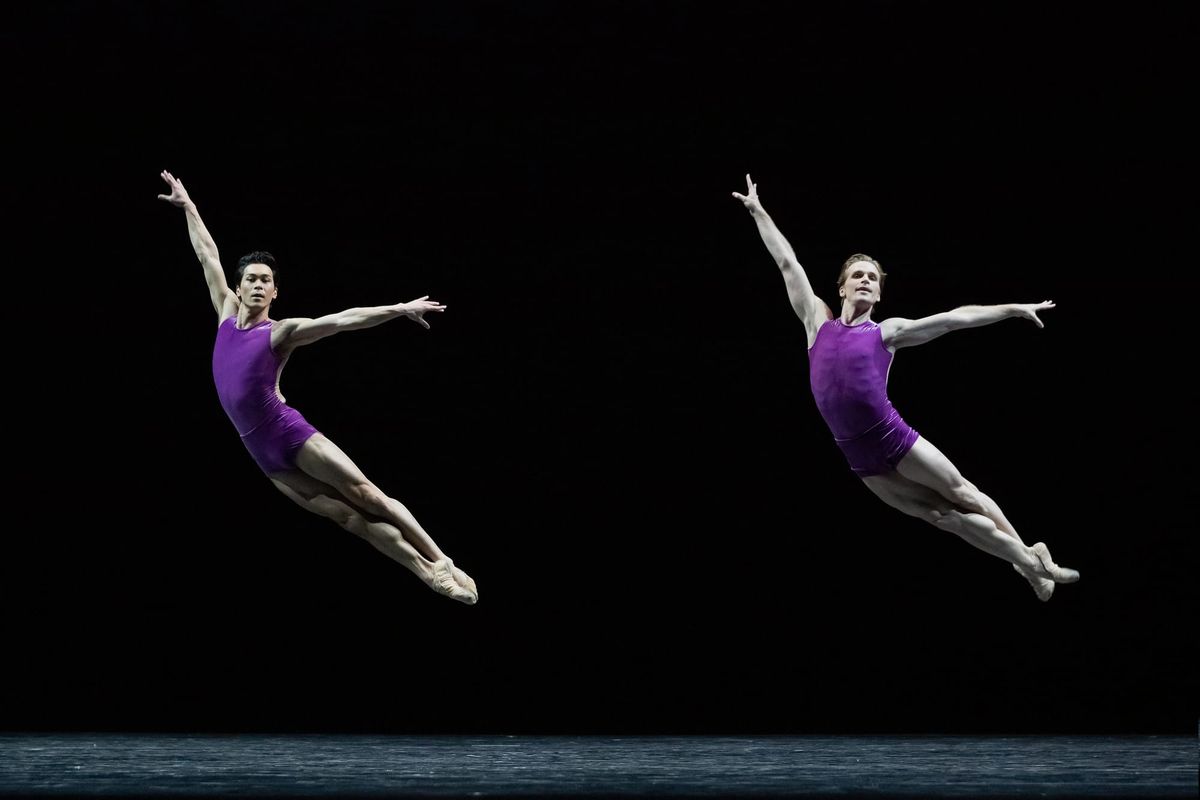
The emphasis throughout this quadruple bill was dance movement for movement’s sake and to probe the potentials of the human body. In “Exactitude”, Forsythe keeps two men and three women busy across the stage. There is haste but also a concern for elegance of motion. These men (Naoya Ebe, Harrison James) and women (Hannah Galway, Chelsy Meiss, Calley Skalnik) dance by themselves and with each other, displaying the richness of balletic technique (posture, propulsion, balance, leaps and leg beats, turns, flexings and foldings, etc.). The choreography alludes to the inventiveness of previous choreographers, particulalty Marius Petipa and George Balanchine, but there is more speed and less langor. Relations between and among the five figures are potentials that remain undetailed. The music by Franz Schubert, although from the 19th Century, is terse – allegro vivace. In contrast, the dancing in Forsythe’s “Approximate Sonata” seems more casual and sometimes more contorted. There are, in sequence, four male/female couples (Sonia Rodriguez and Spencer Hack; Hannah Fischer and Christopher Gerty; Elena Lobsanova and Ben Rudisin; Tanya Howard and Kota Sato) accompanied by Thom Willems’ sound and noise score. These pairs seem to be exercising, rehearsing, practicing more than dancing for themselves or for each other or for an audience. In the 4th Sonata, Howard’s chartreuse tights make her legs seem especially elongated. Wouldn’t reversing the order of Forsythe’s “Exactitude” and “Approximate” make sense – rehearsal before performance?
“Petite Morte” or “The Little Death” is how the French describe orgasm. Kylian’s ballet by that name shows a cadre of sportive men (Joe Chapman, Skylar Campbell, Donald Thom, Spencer Hack, Brendan Saye, Guillaume Cote). The men swordplay and then each pairs with a different woman (Miyoko Koyasu, Hannah Galway, Jillian Vanstone, Tina Pereira, Hannah Fischer, Greta Hodgkinson). Devising so many pairings in sequence strains Kylian’s imagination and yet, especially the plie postures use ballet technique distinctively. Kylian is very specific where Forsyth allowed only allusions.
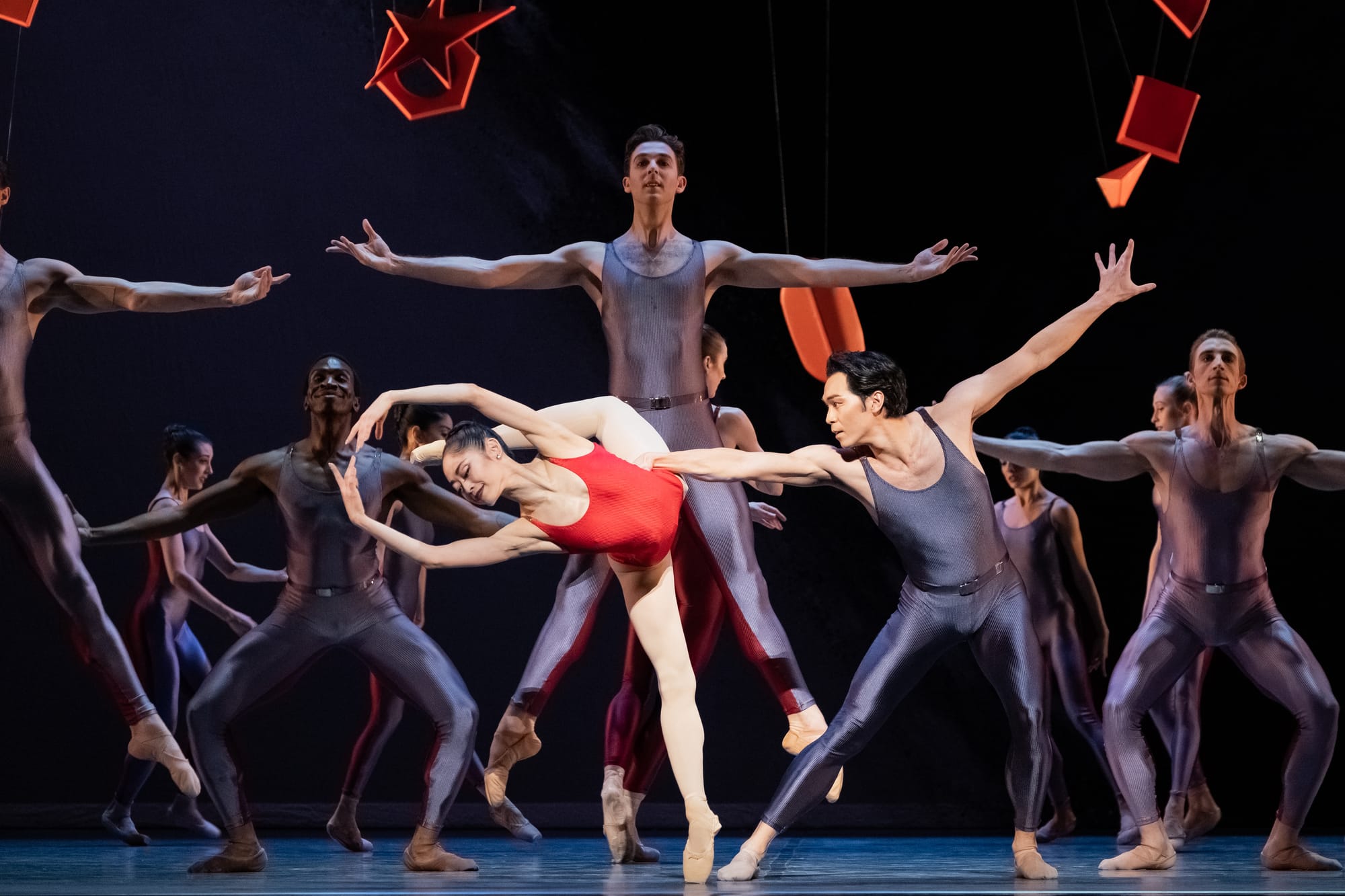
Ratmansky’s Shostakovich is a big ballet, much bigger in impact than seems possible for only 16 dancers. It has a story that is about the Soviet Union/Russia yet there may be no specific plot. However, floating in designer George Tsypin’s sky are red items – stars, a hammer, a military airplane, a bomb, etc. The balletic dancing has a military momentum. It is for two couples (Elena Lobsanova and Harrison Jame; Koto Ishihara and Naoya Ebe). There is a corps of six women and six men. The contrast between the leading couples and the corps asks questions about what makes leaders and what makes followers. I think Ratmansky is nuanced rather than pro or con about Soviet reality. Technically and stylistically, he appears to be elaborating steps that derive from Balanchine’s sparkling and cubistic neoclassicism with the mobile groupings that are sculpted and molded like those in Leonide Massine’s “symphonic” ballets.
Even without seeing The National Ballet of Canada’s “Sleeping Beauty”, I feel confident in thinking that this a major company. Some dancers, such as Guillaume Cote, are Canadian trained. Others come from elsewhere, for example: Svetlana Lunkina was trained in Russia and danced with the Bolshoi Ballet before joining National of Canada. The company’s director, Karen Kain and such members of the coaching team as Magdalena Popa, Christopher Stowell, Lindsay Fischer, and Peter Ottmann keep the dancing clean, even, unmannered and lively. I wish there had been more opportunities to see this display of contemporary choreography.
copyright 2020 by George Jackson



