Corps Values
"Dancers' Choice"
New York City Ballet
David H. Koch Theater
New York, NY
June 14, 2009, evening
The title of the Dancers' Emergency Fund Benefit had a somewhat confusing apostrophe, since there was only one dancer who made the choice, Jenifer Ringer, who served as the gracious hostess. She explained that she wanted to give dancers, especially those in the corps, new opportunities, so there were a number of intriguing debuts. The amount of work to put this together, to rehearse for a single performance, makes criticism seem churlish; in addition, few ballets were complete, so the overall impact was muted. It was an evening to sit back, enjoy, and celebrate.
There were some expected choices, roles that Ringer danced so well, and some unexpected ones; there was an extended excerpts from Peter Martins' American Music Festival production of "The Waltz Project" and Richard Tanner's Diamond Project offering "Episodes & Sarcasms", neither of which is associated with Ringer and whose manhandling disguised as partnering seem a long way from her lush and musical romanticism. But these were new when she joined the company and she could obviously choose what she wanted.
The so-called waltz girl in Balanchine's "Serenade" is one of her signatures, and she cast Maria Kowroski, who usually does the Dark Angel, and Teresa Reichlin as the Russian girl. Kowroski used her height and flair to dramatic effect, and Riechlin showed a lovely concern for her cohorts in the gentle section where the five girls entwine. The giggle dance from Robbins' "Dances at a Gathering" was also one of Ringer's most memorable performances; she used to dance it with Christopher Wheeldon, and they seemed music incarnate. Stephanie Zungre didn't have Ringer's lushness, but she was charming and playful, and David Prottas as the boy in brick was one of many highlights. Another one was Tyler Peck, with Cristian Tworzyanksi in Balanchine's wind-swept cotton candy of a ballet "Valse-Fantaisie", to the glorious Glinka music. She was confident, musical, and delicate. These adjectives also suited Kathryn Morgan, who was making her debut in the grand pas de deux from "The Sleeping Beauty", with Tyler Angle. He had danced the prince in an SAB production of the last act, and seemed even then to the manor born, not just because of his dancing, but because he knew how to move on stage--I can still see his gracious bow to the King and Queen. Unfortunately, he had a couple of minor slips in his solo, but his partnering was seemingly flawless. Morgan is one of those rare dancers who can both shrink and expand the stage, shrink it to a private conversation between her and her partner, and expand it to let the audience in on her secrets, without seeming to play to them; she is a true artist, as well as being a magical dancer.
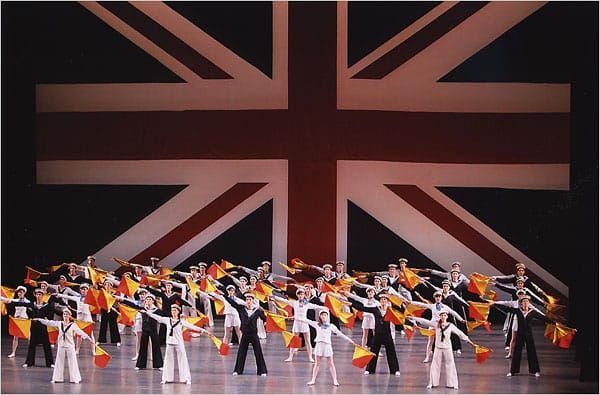
The novelty was a new ballet by Ashley Bouder, called "Give me Fever". It was a series of vignettes to various composers. The first was to Eric Satie's Gnossienne no. 1, which won't make anyone forget Ashton, but the latter two were to popular songs. The costumes, designed by Janie Taylor, were purple romper suits and red tennis shoes, and the choreography seemed to come from "Dancing with the Stars", but it was high-spirited and great fun, and the dancers, Kaitlyn Gilliland, Brittany Pollack, Amar Ramasar, and Sean Suozzi, sold it well. The finale was the final scene from "Union Jack", chosen, Ringer explained, because it used so many corps dancers and because they loved to dance it. The audience, as always, loved watching it, led by a very funny Jared Angle (oddly called Damian Jared Angle in the program--perhaps an homage to Damian Woetzel, one of the roles great exponents), and Jennie Somogyi as the sassy WREN. The entire corps got a bow in front of the curtain, a gracious and happy sendoff for the audience.
copyright © 2009 Mary Cargill



