Coming Attractions
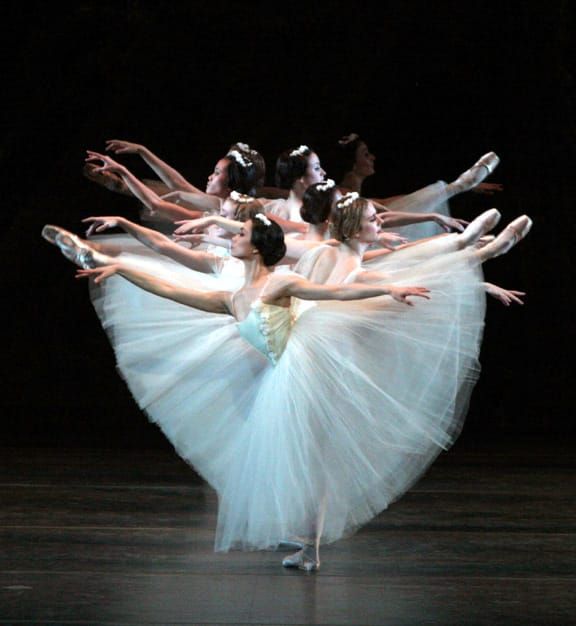
"ABT Gala"
American Ballet Theatre
Metropolitan Opera House
New York, NY
May 19, 2008
As good galas go, this one went quickly, with a lot of variety, and a couple of sets of fouettes to count. It was, by and large, a preview of the season to come, with excerpts from various works. The novelty was Antony Tudor's Judgment of Paris, a preview, so to speak, of the upcoming Tudor homage in the fall City Center season. The only performances I have seen of this sardonic little vignette have been those of the New York Theatre Ballet, led by Diana Byer. Byer, in fact, was credited, along with the late Sallie Wilson, with staging the ABT production. ABT's version starred former ABT dancers Kathleen Moore, Martine Van Hamel, and Bonnie Mathis, in a very welcome return. The major difference between the ABT version and the Theatre Ballet one was in the scale. The cavernous Opera House is not the best place for sardonic subtlety, and Kurt Weill music worked better, I think, in the tinny piano version rather than the somewhat sweeter, more commercial orchestration used at the Met. But the imaginative musicality and characterization that Tudor's steps have were so welcome in an evening otherwise devoted to fluff.
Nothing is fluffier than Ronald Hynd's The Merry Widow, which opened the evening. In a gracious gesture, the corps, dancing the pseudo-folk Pontevedrian dances, was the real star. This colorful variation is, I think, the best part of the ballet, and the Lehar music is irresistible. The new soloist, Joseph Phillips, led the ensemble, and in what must have been a daunting assignment for a newcomer, danced fearlessly and almost flawlessly. He is comparatively short, and of the bouncing ball variety, with all sorts of trick jumps, and an infectious joy that got things off to a fine start.
David Hallberg followed, in the purple boot solo from the ballet referred to as Swan Lake, at least for ticket sales. As always, he was a magnetic performer, and gave the part much more dignity and importance than it deserved. As did Irina Dvorovenko and Maxim Beloserkovsky, in the other novelty of the evening, Jessica Lang's Splendid Isolation III, to Mahler. There were two people on the stage, but the costume designer, Elena Comendador, was also there in spirit, since Dvorovenko's dress was the third party. It was of the white parachute variety, and the hem appeared to be almost as wide at the stage when it was spread out, which it often was. It gave the piece a static, 1930's aura, bringing to mind the photographs of Balanchine's Errante, another ballet about a dress. Dvorovenko, with her fashion model looks, made the most of the elegant poses, and Beloserkovsky, who had to wear white underwear, is a dancer of sculptural dignity, who managed not to look embarrassed.
Two inevitable gala pieces followed, the pas de deux from Don Quixote and The Dying Swan. Gillian Murphy and Ethan Stiefel were the ones sent to Spain, where neither of them really look at home. Murphy, who didn't get her solo, can turn like a demon, but she has a coolness and reticence that doesn't fit Kitri; she seems too elegant for the role. Stiefel, too, danced with flair, but with his all-American looks he gave the impression of Jimmy Stewart wearing a sombrero and saying "Ole" now and then. Diana Vishneva danced The Dying Swan; it is clear that she has thought about the simple piece, and is trying to find an individual approach, and she danced with a dramatic air of defiance and rebellion. But the outbreaks of realism didn't really suit the abstract shimmer of the music, and the simpler approach is usually more effective; as it is, The Dying Swan appears to be ballet's answer to the death of little Nell, as described by Oscar Wilde.
Death turned up again in the excerpts from the second act of Giselle, featuring Nina Ananiashvili and Angel Corella. Even starting in the middle of things, this was the emotional highlight of the evening. Ananiashvili has honed her Giselle to eliminate all extraneous movements; there was no exaggeration, no fuss, no preciousness in her approach. She has jumped higher in the past, but this wasn't about jumping, it was about steps flowing into each other, and their emotional connection. Corella, too, made his solo a cry of pain through the timing and intensity of his dancing, not a clinical exhibition, or an excuse for making faces. Giselle is one of the best of ABT's classical ballets, and based on this preview, it looks like it is in great shape.
Le Corsaire, though it isn't the icon that Giselle is, has proven a reliable and attractive addition to the nineteenth century ballet collection, since it includes the Jardin Anime, and some other glorious classical variations. It also includes more modern generic male jumping, as if every man there were competing with the slave Ali. Herman Cornejo danced one of these solos; it was listed in the program as Conrad's variation, but the corrections slip said Lankendem's. It turned out to be Conrad's, but it really made no difference, and it was a shame that Cornejo wasn't seen in something that matched his abilities. Jose Manuel Carreno danced the Ali solo. Again, it seems too bad to use only his physical talents, but few dance the role with such weight and precision. His Medora was Xiomara Reyes, who brings charm and depth to a number of roles, but who doesn't really seem comfortable with the abstract grandeur of pure classical roles, though she whipped through the fouettes.
The final pas de deux from Onegin certainly doesn't rely on technique, since the steps themselves seem only to go from "Oh woe is me" to "Look at my pretty arabesque". Julie Kent and Marcelo Gomes, even on the vast and empty stage, managed to bring subtlety and tragedy to the final scene, Gomes with his broken pride and Kent with her range of emotions. There is no range at all in Etudes, whose final jumping scene, with the corps barreling down the diagonal, closed the evening. Michele Wiles was a little cautious, and had some trouble with the point work, but she is a scrupulous turner. Sascha Radetsky was the boy with the beats, and was sharp and clean. Corella was the jumping boy, and he flew out, with an urgency and a hunger for the stage that was electric. It was as if he had decided to give a glass of champagne to everyone in the audience, and the audience gladly drank it down.
copyright © 2008 by Mary Cargill



