Butoh a la Vangeline
"Hijikata Mon Amour"
Vangeline
NY Butoh Institute Festival 2019
Theater for the New City, New York
October 26, 2019
Japan and France have long been yoked together by their mutual obsession with each others' elegant style. The US and Japan are connected forever by the atom bomb. "Hijikata Mon Amour" is a bridge connecting those three cultures, and – in the subversive, twisted way of Butoh – an attack on each of them.
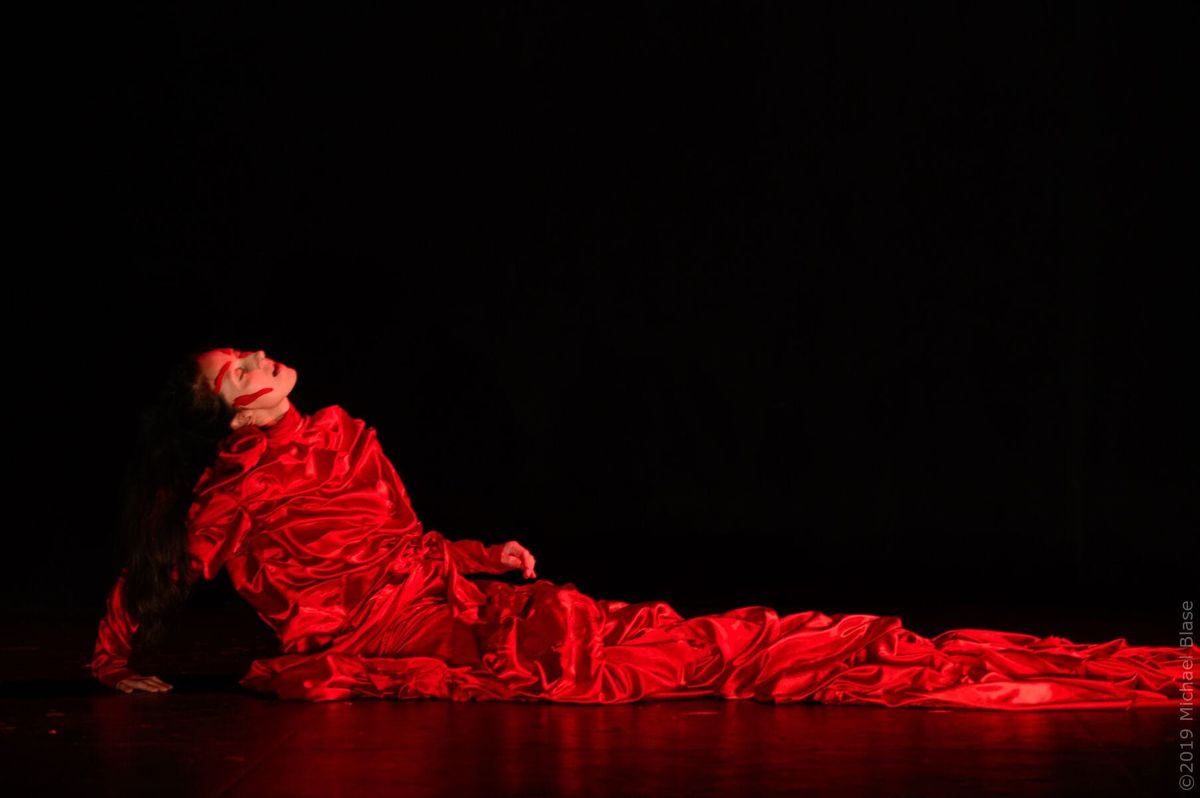
The dancer-choreographer is Vangeline, a French performer now living and working in New York, where she founded the New York Butoh Institute to promote and develop the Japanese "dance of utter darkness" in the West. But the star of the show is an over-the-top French-style ball gown – at least nine yards of flounced red satin – a replica of the costume worn by Butoh's founder Tatsumi Hijikata in his 1968 solo "Revolt of the Body."
To the sound of a storm at sea -- torrents of spray, and the screams and groans of the dying -- Vangeline begins in silhouette, facing rear, her shadow on the back wall like a 19th-century French painting of an elegant lady. After a long few minutes of still life, imperceptibly she begins to move. At roughly the speed of the moon emerging from eclipse, she turns her head to reveal her elegant profile, then returns it to the dark side. After a brief blackout she faces front and slowly rotates the skirt around her waist, so the lower half of her body seems to be revolving while the upper half remains in place -- a trompe l'oeil. In the same extreme slow motion she then walks across the space, raises her arms in an arc like a ballet dancer, opens her legs a la seconde and makes a plie all the way to the floor, without a hitch. With the dress streaming out over the floor she reclines, then rolls herself around and under it, ending like a turtle under a flounced red satin shell. (This image reminded me of the macabre American Civil Defense instructional film, Duck and Cover.)
At last the action speeds up. Two hands emerge from under the shell and perform a madcap waltz. Two feet stick out, turn in, then swoop into the air as the dancer pirouettes on her butt and rises to her feet. The score veers into construction noises, hammers and trucks, then the golden sound of American soprano Jessye Norman singing the Habanera from Bizet's Carmen. Seiji Ozawa conducts the Orchestre National de France. Vangeline swoops to the gypsy rhythm.
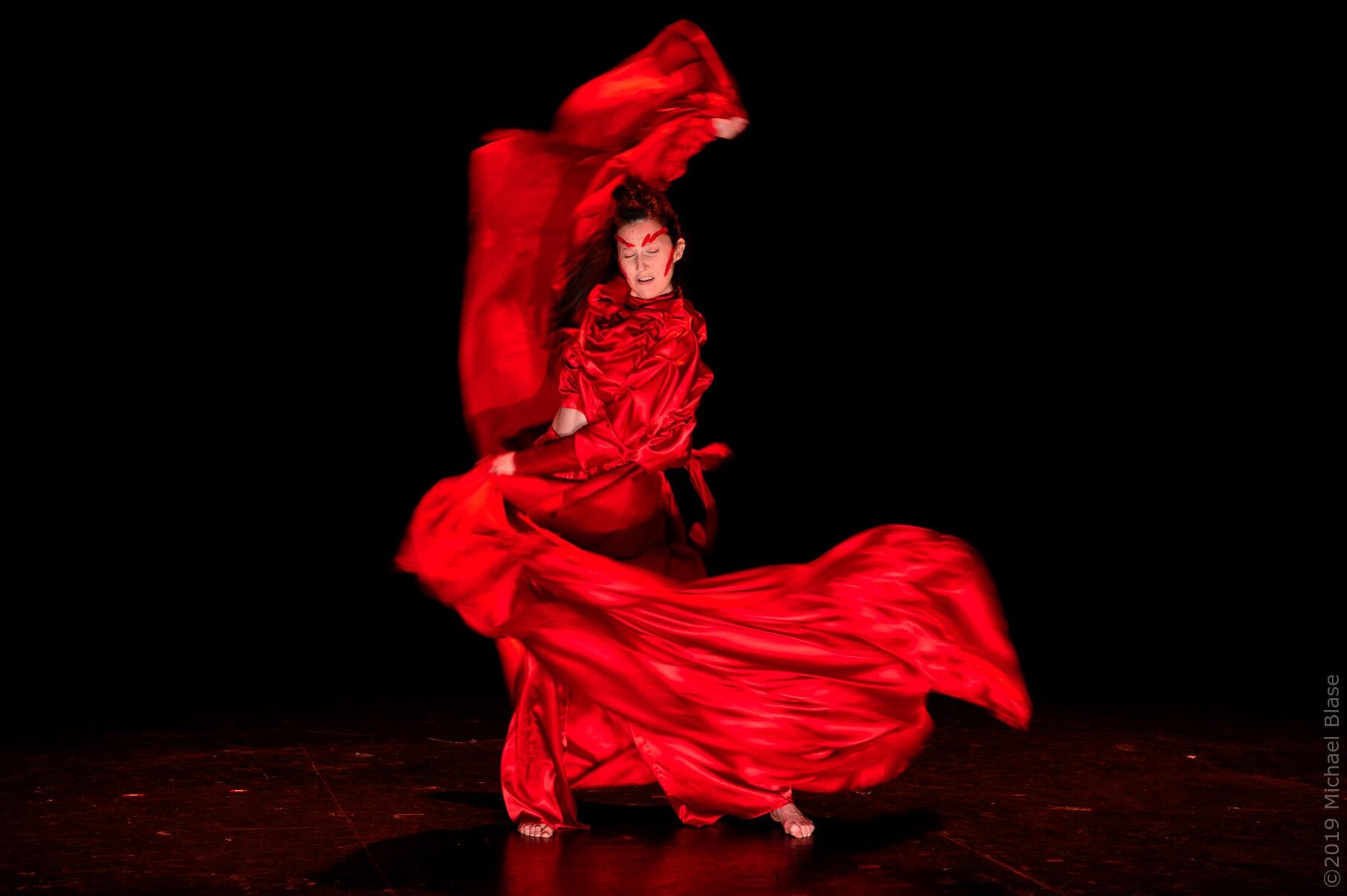
Civilization emerges from its shell, but in distorted form. Vangeline lip-synchs joyfully, her mouth frozen as if partially paralyzed. She leaps and flails her arms like a clumsy child. Disabled and retarded, mutiles de guerre, once again we live.
Tatsumi Hijikata comes to life. Vangeline peels off her skirt, over red satin pants, and shapes the fabric into a puppet. She shakes it roughly and the soundtrack spouts Hijikata's monologue "How to Eat a Watermelon." He sounds agitated, angry, obsessed.
Like a soldier reliving a war trauma, Butoh always returns to the atrocity of the atom bomb: the white flash that disemboweled Japan and shaped the post-war Pax Americana. Now, with that world order falling apart and humanity facing new existential threats, we might ask whether such disturbing art is still necessary or relevant.
IMHO the answer is yes. Violent death and mysterious resurrection are the theme of human history, and its variations go on forever. If you've seen one Butoh show you've seen them all -- but you've never seen anything like Vangeline. Her bid to plant Butoh in the West, in female form, is ballsy and beautiful, unexpected and right.
copyright 2019 by Tom Phillips



