Brandenburgs
"Six Brandenburg Concertos"
Rosas
Park Avenue Armory
New York NY
October 7, 2018
by Carol Pardo
copyright © 2018 by Carol Pardo
Why didn't it work? That question hangs over Anne Teresa De Keersmaeker's "Six Brandenburg Concertos". It should have worked. Evidently, De Keersmaeker was listening to the Brandenburgs (or at least no. 5) while choreographing "Fase", to Steve Reich in 1982, the piece that put her on the map. Having made minimalism move exultantly, you'd think Bach, with his explicit dance rhythms and jazzy syncopation avant la lettre, would be a cinch. Nope.
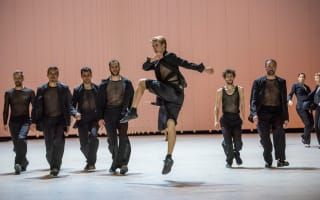
The production gave every indication of unity and certainty of vision, of someone in charge and in control, from the image of the first opening of Bach's score, projected as the audience took its seats and the colors of the cyclorama thereafter – orange, yellow orange, gray or gray-blue – to the placement of the B Rock orchestra below, but not beneath, the stage, to the stage itself: shining white, part circus ring part roller derby rink. The costumes, pants of various lengths, shirts with a variety of sleeves in translucent or opaque black, with a smidgen of cross-dressing to keep everything current, announced "We're serious but chic." Nor was there any fault to find with the sixteen dancers: clear, fleet, committed, fluid and fluent, their stamina and endurance remarkable (the show ran two hours without intermission).
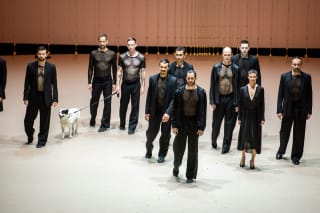
The movement vocabulary was just as carefully chosen and calibrated: walking, running, with a hop, skip, jump or a little hitch kick added to spice things up. The performance opened with the dancers striding forth, one woman's stacked pumps reverberating through the house, an announcement of martial rigor and vigor to come. As the show went on, the rigor remained the vigor evaporated. At the end of the first Brandenburg, the cast was joined by a color coordinated dog (gender: female; name: Stella – very well behaved) and taken on her walk. Cute for cute's sake isn't De Keersmaeker's way, so what was Stella doing there? A homage to Fred and Ginger walking the dog in "Shall We Dance"? An indication of desperation and time left to fill? At any rate, Stella never reappeared.
And so the piece continued with the addition of some lifts and costume changes, but only once, as some dancers struggled upstage dragging a leg behind as if broken, was any of this activity searing, dancer and viewer united in shared pain. Otherwise, the big event was the advent of the sign carrier (understudy Lav Crncevic) announcing each concerto, checking how many ways one could lower the sign and how it disappeared into the cyclorama, its work done. Only the realization, late in the day, that one dancer had bright orange details on the heels of his otherwise black shoes gave as clear a sign of life, like a breath of oxygen just before passing out. Did De Keersmaeker suck the life out of the concerti, or did they prove too difficult for her to penetrate? In any case, the music stayed in its bubble and the dance in its bubble, suffocating each other and suffocating to sit through.
copyright © 2018 by Carol Pardo



