Blast from the Past
"Raymonda Suite", "Leaves are Fading Pas de Deux", "Ballebille", "Flames of Paris", "Pas de Quatre" "Cavalry Halt"
Gelsey Kirkland Ballet
Peter Norton Symphony Space
March 7, 2014
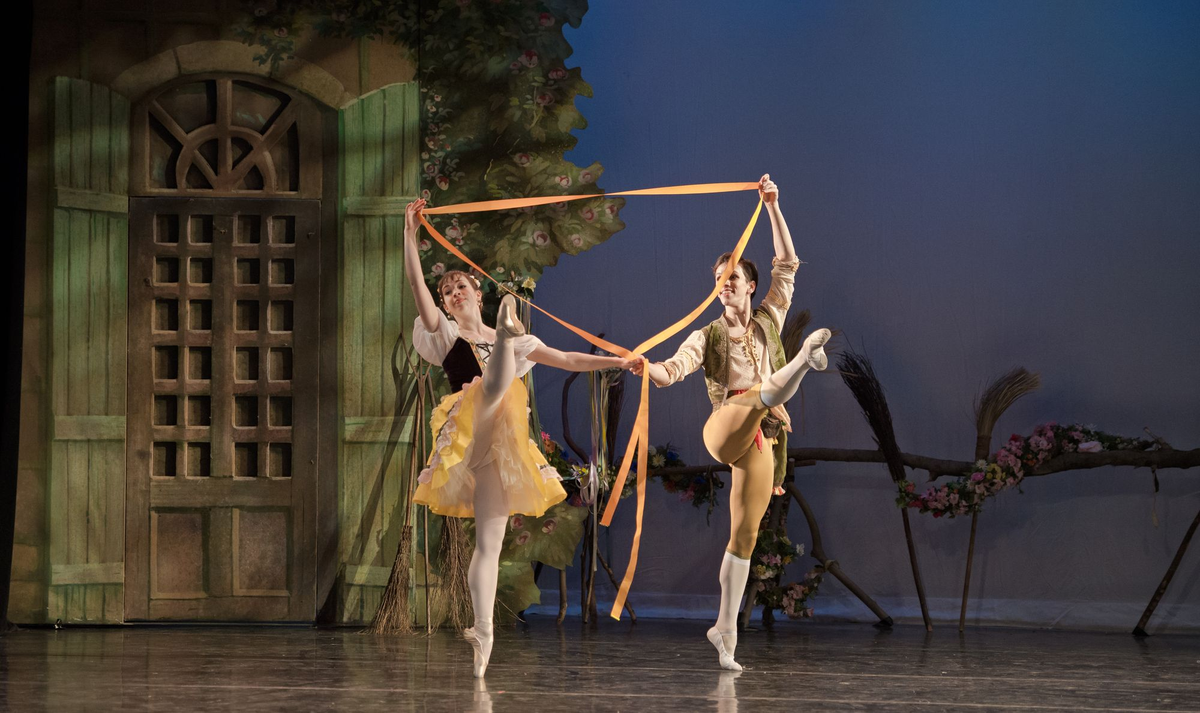
Gelsey Kirkland established a ballet school in 2010, with an emphasis the dramatic aspect of dance; she has classes in mime and character dance, two arts which are often shortchanged in today's emphasis on strength and power. This year, she has established a company, made up of both professionals and students from the school, with an emphasis on those older virtues. Their second performance (a "Nutcracker" last year was the company debut), showed a well-trained, stylish group of dancers, which saved the best for last. "Cavalry Halt" (originally "Halte de Cavalrie") is an 1896 one-act Petipa comedy, which was revived for the Maly Ballet in 1968 by Pyotr Gusev. There was not much information on the genealogy of the Kirkland production, and the already simple story seems to have been smoothed out (in the original libretto the heroine, Marie, had a father). It is set in an Austrian village, apparently bordering on the town of Swanhilda and Franz, where happy young peasants have banished the grownups so they can spend the day dancing and frolicking. Philipp and Maria, the hero and heroine (Dawn Gierling and Anderson Souza), dance and frolic with glorious abandon. In their opening dance they wrap themselves up in ribbons, related, perhaps, to Ashton's more complex ribbon embroidery in his pastoral "La Fille." (Certainly, Tamara Karsavina, who encouraged Ashton to re-choreograph the old ballet, would have known "Halte", so there may be a connection between the two.)
Philipp, though, has another woman after him, Theresa (Katrina Crawford), the village flirt in striking red boots. Their encounter is interrupted by a visit of a cavalry regiment; the entire plot is basically the cavalry arrives, flirts, and leaves. Maria has moments with young, middle-aged, and old cavalry members (Alexander Mays, a student, was particularly funny as the lame but game old general), indulging in lots of character dancing. This production ends with Maria alone on stage, saluting the departing cavalry, (marching off as of they were headed for Balanchine's "Stars and Stripes") and, apparently happily waiting for the next group to appear. I suspect that the original Petipa ended with his equivalent of a group hug, with the stage full of happy people arranged in harmony. This proto-feminist ending, with an independent, strong-minded woman on her own, while uplifting, doesn't seem very 19th century, though I did love it.
The dancers looked relaxed, free, and engaged with each other, and the audience had a wonderful time, even clapping along with the marches. (The music was credited to one Johann Armsheimer and to Johann Strauss, and I expect the marches belong to Strauss.) Gierling, especially, has a fresh, open and lush style, and was a true joy to watch.
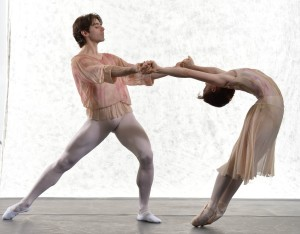
She, with Cristian Laverde Koenig, danced the main pas de deux from Antony Tudor's "The Leaves are Fading", which he choreographed for Kirkland. (Amanda McKerrow and John Gardner set the pas de deux for the company.) I did see Kirkland dance it, an unforgettable experience, but Gierling gave a fine, individual performance; she didn't seem afraid of dancing it her way. She was a bit more naive than Kirkland, a little less determined, but created a real person on the stage with an appealing vulnerability, as she stared longingly and hopefully into the future; Koenig was a fine and supportive partner.
The program opened with "Raymonda Suite", basically a collection of Glazunov's greatest hits, as that lush, melodic music (unfortunately, but understandably, taped) let Petipa generally ignore the story and just choreograph. India Rose danced Raymonda with a fine, careful style, with an elegant upper body and detailed arms. She followed the current Russian practice of just indicating the claps in her famous solo, which, to my mind, diminishes the flavor, but it was wonderful to see the glorious steps and patterns danced with care and style.
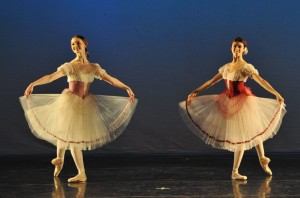
"Ballebille" (or ballabile as it is usually spelled) is a group dance by the great 19th century Danish choreographer, August Bournonville. Oddly, the program notes say it is from the third act, confusing it perhaps with the famous tarantella, but it is actually from Act 1, as the fisher folk dance and frolic, as ballet peasants tend to do. It was set by Karina Elver, who trained in Denmark, and the dancers showed the care they had taken to absorb the unusual style, with its distinctive low-held arms, flashing feet, and use of demi-point. Bournonville style is more than technique, however, and the dancers had clearly worked on presentation, and the gentle little kisses to the audience looked natural, not coy.
"The Flames of Paris", Vasily Vainonen's 1932 "power to the people" romp through the French Revolution, is not coy, and the pas de deux, which has been showing up on galas with some regularity, needs dancers with both innocence and strength to make it more than a steamroller. The man, Erez Ben-Zion Milatin, was a bit self-aware, as he tried to make the Soviet flourishes seem natural. (He was much more appealing as the eager Coronet in "Cavalry Halt".) Nicole Assaad, a dark-eyed beauty, seemed more at ease, as she made the dancing, with its myriad of turns, explosive but not hard-edged.
"Pad De Quatre", Sir Anton Dolin's pastiche of Jules Perrot's famous dance for four Romantic ballerinas, could have used more of an edge. Only a lithograph remains of the original choreography, and Dolin created his work for four Ballets Russes dancers, who also posed in the well-known picture. The four Kirkland dancers (Anastasia Barsukova, Michelle Katcher, Nicole Federov, and Katia Raj) caught the outlines of the Romantic style, but didn't have the inner sense of mystery; much of the problem may be that today the wafting arms and sloping shoulders can't help but evoke Edward Gorey. It was a respectable and dutiful performance, but there are other genuine Romantic works that might have worked better. But all in all, it was a thrilling evening, and I am grateful that the cavalry halted where I could see it, if only for a moment.
copyright © 2014 by Mary Cargill



