Birthday Presents
"Birthday Offering", "Thaïs Pas de Deux", "Awakening Pas de Deux", "The Dream"
American Ballet Theatre
Metropolitan Opera House
June 10, 2010
New York, NY
ABT continued its 70th birthday party with a real bash, dancing Sir Frederick Ashton's 25th birthday homage to company soon to be Royal as well as his "Dream" of a ballet celebrating Shakespeare's 400th birthday. "Birthday Offering" is a set of classical dances to selections of Glazunov, who apparently was incapable of composing anything that isn't lush and danceable. Ashton was obviously inspired by the architecture of "The Sleeping Beauty" Prologue, but the seven female variations have his own indelible musicality and wit, with many changes of direction and quick shifts of positions. Though unbelievably beautiful, they must be very hard to dance. ABT's dancers coped very well, especially Hee Seo in a languorous variation, where she seemed to be looking inward, and Simone Messmer, who seemed to be digging into the movements. She would be ABT's jill of all trades, except that she is mistress of everything she does; Taylor-made as the grieving girl in "Company B", she is also a radiant and elegant classical dancer. Irina Dvorovenko danced the Fonteyn role; she was more flirtatious, I expect, than Fonteyn, but had obviously worked hard on the style, and avoided the temptation to flaunt her extensions.
The men don't have as much to do, but the partnering, with the tricky balances, must look smooth. Maxim Beloserkovsky was the lead male, and his air of stylized and majestic graciousness, as he stood at the back of the stage, made it seem as if he were looking out into a palace. This ability to project a calm nobility is a rare gift, and few are better at it than Beloserkovsky.
The "Thaïs Pas de Deux" wasanother piece Ashton made for a special occasion (this time for Antoinette Sibley and Anthony Dowell) which has thrived. Maria Riccetto and Jared Matthews danced the filmy piece, set the the Top Ten music by Jules Massenet. Again, its difficulties can be deceptive, and dancing around with a scarf over your head, while simply lovely for the audience, must be challenging. The choreography is full of Ashton's trademark skimming lifts, where the woman just seems to float above the stage. Again, these lifts aren't spectacular, but require stamina and timing on the man's part, which Matthews certainly had. He also had the ability, so well described by Ashton in a documentary of him coaching the role, of anticipating the woman with his eyes. Matthews did seem to be dancing with a dream, and Riccetto floated like an orange mist.
The "Awakening Pas de Deux" was choreographed by Ashton in 1968 for a short-lived production of "The Sleeping Beauty" set in the Middle Ages. (Unfortunately, it was not the last, or the worst, of misguided tinkerings with that most perfect of ballets.) The pas de deux was set to the entr'acte, which will always say "Nutcracker" to New York audiences, but which was written for the Prince's journey to the castle. Though lovely, it was artistically extraneous in the ballet, since the vision scene had already told the audience all they needed to know about Aurora and her Prince. But it is magnificently choreographed, and well worth seeing, for the way it builds up to the soaring lifts, and then floats down again, as the couple dip and sway to the music. Veronika Part and David Hallberg looked lovely, though the timing wasn't quite perfect for the gentle little pauses in the music, so evocative of two people feeling as one.
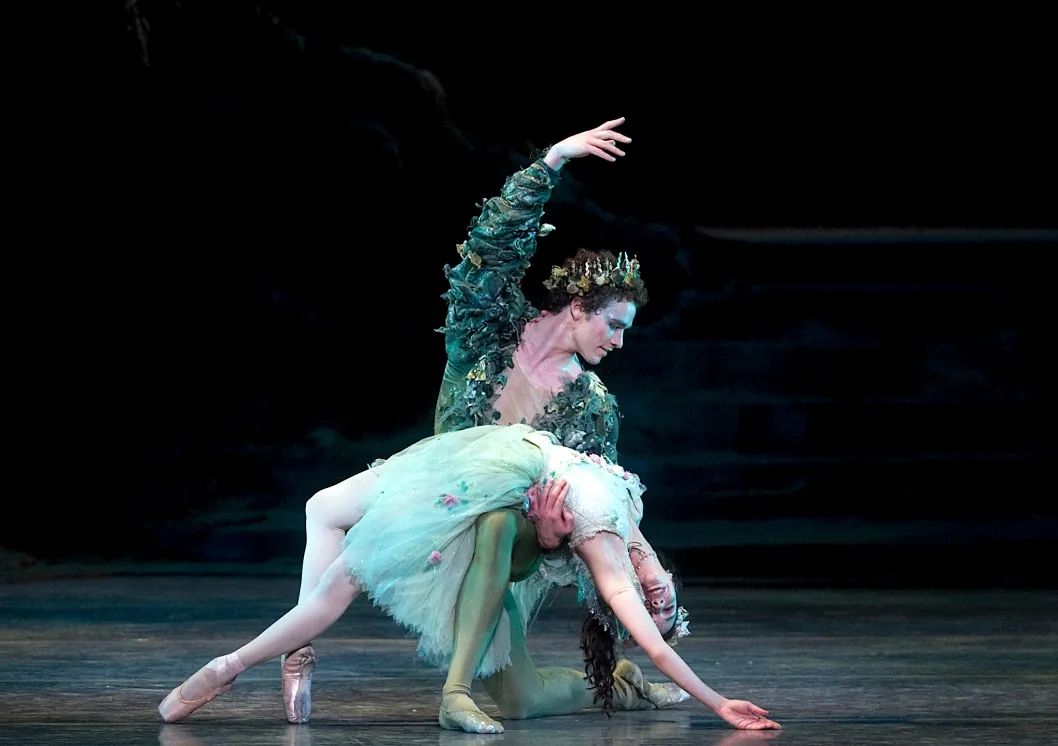
"The Dream" saw the debut of Cory Stearns as Oberon and Daniil Simkin as Puck, with Xiomara Reyes as Titania. Both were outstanding. Stearns projected much of Dowell's air of mysterious and guarded power, and he also has an effortlessly beautiful line and plush arabesque that Dowell had. As yet, he doesn't have all the sharpness in the scherzo that the role needs, and he did seem to flag a bit in the final pas de deux, but he performed with clarity, wit, and a true sense of magic.
Simkin, too, was magical, and it seemed like the air was his natural habitat, as his leaps seemed to float upward. He is a young dancer, but has a fine ability to create a world on stage, and it is thrilling to see such an phenom not just stand around waiting for the whirly bits, though the whirly bits were well worth waiting for.
Reyes is nothing like Antoinette Sibley, the original Titania, either physically or emotionally (Titania captured so indelibly Sibley's diamond sharp technique and her fierce independent streak) but she is a fine and intelligent actress, and her Titania was a willful dynamo. She played the love scene with Bottom beautifully, approaching him with a gentle awe that bloomed into radiance. If Ashton had choreographed only this scene, he would still be one of the greatest around; he avoided the easy way of laughing at the deluded Titania, of letting the audience into the joke, but shows us, so powerfully, the magical power of love to blind anyone. It is a very funny scene, but these are slightly rueful laughs.
"The Dream" of course is so much more than the three leads, and it was a joy from beginning to end. The opening, with it skittering fairies, is like a game of magical musical chairs, and when the music pauses, the dancers freeze into the most beautiful formations imaginable. The lovers were wonderfully daffy, playing to each other, and not to the audience. Alexei Agoudine, as Bottom, danced very well, making the point work musical and full of character, not just a Trocadero trick. He didn't quite catch all the pathos in his mime scene, as he remembers the luscious Titania and knows he would never have someone like that in real life, but his comic timing was very good. It is easy to underestimate the consummate craft of this work, since Ashton makes it all seem so easy, and the work is so perfect that it seems as if anyone listening to that music would come up with the same choreography. Great art always looks inevitable, and ABT has given its audiences a wonderful present.
copyright © 2010 by Mary Cargill



