Biennial Buzz
2019 Whitney Biennial
Whitney Museum of American Art
New York, New York
May 14, 2019
Neck-deep in controversy even before it began, the 79th Whitney Biennial opened today –- organized by two adventurous young women, showcasing emerging artists and artists of color, many of them under 40 years old. Curators Jane Panetta and Ru Hockney set out to reflect the current American turmoil in both social and aesthetic issues. Their show delivers with a panoply of objects d’art from the purely beautiful to the politically explosive.
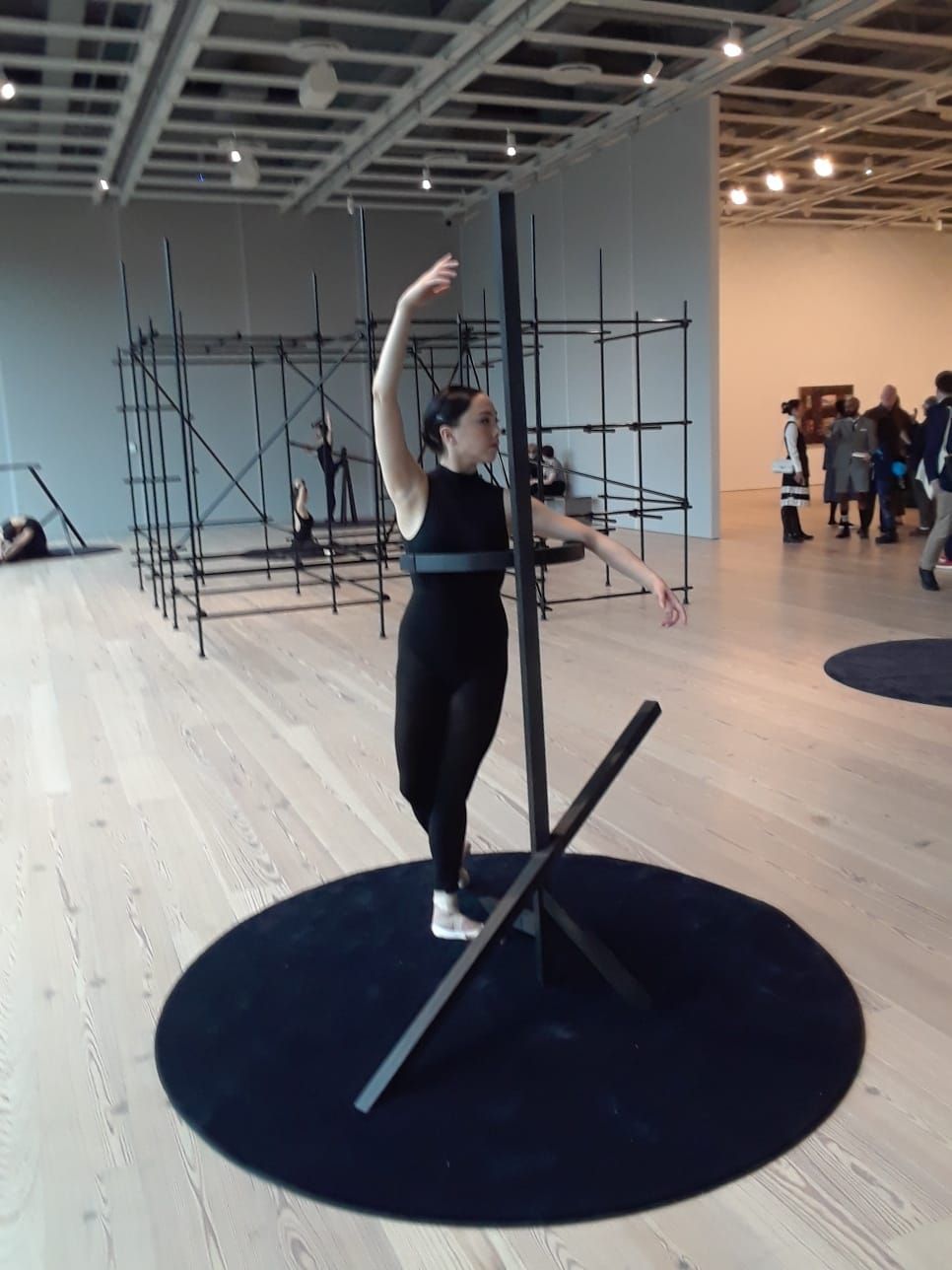
On the aesthetic end of the spectrum is a live installation by Brendan Fernandes called “The Master and Form,” which examines the relation of ballet to sculpture. This occupies a spacious room with props including a large jungle gym structure, used like a barre by a half-dozen well-trained New York ballet dancers. It’s a black leotard ballet without dancing, static poses rather than movement. More interesting for sculpture buffs than balletomanes, probably, but physically bracing and fun to walk around in.
At the other extreme the exhibit literally picks up a live grenade, showing a film about anti-personnel weapons made by a company owned by a director of the Whitney. Warren B. Kanders is CEO of Safariland, which sells tear gas canisters and other weapons to police departments and governments including the US. The film by Laura Poitras unveils a technology that can track the use of these weapons – and did when they were used by US troops against asylum-seekers at the Mexican border. Safariland’s new tear-gas product “Triple Chaser” works like a cluster-bomb, breaking into three pieces when it hits the ground, making it harder to throw back. The film details the effects of the gas on its victims – as well as the bloody effects of bullets the company sells to the Israeli army, which fired them against Palestinians charging the border fence at Gaza.
Kanders says he is “not the problem” and has resisted calls for his resignation or ouster. To him, the problem is rioters and demonstrators endangering the police and soldiers who “keep us safe.” But who exactly is “us?” The exhibit as a whole identifies with the poor, people of color, the excluded and rejected -– and artists, struggling to survive in an art world so deeply implicated in the politics of privilege and oppression.
A few impressions from a fast preview:
The piece best uniting aesthetic and ethical concerns was a symmetrical bronze sculpture by Simone Leigh: a stylized black woman atop a ballooning skirt, bristling with black metal spikes. She’s black, beautiful, permanent, fortified.
A series of back-country and inner-city photographs by Curran Hatleberg showing the resilience of the poor, comfort amid squalor. Politics be hanged, these people say, let’s play dominoes, crawl over a broke-down truck, fool with a snake, sit by the river and smoke.
An animated cartoon of NFL football scenes that shows pity for everyone -- players kneeling at the national anthem, others standing defiant or doubt-filled, soldiers venerating the flag, the band playing on, schlumpy photographers recording the historic muddle.
An old-fashioned ringing telephone, painted in old-fashioned oils by Keegan Monaghan, ambiguously titled: “Incoming.”
A large woven rug by American Indian artist Nicholas Galanin simulating a TV on the fritz – nothing but “snow.” He calls it “White Noise, American Prayer Rug.”
Garish flat scenes from the LA bubble painted by Calvin Marcus: an old man lifting weights in the gym, urged on by a phantasm of his younger self.
White noise, black lives, old men in the gym, and the Gordian knot of oppression paying for the beauty that rails against it. It’s impossible to take a snapshot of America, there’s too many of them. But this attempt is broad, inclusive, gutsy, youthful, real.
Copyright 2019 by Tom Phillips



