Beatledom without the Beat
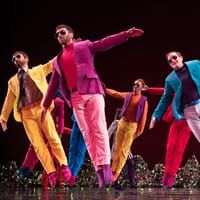
Pepperland
Mark Morris Dance Group
Brooklyn Academy of Music
Brooklyn, New York
May 11, 2019
Great artists know where they shouldn't go. George Balanchine, for example, never choreographed to Beethoven, because he said Beethoven's works were complete in themselves, nothing to add. Mark Morris could have used that kind of discernment when he accepted a commission for a 50th-anniversary tribute to the Beatles’ masterpiece “Sgt. Pepper’s Lonely Hearts Club Band.” The resulting “Pepperland” is an uncharacteristically shallow work that does worse than add nothing. It subtracts much of the album's content, substituting original segments by composer Ethan Iverson that have only fleeting connections to the Beatles. Beyond that, the whole project completely misses the spirit and the style of "Sgt. Pepper."
The Morris troupe has perfected a casual, communal style of ensemble dancing that celebrates relationships, particularly those among its dancers, who typically spend many years collaborating until their movements and mannerisms meld into each others'. This is almost a Platonic ideal of society transformed by dance. Unfortunately, it is completely at odds with the content of “Sgt. Pepper,” which brings to life a gallery of misfits and loners pursuing fantastical dreams – the Lonely Hearts Club of the world. Morris might have reached his Platonic ideal in response to Sgt. Pepper's loneliness. But to get there he would have to walk his company through descending levels of Hell, like Virgil leading Dante. And this he would not do.
“Pepperland” begins with a promising gesture: a tight circle of dancers opens out from the center of the stage, unspooling like the grooves of an LP record. But the imaginary world the Beatles created on that disk, the psychedelic trance of “Lucy in the Sky,” the stuck-in-a-groove optimism of “Getting Better,” the narcissistic self-pity in “She’s Leaving Home,” the loopy frustration of “Lovely Rita,” and most of all the thunderous moral critique of “A Day in the Life” are all absent or caramelized into playful, sentimental pas de deux.
“When I’m 64” is a three-ring clown circus, full of gawky leaps and flopping around in groups, but the comic pathos of "will you still feed me?" is unfelt. The only song this work seems to take seriously is George Harrison’s eastern meditation “Within You Without You,” lamenting the “the space between our souls.” Harrison's mournful sitar echoes the theme of "Sgt. Pepper" but his lyrics lack the bite of Lennon and McCartney’s –- a problem the Beatles solved by isolating this cut at the beginning of Side Two, and closing it with a laugh track. Morris makes it central to “Pepperland,” with a crossed-legged dancer meditating center stage.
As for the sound: One of the Beatles' great innovations in popular music was the importing of classical elements, most strikingly the harpsichord and string passages composed by producer George Martin. Still the Beatles were fundamentally a rock band, inspired by American Rhythm-and-Blues and its solid, gritty core. Composer Iverson ignores the roots and embraces the refinements. His arrangements play around with Beatle tunes but excise their soul, banishing the thumping beat of rock for a light, airy, cerebral, often atonal conservatory sound. The dancing follows the music – classic-jazz in character shoes with a lot of ballet steps. Morris makes it flow with his weaving, looping moves for shifting groups of dancers. Very charming as always, but it looks more like a tribute to Balanchine than the Beatles.
“Pepperland” is a place Mark Morris should never have gone. And if you love "Sgt. Pepper" as complete in itself, neither should you.
copyright 2019 by Tom Phillips



