Balanchine's City Center Years Continues
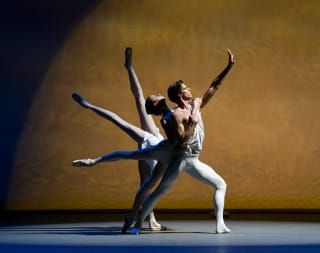
“Apollo,” “Concerto Barocco,” Tchaikovsky Pas de Deux,” “Divertimento No. 15”
Mariinsky Ballet, New York City Ballet, Royal Ballet, San Francisco Ballet
Balanchine: The City Center Years
New York City Center
New York, New York
November 1, 2018
Last year the Lincoln Center Festival celebrated the fiftieth anniversary of George Balanchine’s “Jewels” by inviting the Paris Opera Ballet, the Bolshoi, and New York City Ballet to perform sections of the work, trading off sections at various performances. One good idea deserves another, and now City Center, as part of its seventy-fifth anniversary is devoting this week to Balanchine works danced by a variety of companies. The repertory is made up of ballets danced during the company’s residency at City Center from 1948 to 1964.
The second of the six-program series, offered on Thursday, began with “Apollo” from 1928, one of the earliest Balanchine works that still remains in the repertory. It was danced on Thursday by the Mariinsky Ballet of St. Petersburg. The cast was led by Xander Parish in the title role, accompanied by Maria Khoreva, Anastasia Nuikina and Daria Ionova as the three Muses. Xander is a British dancer and a principal in the Mariinsky, while the women, all graduates of the Vaganova Academy, became company members just this year.
The interpretation they offered stressed a playfulness that is a bit different from the more dignified New York City Ballet approach. It makes perfect sense, since the ballet is about a young, untried god, who only at the end of the ballet assumes the mantle of maturity. When Parish strummed his lute, he whirled his arm as if just learning to play the instrument and finding the process delightful. Each of the Muses’ solos were conducted in a lighthearted spirit, as if they were inviting Apollo to play, and when he joined them, the sense of play continued. It was an appealing way of dancing the ballet and it was helped by the dancers’ performances, which were charming until the last moments of the piece, when the music changes and a new seriousness takes hold. Then it was as if the dancers had left childhood behind. It should be added that Parish, Khoreva, Nuikina and Ionova are all superb dancers. Although Parish grew up in the school and company of the Royal Ballet, he has fully acclimatized to the Mariinsky style. As for the women, it is hard to believe they are company neophytes.
From the Mariinsky, where Balanchine was trained and danced, we moved to his American home, New York City Ballet, and a performance of “Concerto Barocco,” led by Maria Kowroski, Abi Stafford, and Russell Janzen. Made in 1941, thirteen years after “Apollo,” “Concerto Barocco” is an interesting comment on how Balanchine’s choreography and style developed in the intervening years. It is a more complex work than “Apollo,” with three soloists and a corps of eight supporting dancers, but the clarity and sense of an architectonic structure is similar. Gone is the neo-expressionist mood of much of Balanchine’s work of the 1930s (including “Serenade”). We are back in the Apollonian territory that would govern Balanchine’s modernist works for NYCB, which have come to be known as the black-and-white ballets.
Kowroski and Stafford were a contrast to Sara Mearns and Teresa Reichlen, who so often dance these roles. The latter tend to be fire and ice. Kowroski and Stafford are not so dramtically different, but they are different. On Thursday Stafford was smiling and good humored, seeming to enjoy every minute of what she was doing. Kowroski was nobler but warm, and in the pas de deux with Janzen the two were connecting throughout so that the dance became a meditative love duet.
The formality of J.S. Bach was followed by the all out virtuosity of the “Tchaikovsky Pas de Deux” from 1960, danced by the Royal Ballet soloists Anna Rose O’Sullivan and Marcelino Sambé. Here one saw the great stylistic difference between the Balanchine and English schools. Neither O’Sullivan nor Sambé had any difficulty with the high-flying technical demands. They were conquered with ease. But the dancing was much softer and flowing than what we are used to at NYCB, where drive and dynamic energy are the norm.
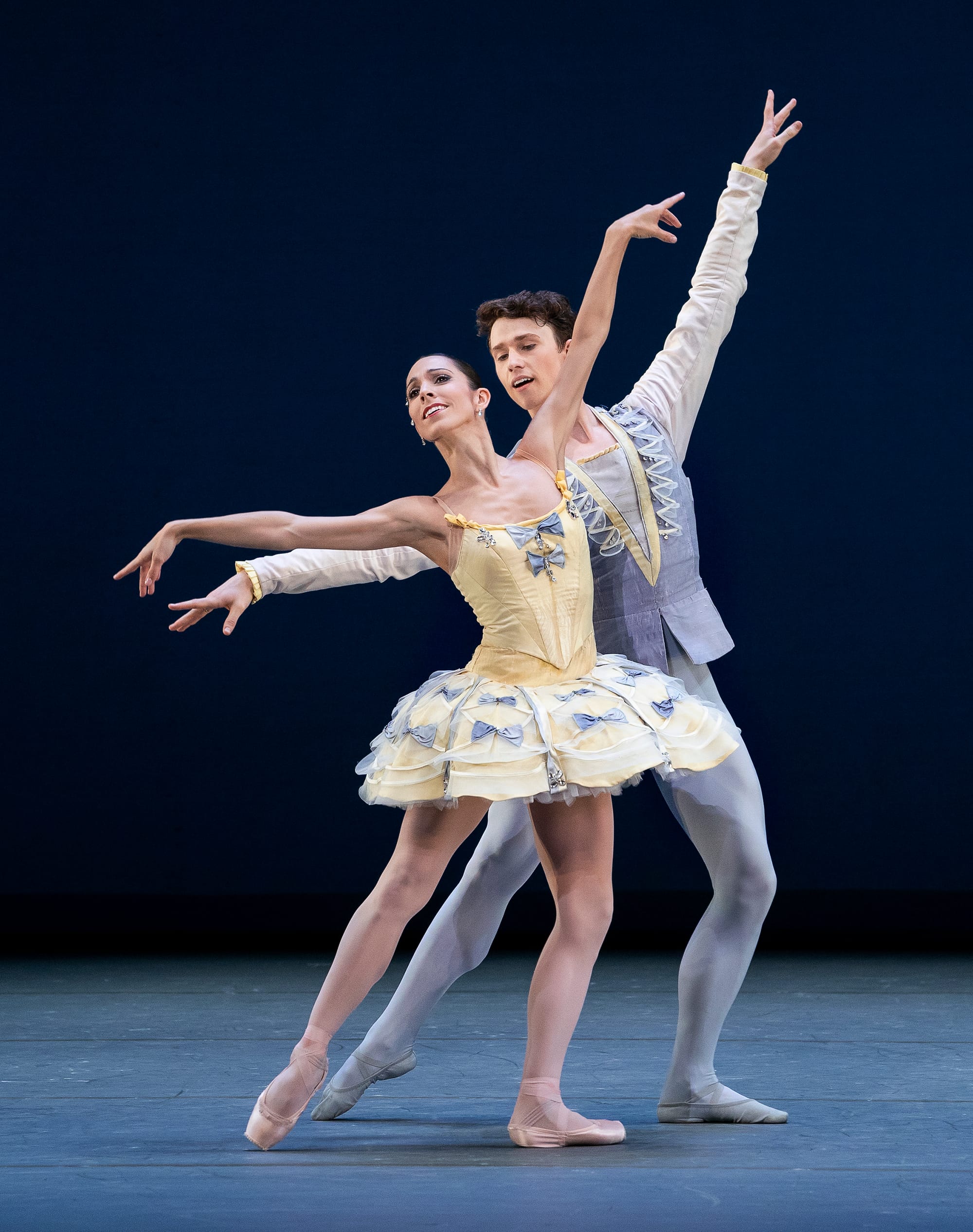
Last up on Thursday was San Francisco Ballet in “Divertimento No. 15” from 1956. This work is set to Mozart, and although in a classic vein, nevertheless has the clarity and complex patterning notable in Balanchine’s American works. It is set for eight soloists (three men and five women) and a corps of eight women. The work consists of a theme and variations, with the six variations being solos. The outstanding dancer here was Ana Sophia Scheller, formerly with New York City Ballet, who is one of those who reaches a little farther, aims a little higher, and at the same time is gracious in every movement. Otherwise, the ballet was well-danced, if lacking a bit in energy.
“Balanchine, the City Center Years” continues with performances through Sunday. The festival not only offers a chance to see Balanchine’s choreography danced by a number of different companies, it demonstrates how far-reaching his influence has been and how his ballets have spread across the globe.
copyright © 2018 by Gay Morris



