Bach to Bach
"Junction", "all at once", "Promethean Fire"
Paul Taylor Dance Company
Neidorff-Karpati Hall
Manhattan School of Music
New York, New York
June 7, 2019
The Orchestra of St. Luke's is presenting a three-week festival of Bach's music in various New York City venues, including the elegantly restored theater at the Manhattan School of Music where the Paul Taylor Dance Company is performing all six of Taylor's works set to the composer. The company's first night included the first ("Junction" from 1961) and the last ("Promethean Fire" from 2002) as well as the premiere of Pam Tanowitz's "all at once".
"Junction", last performed in 2013, is set to excerpts from "Solo Suite for Cello No. 1 and 4" and has colorful, cartoonish costumes by Alex Katz. The cheeky choreography seemed to wink at the Bach music, giving a friendly, non-competitive nod as if to say "I can't compete with your grandeur so I will go my own happy way". This way alternated between bursts of energy and a serene, if surreal, calm. The original description was "Pedestrians cross at the intersection of Tranquil Street and Turmoil Boulevard", which is a succinct and accurate description.
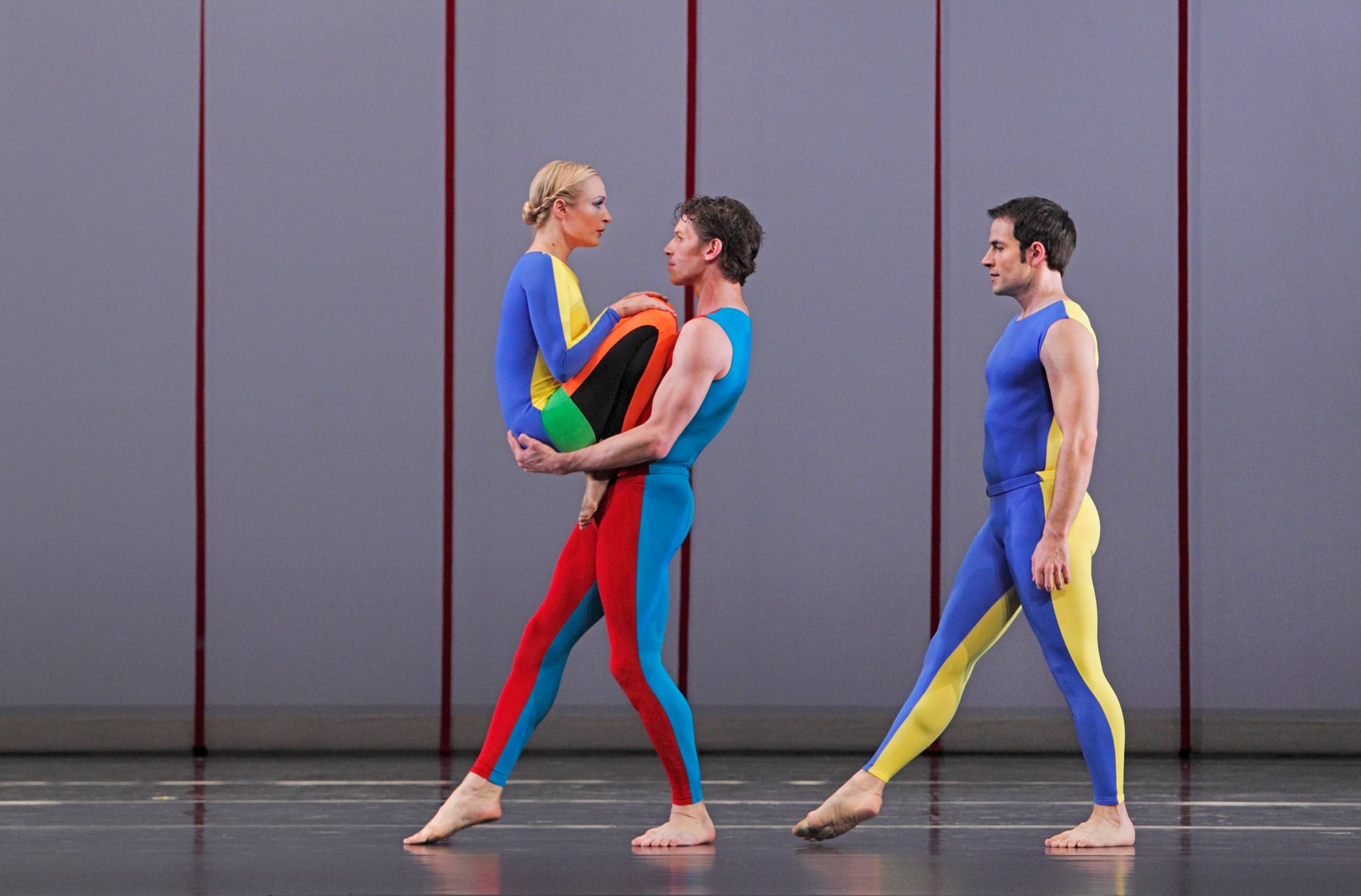
The eight dancers wore their colorful leotards with a witty calm, walking as if they were dressed for the office, and they gave an oblique logic to the most absurd moves, passing a woman (Madelyn Ho in this performance) folded up in a tight little bundle from partner to partner impassively, as if they were waiters serving a meal. The final moment had Jamie Rae Walker standing calmly on Sean Mahoney's back as he crouched down raising and lowering his body. She slowly raised her arm in an oddly noble gesture, perfectly timed to the final chord. It was as if the choreography and the music finally met and walked off together.
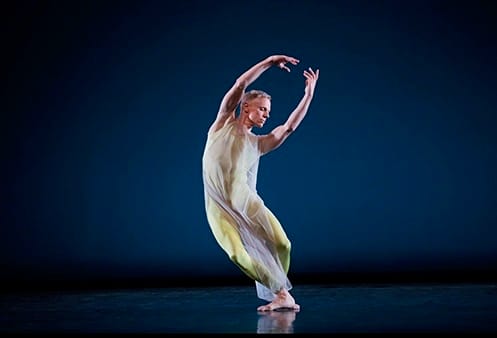
Tanowitz's "all at once" also took a casual approach to the music (Bach's "Violin Concerto in A Minor" and the "Oboe Sonata in G Minor"), but she seemed to use it as a background, letting it play harmlessly in the pit as the choreography went its own way, never connecting. She used the current affectation of avoiding capital letters, presumably to signify "Not your grandmother's Bach". The costumes, by Harriet Jung and Reid Bartleme, were fluffy chiffon overalls covering pastel leotards, and looked magical when the dancers were spinning, but obscured the dancers' shapes.
The choreography was a bit choppy, with occasional references to iconic Taylor phrases, especially the bright open arms and the luscious sideways jumps, which were sprinkled among Tanowitz's little hops and sudden stops and starts. The 17 dancers seemed to have little relationship to each other (or to the music), filling the stage without a focus. Michael Trusnovec, though, did have a long solo with bursts of energy alternating with poses of Grecian glory. Lee Duveneck and Laura Halzack danced an interesting push/pull pas de deux where they seemed to be just missing connections, but this hint of emotion disappeared as they walked off indifferently in opposite directions; life may be a bit "So what" but it made for a long and often unexhilarating dance.
Trusnovec was also featured in "Promethean Fire". The hero of this monumental work, set to Leopold Stokowski's orchestration of Bach (played with great enthusiasm by the orchestra), was originally Patrick Corbin but Trusnovec began dancing it soon afterwards. It has become almost a compendium of that magnificent dancer's many virtues -- power, commitment, precision, and beauty. He will be retiring after this brief season and it was impossible to watch the performance without longing for time to stand still.
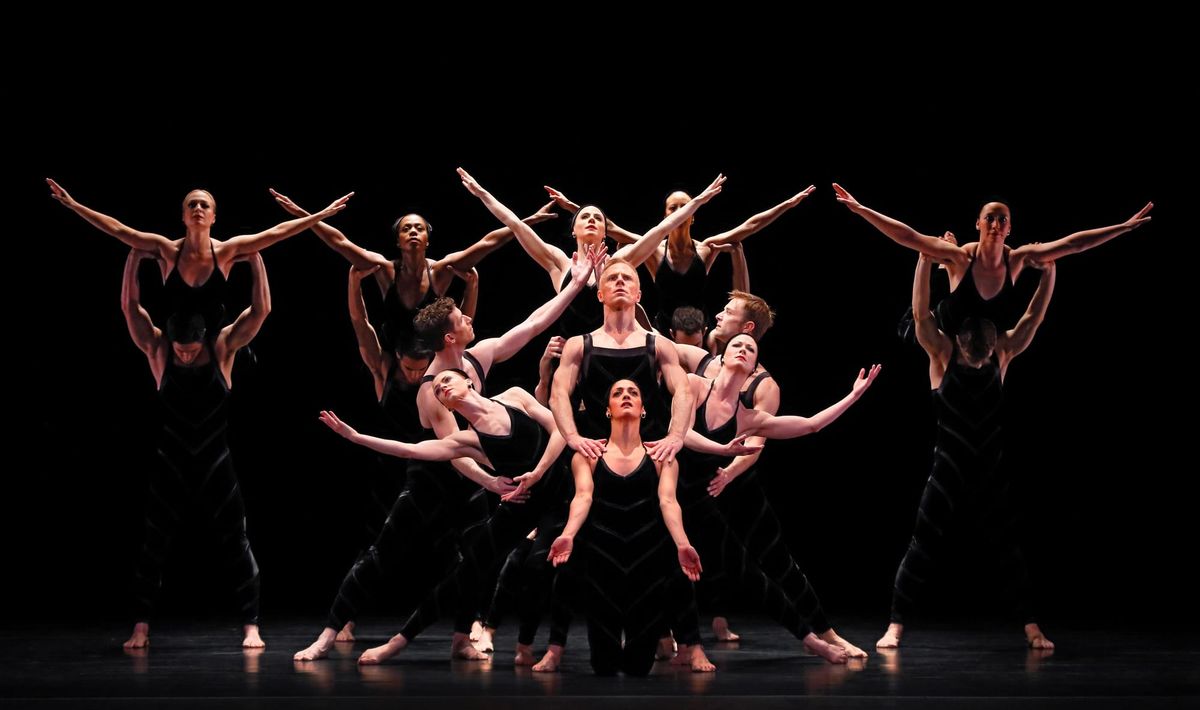
But it doesn't, and neither did the dancers as they rushed through the opening chaos, the dark Santo Loquasto leotards highlighting their disembodied hands and faces. The apocalypse, as the dancers hurled themselves into a helpless heap, seemed to signify a new beginning, as Trusnovec emerged, lifting Bugge into a golden glow. Their pas de deux was a complex mixture of emotions, with a desperate violence resolving into need and comfort, leading to the triumphant finale, with the mass of dancers in a harmonious pose, a serene and hopeful picture of order carved out of chaos.
Copyright © 2019 by Mary Cargill



