Au Revoir
"Acheron", "Afternoon of a Faun", "Walpurgisnacht Ballet", "La Valse"
New York City Ballet
David H. Koch Theater
New York, New York
February 26, 2014
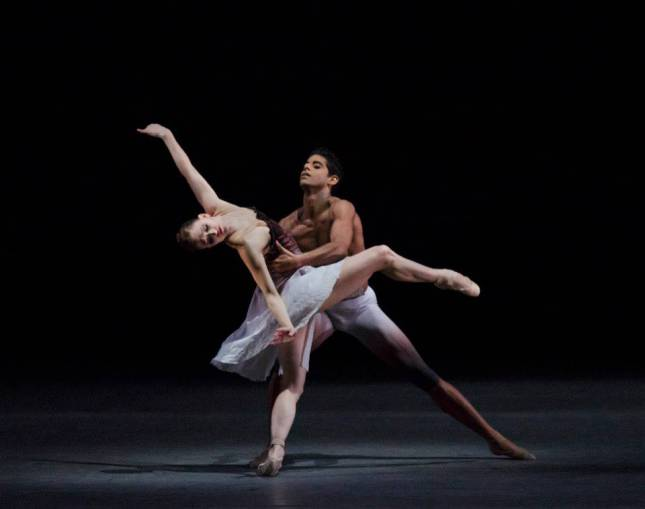
The evening was an all-French affair, featuring a quartet of Gallic composers; it was also the last chance I had of seeing Janie Taylor, whose official farewell will be covered later, but whose iridescent presence couldn't help but haunt the dancing. "Acheron", the new ballet by the Royal Ballet based Liam Scarlett to the "Concerto in G for Organ, Strings, and Timpani" by Francis Poulenc, was the somewhat gloomy opening work; it was named after one of the rivers of Hades, across which Charon ferried the dead. There was certainly a lot of ferrying in the ballet, as the men carted, lifted, supported, twined, and spun the women, who seemed completely unable to stand on their own two feet. Lovely though some of the images were, it was hard not wish that they would just stop lifting and dance. But the three main couples (Tiler Peck and Robert Fairchild, Sara Adams and Andrew Veyette, and Ashley Bouder and Amar Ramasar) flowed through the music wrapped together; it was a bit like watching ice dancing in a lava lamp.
But Scarlett can certainly create an intriguing atmosphere, and he used ten corps members well, merging them into the gloom. The ballet opened with what seemed to be a reference to Balanchine's "Central Park in the Dark" section, as a single woman (Tiler Peck) wound her way through a mass of bodies, finally encountering a somewhat ominous man (Robert Fairchild). Fairchild, always an engaging performer, has developed a niche in the line of power and mystery, as his breakdown solo in Preljocaj's "Spectral Evidence" showed, and he was able to give his every move (when he wasn't serving as a hydraulic lift) an intense power. The other dancers were also fiercely concentrated and committed, wringing as many emotional nuances (and, for the women, finely articulated upper bodies) as possible from the poses.
The three couples were occasionally interrupted by a male soloist, Antonio Carmena, as an outsider/observer, rushing through the corps with brio. He had the most interesting and varied choreography, and his usual sunny presence had a tinge of despair.
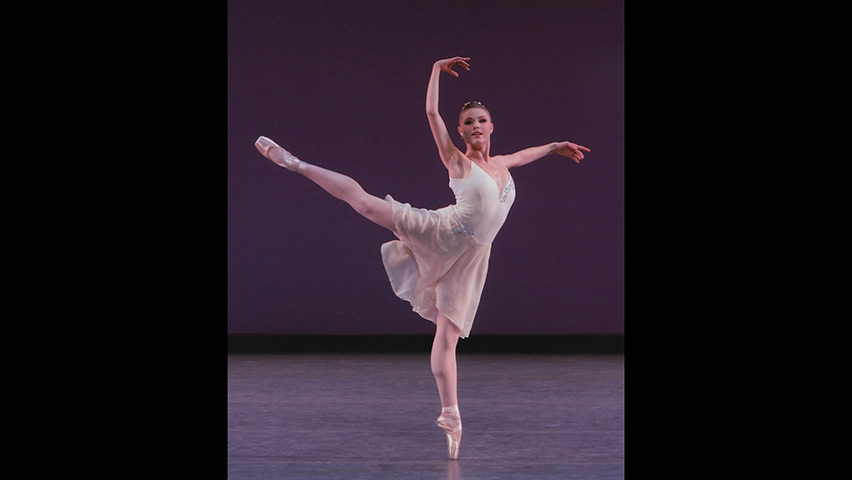
"Walpurgisnacht Ballet" is quite another view of the underworld, as Balanchine pony-tailed dead souls prance through Gounod's irresistible confection. The women rule here, as the man (Adrian Danchig-Waring) appears basically to catch the ballerina in the final, triumphant finale, as the woman poses on the man's shoulder like a magical figurehead at the prow of a human ship. (Balanchine knew how to make lifts a dramatic highpoint.) Sara Mearns, always a musically incisive dynamo, did not look quite at home in the quick changes of direction and little flicking moves of the Farrell role; for once she didn't look as if she owned all of steps. But her windswept quality and full-blooded commitment gave the cotton-candy piece (all those pinks and purples swirling to that gloriously um pah pah music!) a joyful depth.
Lauren Lovette made her debut as the bouncy second banana, showing off her creamy upper body. She was a bit careful in those bounding steps, and occasionally there was a tinge of the metronome to her approach, but with more experience, she should be able to relax and play with the music; certainly Mearns is a fine role model.
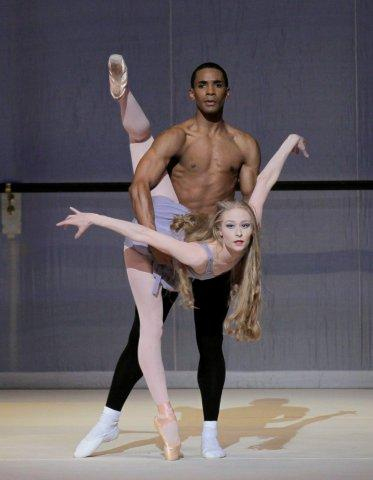
Janie Taylor probably isn't a role model, since her other-worldly phospherescene seems impossible to replace. This suits "Afternoon of a Faun", Jerome Robbins' slightly sour take on adolescent vanity. Taylor, with Craig Hall, avoided any air of sentimentality. Hall gave the role a slight swagger, as he preened in front of the mirror and his complete absorption in his own physicality made it seem as if the audience were prying. He changed when he realized Taylor had appeared, becoming slightly awkward and shy--the distinction between his private and public persona was a subtle masterpiece. Taylor's languorous radiance and that fabulous hair would shake up anyone. There is a slightly knowing edge to her portrayal that gave it a modern twist--she was not a dewy-eyed innocent.
This edge turned up again in "La Valse", as she danced the doomed heroine with a triumphant nihilism. The ballet looked well-rehearsed, and the three fates (Markia Anderson, Gwyneth Muller, and Gretchen Smith) opened with a stacatto stylization that hinted of the mysteries that followed. There may not be a linear logic to the work (just try to make sense of the mime between to two lead characters) but there is an emotional force that transcends words--a romantic work in the fierce 19th century context.
copyright © 2014 by Mary Cargill



