Another Triple -- Variety Triumphs
"The Fifth Season," "Snowbird," "Etudes"
San Francisco Ballet
War Memorial Opera House
San Francisco
February 14, 2019
The third season program again showed the SFB in fine mettle with Helgi Tomasson’s darkly hued “The Fifth Season,” the heart-breaking “Snowbird” by Cathy Marston, and one of the oddest works in Ballet repertoire, Harald Lander’s “Etudes”, first performed by SFB in 1998. For that one the dancers ought to have been given a bonus for the sheer stamina and focus they had to bring to this demanding endeavor.
Sandra Woodall’s subdued panels for Tomasson's "The Fifth Season" (2006) suggested an atmosphere of uncertainty, enhanced by the minimalist but insistent Karl Jenkins score. Very rarely did the choreography make musical sense. It’s a strange ballet that opens with Dores André and Vitor Luiz’ tentative waves from opposite corners of the stage that lead to encounters of stretches, turns and lifts; lines were often broken but connections maintain until André escaped into the wings. The duo later returned in a not very romantic ‘Romance.’ The subsequent ‘Waltz’ for two couples showcased stately though very different ballerinas, the regal Sofiane Sylve and the sinewy but pliant Yuan Yuan Tan. Tiit Helimets and Luke Ingham alternated in partnering her. For the Tango’s give and take pretzel formations Luiz joined Helimets and Ingman in partnering Sylve. Tan and Helimets' ‘Largo’ offered the most logical and consistently communicating choreography. Too bad that Tomasson, apparently, didn’t feel the need to offer Tan a single move that challenged her already formidable abilities.
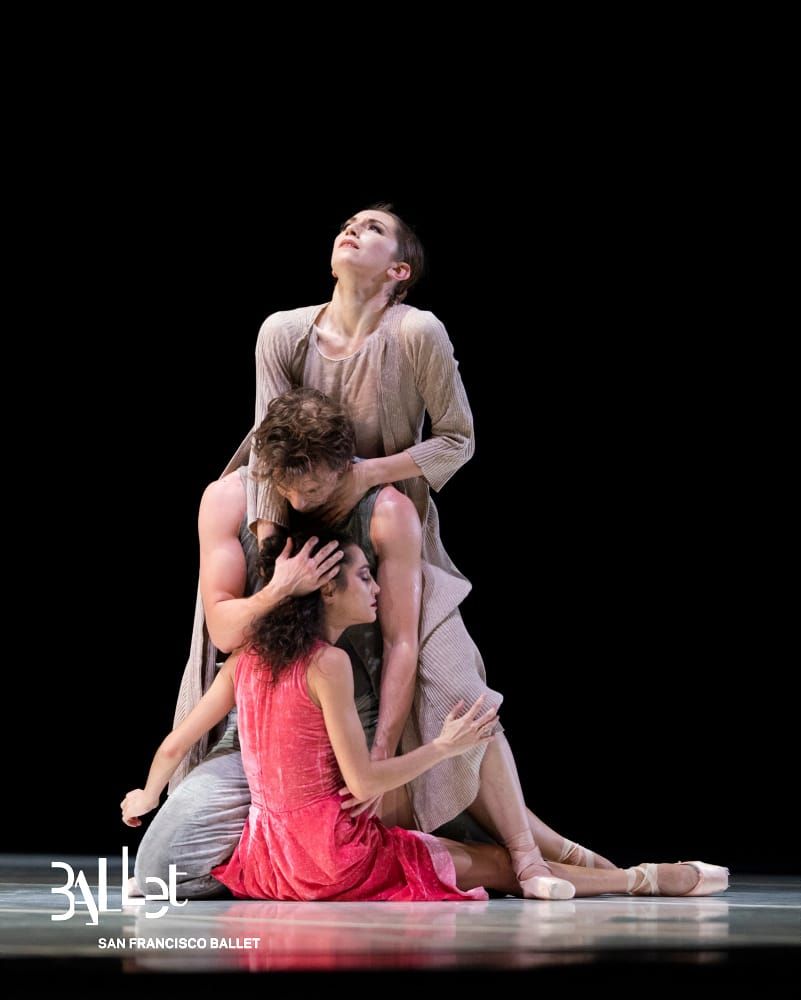
“Snowblind”, Kathy Marston's trio based on the haunting novel of Edith Wharton, “Ethan Frome,” elicited excellent performances. Maybe not as characters, but as dancers this trio was tightly connected, beautifully dancing off and with each other. It offered new perspectives on Jennifer Stahl, as Frome’s wife Zena, and Mathilde Froustey, as Mattie Silver. Stahl, both frozen in pain and fury, used her legs like spears, while Froustey’s wild but contained passion streamed like torrents from this elegant dancer. Birkkajer took full advantage of this Royal Danish inheritance. The last image, dramatically conveyed the no-exit hell of this triangle.
The evening closed with “Etudes.” No surprise to wild acclaim. Choreographed in 1948 by Harald Landor, it must have been a major talked-about occasion. What a strange, yet engaging this work is. It’s a ballet about Ballet, not only fascinating in its trajectory, from simple tendus, frappés and rond de jambes to bravura allegro and complex overlapping ensembles but also from line-ups at the barre to increasingly complex spatial designs. Legs and arms are what we see first, and the whole human being, at first in silhouette, only gradually emerges. The way the overlapping cross diagonals changed kept interest up. That’s good theater.
Unforgiving in its demands for discipline and exactitude, unrelenting in its requirement of submitting your ego to something bigger than yourself and, last but not least, an ability to keep going often at top steep when you don't know that you can, is also part of Ballet. I keep thinking of the male dancers in a series of leaps to the timpani without being able to depend on momentum.
Whoever said that a company is only as good as its corps must have had SFB in mind. SFB is that good. Angelo Greco, luxuriating in his turns and leaps, Joseph Walsh so elegant, and the fine Carlo di Lanno, squired Sasha De Sola who looked like the sun around whom the constellations turned. Nothing seemed to faze her; chainés, piqués and fouettées with some jetés thrown in flowed out of her non-stop. Her calling on three lovely sprites to compliment her own Sylph/Giselle part highlighted just how accomplished De Sola has become. She is not a “natural” adagio dancer, but she just might be on the verge of acquiring the ineffable quality of a star performer. At the end of the evening De Sola looked as if she could keep going for at least another forty-five minutes.
copyright © 2019 by Rita Felciano



