An Old Fashioned Gala
"I'm Old Fashioned", "Plainspoken", "Tarantella", "Western Symphony"
New York City Ballet
Koch Theater
Lincoln Center for the Performing Arts
New York, NY
October 7, 2010
The brief fall season included a gala, with the New York premiere of a new Benjamin Millepied ballet, sandwiched between some charming older works. The evening opened with the orchestra, on their new floating stage, rising up and playing the exhilarating "Candide Overture", and then disappearing back to watch the equally exhilarating Fred Astaire and Rita Hayworth open Jerome Robbins' "I'm Old Fashioned". These sets of variations, danced by couples in vaguely Astaire and Hayworth costumes (more successful for the women than the men), range from lyrically lovely to overly cute, as there are too many of the jokey accidental bumps that Astaire made in his gentle finale. Rebecca Krohn, with Adian Danchig-Waring, had the smallest part and barely got a look in, but she was melting and lovely. Jenifer Ringer, with Jonathan Stafford, and Maria Kowroski, with Tyler Angle, had the more typical Robbins' solos, with expansive legs and innovative lifts; Ringer was especially impressive in her solo, which had an exploratory, improvisational feel.
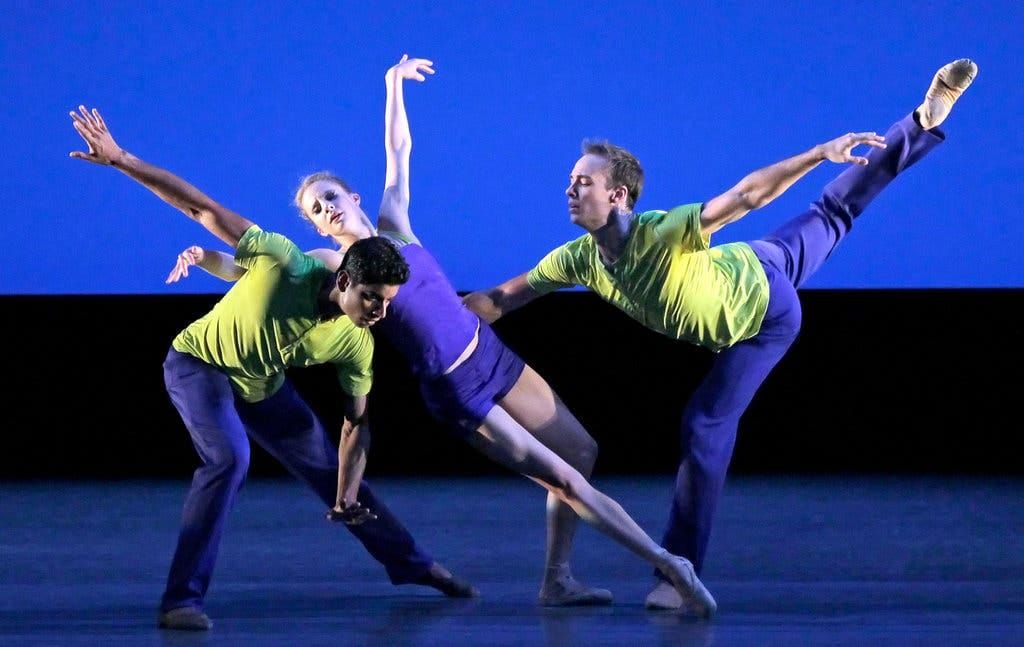
The new Millepied also had a somewhat improvisational feel, and the Robbins' influence (particularly his "Glass Pieces") was evident. It was set to a commissioned quartet by David Lang, and it does seem a shame, with all of Western music as an example, that he couldn't have come up with more than two notes, played with little variety or shading. This minimalist approach was echoed by Millepied, who had his eight dancers chugging along; he does know how to move groups around, but moving is not the same as meaning. The costumes, by Karen Young, were colorful--rich purple shorts and tops for the women, and lime green shirts with purple pants for the men; an unexpected but vibrant combination. Sterling Hyltin has the most disturbing dance, since she seemed to embody Kipling's description, without the irony, of woman as "a rag and a bone and a hank of hair" as she was mauled endlessly by a group of boys.
The most intriguing section was the somewhat enigmatic pas de deux with Janie Taylor and Jared Angle, where her hothouse lyricism seemed to hint at depths of emotion. There is something fascinating and unknowable about her stage presence, and the section seemed suspended in time; even the repeated gesture of hiding her eyes seemed mysterious, not cliched.
There is nothing mysterious about Balanchine's "Tarantella", a full-blooded romp through tambourine-land, led with unbelievable verve by Ashley Bouder and Daniel Ulbricht. They weren't just going for broke, they were going for style, and Ulbricht blended a beautifully shaped upper body with some hang-time jumps that seemed to freeze up in the air. Bouder, too, shaped her dancing, pausing ever so slightly at the top of a movement to capture a perfect phrase. The audience roared its approval.
"Western Symphony" is another Balanchine guaranteed to make the audience roar, and, though only the final movement was on show, it was wildly cheered. Sara Mearns and Charles Askegard were the saloon girl and the cowboy, tossing off jumps and turns with charm to burn. Mearns' luscious appeal was irresistible in the sassy role, as she flaunted her hat and swung her hips, and tossed in some gorgeous fouettes. Askegard was both dignified and witty as her consort, and the underlying rigor of the ballet's structure, which built to that thrilling climax of all those dancers on stage, turning in unison, proves that structure can be both old fashioned and timeless.
copyright © 2010 by Mary Cargill



