An Impressionist?
“Beach Birds”, “BIPED”
Merce Cunningham @ 100
Compagnie Centre National de Danse Contemporaine – Angers
Eisenhower Theater
The John F. Kennedy Center for the Performing Arts
Washington, DC
October 3, 2019
To celebrate what would have been the 100th birthday of New York choreo-grapher Merce Cunningham (1919 - 2009), the Kennedy Center imported a contemporary dance company from Angers, France. The troupe is directed by Robert Swinston, a Juilliard School graduate who danced for Martha Graham, Kazuko Hirabayashi, José Limón and, of course, for Cunningham, whose assistant Swinston became. We were shown two Cunningham dances, the fairly digestible, brief “Beach Birds” (1991) and the behemoth “BIPED” (1999). How telling are the choreographies’ titles? Is “Beach Birds” really about flocking behavior in nature, at the shore and is “BIPED” about human beings’ civilized, even technological activities?
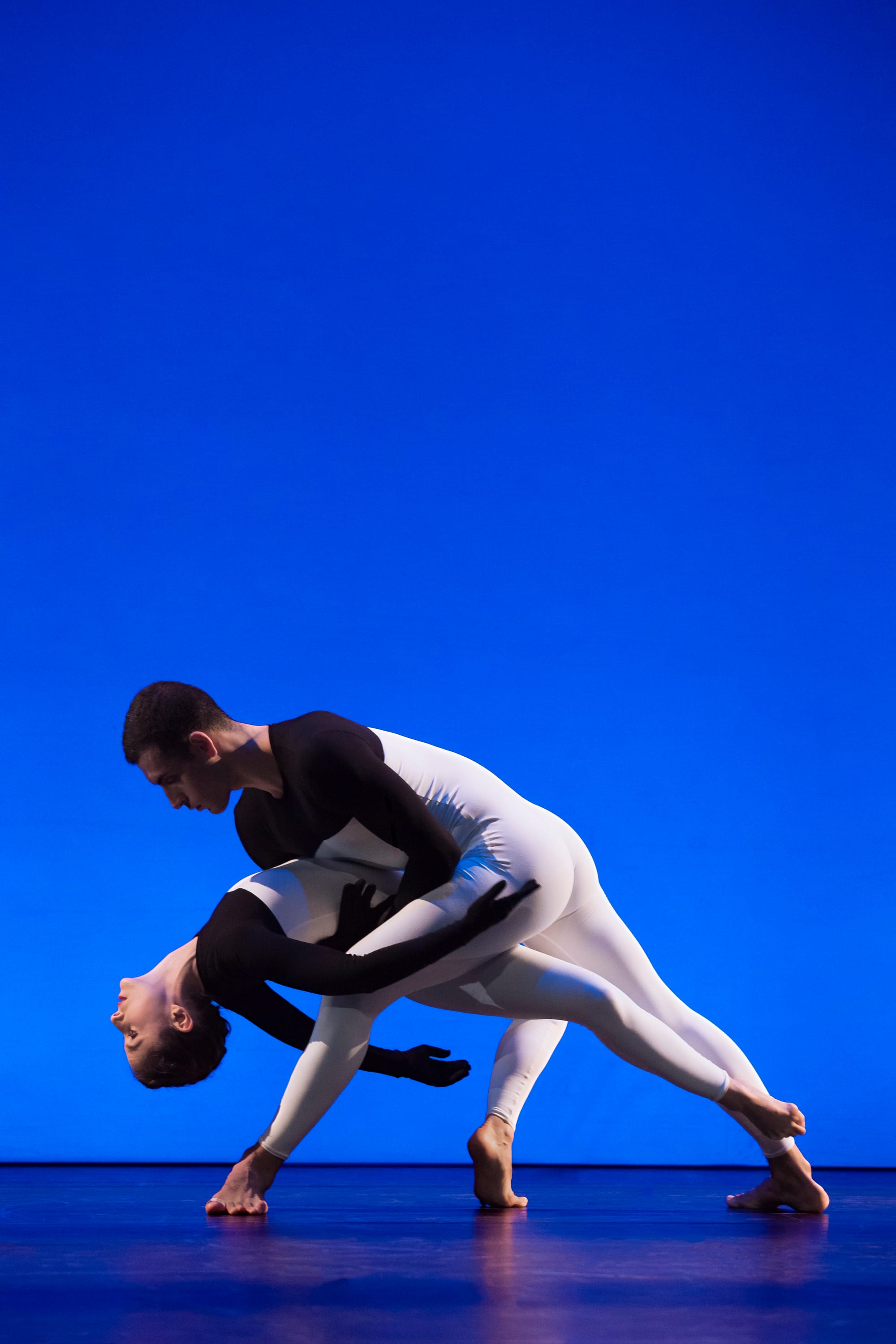
Movement in “Beach Birds” tends to a slow pace. There are eleven dancers in the cast, both women and men, dressed in tight white with black above, from arm to arm across the top of the torso. At times these figures could represent sea gulls balancing on the beach, swaying slightly in the wind, clustering, picking their way about, hopping from stance to stance. Birds, though, don’t partner, don’t handle each other and yet these dancers do. So; there is also the impression of human activity. Due to the lack of speed and a sense weight, one starts to notice dancers’ individual traits. And, too, the motions begin to seem ponderous, even when only a few bodies and not all eleven are one stage – 3 plus 4 plus 1, or just 2 plus 3 , or only 2. There is more balancing, more tensing to John Cage’s sound score of bird calls and (for four live musicians) of echoing tones. Some sequences of motion seem fragmented. Then, “Beach Birds” ends abruptly.
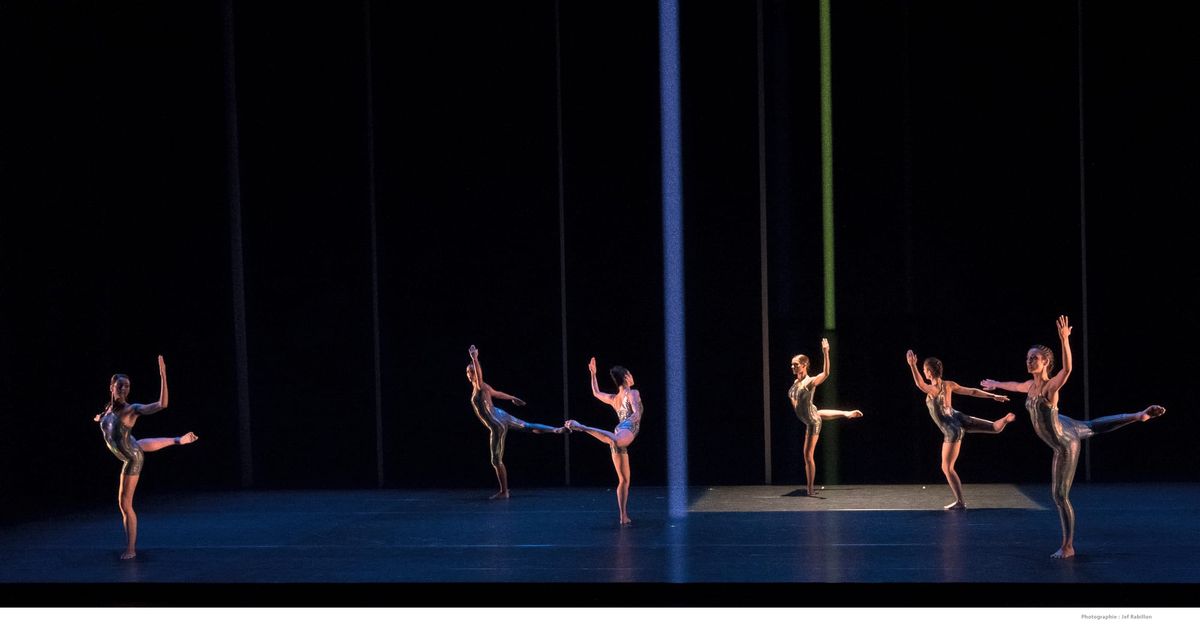
There is no one on stage as “BIPED” begins to droning music by Gavin Bryars, but there are seven upright poles. A figure appears – male, clad in a brief outfit of metallic fabric. He executes a movement phrase, disappears but is replaced by another figure, female. She, also in metallic wear (Shizanne Gallo’s design), does likewise by presenting, departing and being replaced. And so on for a while.The total cast consists of 15 live dancers but there are, in addition, projections of cartoon dancers. Some are recognizably shaped linear drawings and others are more abstract constellations of lights. At first, the movement’s faster pace seems a welcome change from “Beach Birds”. However, the repetitiveness of the balancing, turning, folding choreography becomes tedious. Some of the cartoon animation begins to look close to cheap. There is more repetitiousness, and more. Will “BIPED” never end?
I have no questions about Swinston’s reconstructions of original Cunningham. A mix of choice and chance was used in making these dances. Chance seldom gives interesting results. Cunningham’s choices were as dull as the chance results. I saw his work and his company often, beginning in 1959. Diaghilev used to demand that choreographers astonish him and the audience. Only once have I been astonished by a Merce Cunningham dance. It was for a gala at which ballet stars showed off technically. Cunningham and his partner, Carolyn Brown, danced a duo that was ever so simple!
Images of birds at rest and of people perplexed remain. If that is so, can Cunningham be labeled a late impressionist, perhaps a minor one?
copyright 2019 by George Jackson



