All the Lonely People
“Pitkin Grove”
Beth Gill
Joyce Theater
New York, NY
October 4, 2018
Beth Gill is in no hurry. She has lots to say, but the audience must step up and choose to join her in the complex performance she creates. The world premiere of her latest work, “Pitkin Grove,” has been set on the Joyce’s temporary Quadrille stage; it’s a delicate assemblage, where all the players, boldly color-coded, play their not-quite-solo parts with different energies, and all are connected by that deliberate, glacial pace. The richness builds, and mysteries abound.
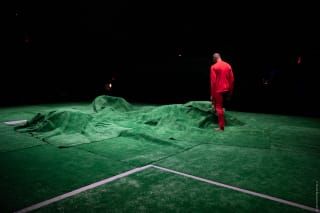
The Quadrille stage, conceived by Lar Lubovitch to house the work of five top contemporary dance artists, turns the traditional proscenium Joyce house into a theater in the round on a grand scale. Like some of the other artists who have appeared during this special season, Gill used the areas on, around, and between the stage and its surrounding spaces to create her world. Before the lights went down on the audience, the stage had already come alive. It was covered with several large humps covered in a lawn of green astro-turf, like a landscape of low green hills. Kevin Boateng, an elegant and stately dancer clothed in bright scarlet, wandered carefully through the landscape, looking biblical, with a slightly frightened and uncertain face, a tall Job in a green wilderness.
Gill, in gray pajamas, wandered with him, though they didn’t acknowledge each other. She began to clear away the green coverings, slowly pulling sheets of the astro-turf off the detritus that was heaped underneath. Like the stage manager in “Our Town,” Gill framed the work with this down-to-earth task, revealing a bit of the ongoing tide of life underneath all the outer coverings.
As it turned out, under one of those lumps there was also a dancer, Danielle Goodman swathed in pink from head to toe. Her pink fabric headcovering was marked by rough torn holes for eyes and mouth, like a pale pink horror mask. Rotating a bag over her head, she rolled around, a splendidly spooky cocoon.
Gill wasn’t the only one cleaning up life’s detritus in “Pitkin Grove.” Two actual stagehands wandered in and out of wings as things were tossed off the performing space into the areas on the sides -- lugging off the box, the pipes, the wood, the astro-turf. They were distracting at first, unwanted practical visitors from the present, interrupting the serene mysticism of the scene. Eventually, though, their clean up (like Gill’s unveilings) became part of the process of moving from one event to the next, one figure to the next. They swept away the leftover images in our minds, and made a path for what was coming, and every time, it was new.
Each character was offered a satisfying but solitary dance. As Goodman finished her solo, Joyce Edwards, another tall and elegant figure (who, in fact, had been paired with Boateng in the majestic twin scene of Gill’s 2017 “Brand New Sidewalk”) rose like a deep yellow sea creature out of the dark, from the first row of one side of the Quadrille stage. Edwards’ dance was that of a quiet but pugnacious boxer, just as described by Muhammed Ali, floating like a butterfly, stinging like a bee across each corner of the stage.
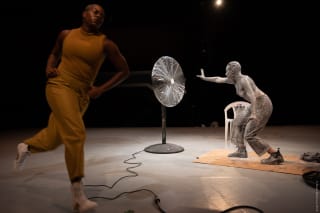
Gill herself provided the most striking image. As Edwards sat and watched from a folding chair, Gill dragged a heavy barrel into the center of the stage, stripped off her top, and plunged head first into the barrel top. When she emerged, the top half of her body was covered in a thin clay coating, eyes closed against the mixture, looking like a death mask, but standing alive in our midst. She stood, arms raised to a large drying fan for several moments, then slowly turned in the 360-degree performing space to present to every corner of the audience. Edwards rose and took off in a casual jog around a stage, framing Gill, without paying any attention to the outstretched arms or silent cry. Gill slid to the ground and slithered into a corner of the stage, prostrate, gray and lifeless.
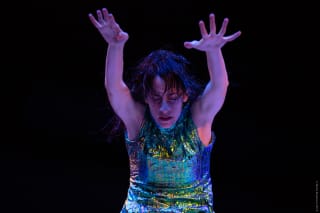
The stagehands who had earlier seemed intrusive were now part of the cast, and one of them stepped out with a large floor duster, and carefully cleaned what was left of the remaining stage leavings, not going quite far enough to sweep off the detritus of Gill’s body. On that clean stage, Jennifer Lafferty, the last character, entered in a blue-green silvery dress scrunched like tin foil, and highlit in each crinkly fold by Joe Levasseur’s caressing lights. As Gill lay still, face down in the corner, Lafferty came to life.
Lafferty slid into the center of the cleared stage (excepting that Gill-inhabited corner), and danced a shimmering solo, mainly with her upper body and hands, her arms and fingers spread, reaching up and out. She crumpled and then spread, like the texture of her costume, sometimes falling in slow motion to her back to land like a crab on all fours, sometimes pulsing her shoulders to the mini-beats of the score from a rich mélange of sound, rhythm, and barely-heard vocals by Jon Moniaci.
There are many communities in literature and art that build a world out of the unique individuals who circle around a common landscape, like Edgar Lee Masters' Spoon River or Bosch's Garden of Earthly Delights, creating a rich portrait of a larger whole. Each scene, each character drew us closer to “Pitkin Grove,” Each dancer and scene added to the texture of this mysterious world, its solitary characters, its green hills, its detritus, its movement, its beating hearts.
copyright © 2018 by Martha Sherman



