A World A Part
Theme and Variations/Tschaikovsky Pas de Deux/Mozartiana/Ballet Imperial
American Ballet Theatre
Metropolitan Opera House
New York, NY
May 29, 2004, matinee and evening
ABT’s classical extravaganza was billed as a Salute to Balanchine, but it might as well have been called a Salute to Tchaikovsky, or a Salute to The Sleeping Beauty, since both Theme and Variations and Ballet Imperial are essentially variations on the theme of Aurora. It was not the most balanced of programs, and the cumulated effect was a bit like being caught in a shower of crystals, with one glittering performance after another.
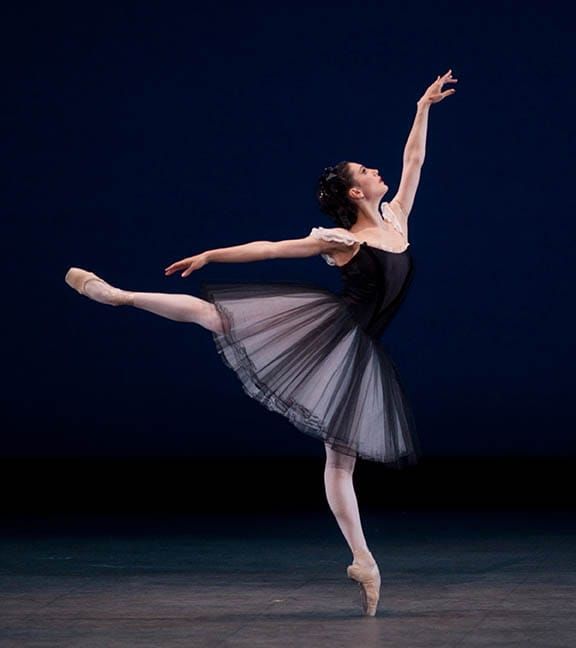
Veronika Part’s Mozartiana did not glitter, it glowed with a rare and special radiance. That ballet, which was staged by Maria Caligari, is one of Balanchine’s meditations on Suzanne Farrell, and opens with a danced prayer. Part is an extraordinarily beautiful woman, but her face alone did not account for the light that seemed to come from inside her. In the Preghiera, her arms seemed to reach from here to the moon, and her backbend was like a bridge to heaven.
Ib Andersen, a smallish, sprightly and elegant dancer, was Farrell’s original partner, and it was as if, in the Thème et Variations, Balanchine had decided to give Titania and Oberon their pas de deux. The series of solos, with a brief dance together, is like a conversation between two equals, it is not a romantic encounter. Part’s point work could have been stronger, but she shaped her dances with unusual beauty. Ashley Tuttle, in the evening performance, had a more personal take on the role, implying some unspecified sadness during the opening that her bright, musical approach in the second half seemed to banish. Maxim Belotserkovsky, with Part, had much of the “not quite of this world” spirit that Andersen had, though Ethan Stiefel, in the evening performance, had sharper, brighter jumps. Herman Cornejo’s Gigue was light, elegant, precise, and flowing; the perfect evocation of the Mozartian spirit.
Theme and Variations opened the program. ABT’s version, danced before a black backdrop, does have a slightly downbeat feel, so at odds with the sparkling music of the opening and closing sections. But there were plenty of bright spots to the dancing. Tuttle, in the matinee, danced with a delicate musicality that seemed to invite the viewer in; she does not sweep through the steps, but the pas de deux had a hushed intensity. Her partner, Angel Corella, has grown far beyond his early charming technician days (though he has charm and technique to spare), and danced with an elegant, if still slightly lightweight, gravity.
Ballet isn’t necessarily a fair art, and Corella, with all his enormous appeal, will never look as effortlessly noble as ABT’s reigning princes, David Hallberg and Marcelo Gomes. Hallberg danced Theme and Variations with Michele Wiles; Wiles is a stunning technician, with a forthright and honest approach, but she has a somewhat inexpressive upper body, and, as yet, does not seem to lose herself in the romance of the role, in the way Tuttle can. The pas de deux was more of a series of beautiful shapes punctuated with smiles, than a conversation; Hallberg cannot talk to himself.
Gomes was the cavalier to Nina Ananiashvili’s Queen in Ballet Imperial. Like Hallberg, he has technique to burn, and a warm and generous stage presence. To see either Hallberg or Gomes present a ballerina is one of the most beautiful sights on the stage today. Ananiashvili’s opening credenza was a bit sharp, with some extraneous hand flicks, as if she were trying to inject some unnecessary drama. But the adagio was beautiful, and her jumps and carriage were magnificent; she just radiates authority.
Monique Meunier, though, as the soloist in Ballet Imperial, can certainly give her a run for her money in the authority department. Reportedly, she had a bad fall earlier in the week, but her dancing on Saturday night was daring and accomplished, and it was wonderful to see her dancing again. Anna Liceica, the soloist in the afternoon performance, danced with a more restrained precision, but was, in her own way, equally impressive. She has a face that the stage loves, with high cheekbones and huge, expressive eyes, which she uses so imaginatively; with her secure and refined dancing, she always brings something special to her roles.
There were a lot of special performances on Saturday—Xiomara Reyes’ Tchaikovsky Pas de Deux was joyful (if the final jumps a little careful), Gennadi Saveliev had a fine romantic presence in Ballet Imperial—but the corps certainly deserves notice; on a Memorial Day weekend, with half-filled houses, everyone danced as if each member of the audience were the most important person in the world.
copyright © 2004 by Mary Cargill



