A Wish Your Heart Makes
"Cinderella"
The National Ballet of Canada
Four Seasons Centre for the Performing Arts
Toronto, Canada
March 10, 2023
James Kudelka’s “Cinderella” has been a perennial favorite at the National Ballet of Canada since its premiere in 2004. With its broad appeal, “Cinderella” was programmed over March break to draw in families and hopefully gain some new audience members for the company. Kudelka’s modern take on the familiar fairy tale has something for everyone – humor, romance, intricate choreography, stunning designs and high production value. The last time “Cinderella” was performed by the NBoC was in 2016. This most recent run features several noteworthy debuts.
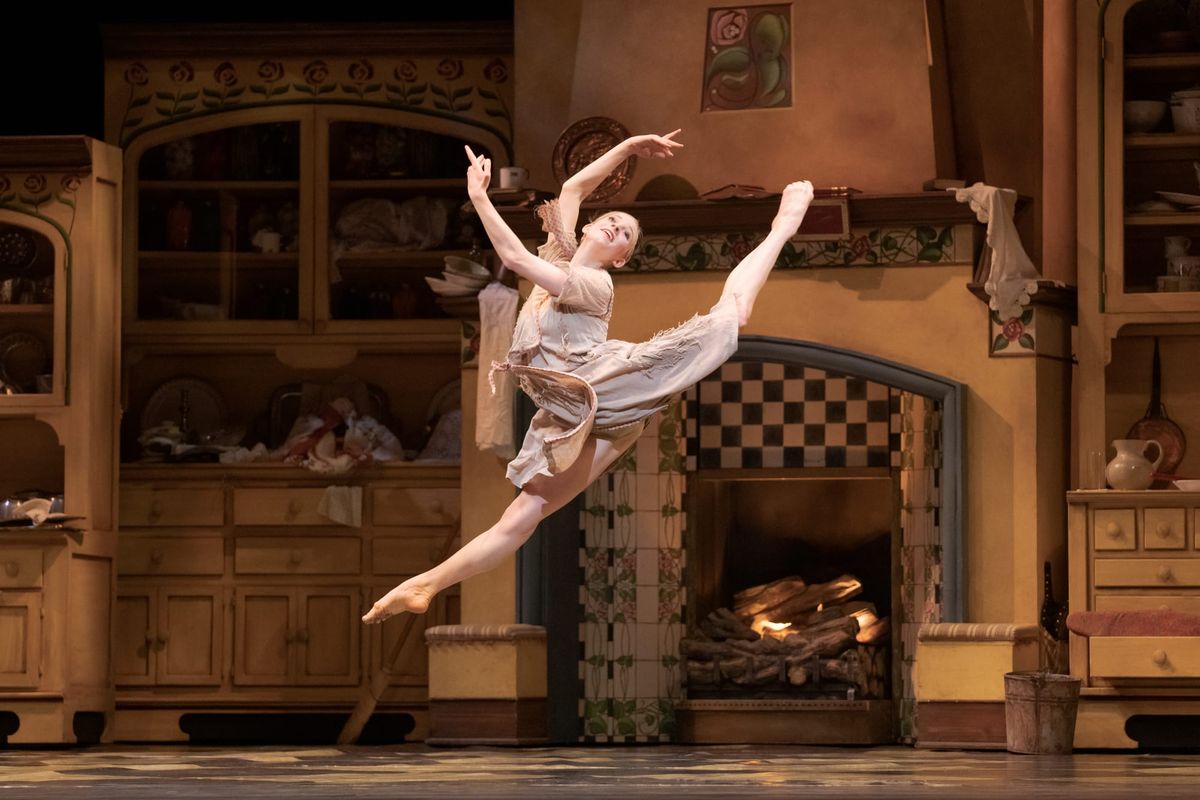
The title role has long been associated with Sonia Rodriguez, on whom it was created. She retired exactly one year ago. The opening night featured a new Cinderella, rising star Genevieve Penn Nabity, with corps de ballet dancer Larkin Miller’s debut as her Prince Charming. Together, they were the epitome of young love. Penn Nabity, especially, is a promising dancer to watch with the full package – strong technique, believable characterization and a lovely rapport with other dancers.
From the first scene, Cinderella is established as more than a passive victim of her circumstances. Despite her unfortunate situation, she is able to find joy in mundane chores and finds moments to daydream. She dances alone, for her own enjoyment. She is repeatedly tormented by her stepsister, but when they go low, she goes high. Penn Nabity’s movements are clear and articulate, whether earthy and grounded in the barefoot kitchen scenes or skimming the stage in bourées when she arrives at the ball in bedazzled pointe shoes (a balletic stand in for glass slippers). After the ball is over, she is left with just one pointe shoe. Back at home, still giddy with delight after that magical evening, she performs a dizzying series of fouettés traveling along the diagonal (supporting foot en pointe, the other foot bare) in one of the ballet’s unexpected bravura moments.
As her Prince, Miller gave an understated performance that allowed Penn Nabity to shine. He made a classy entrance to the ball, matching Sergei Prokofiev’s dramatic melody with clean, soaring jumps. While dancing with tremendous energy, he currently lacks the polish of the company’s more experienced leading men. Some pirouettes would have been more impressive if they ended a rotation or two less, rather than pushing for more turns but ending with a flat supporting foot. Nonetheless, he nailed the key moments of storytelling, such as the swoon worthy first kiss during the pas de deux at the ball.
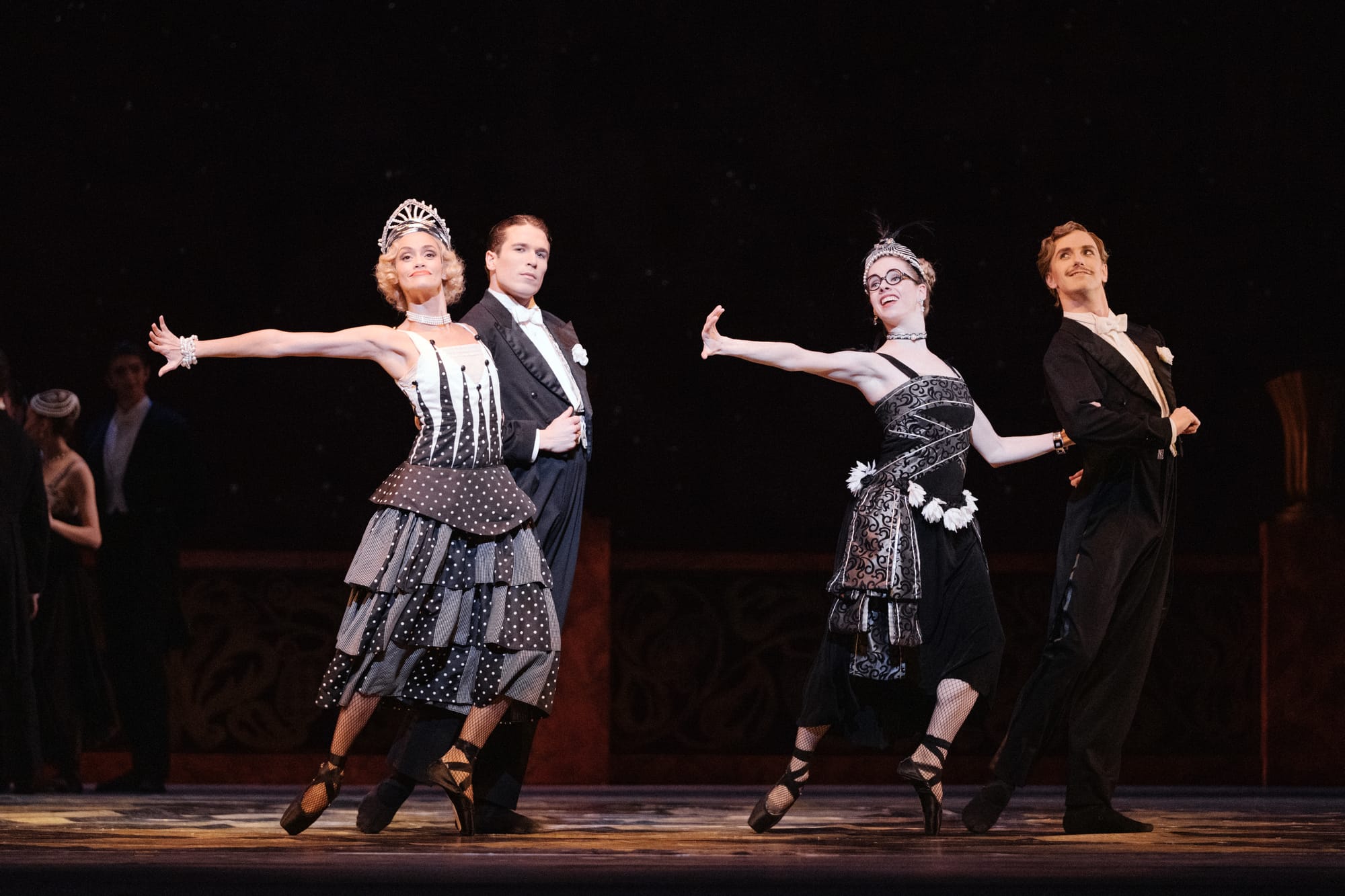
The stepsisters, one haughty and obnoxious, the other dorky and shy, are on stage for much of the ballet and are the perfect foils for the gracious and gentle Cinderella. Veteran Tanya Howard has been dancing the role of the former for many years and it shows. Her comedic performance has a spontaneous quality to it, as if improvised on the spot (right down to her melodramatic curtain calls). She commits to her over the top character, pulling hilarious facial expressions and borrowing gestures from slapstick comedy. Even when on the sidelines, she hams it up. For instance, trying to take a slow, seductive drag from a cigarette, she ends up crudely coughing uncontrollably. The performance was a fun send off for Howard who retired at the end of this run of “Cinderella”, after 25 years with the company.
As the awkward, myopic stepsister, second soloist Brenna Flaherty made a wonderful debut. A young dancer with beautiful technique, this was among the first times she had an opportunity to show her comedic chops. She has a keen sense of timing and delivery when it comes to acting. She held her own next to Howard’s hilarious antics. When the Prince searches for the wearer of the sparkling pointe shoe and Cinderella produces the other shoe, Flaherty softly collapses on the spot. At her dance lesson and at the ball, her stiff and clunky pointe work is perfectly gauche. While the stepsisters treat Cinderella with disdain, at the ball, it is evident that they are outsiders themselves, completely out of step with high society and in the end, oblivious hypocrites.
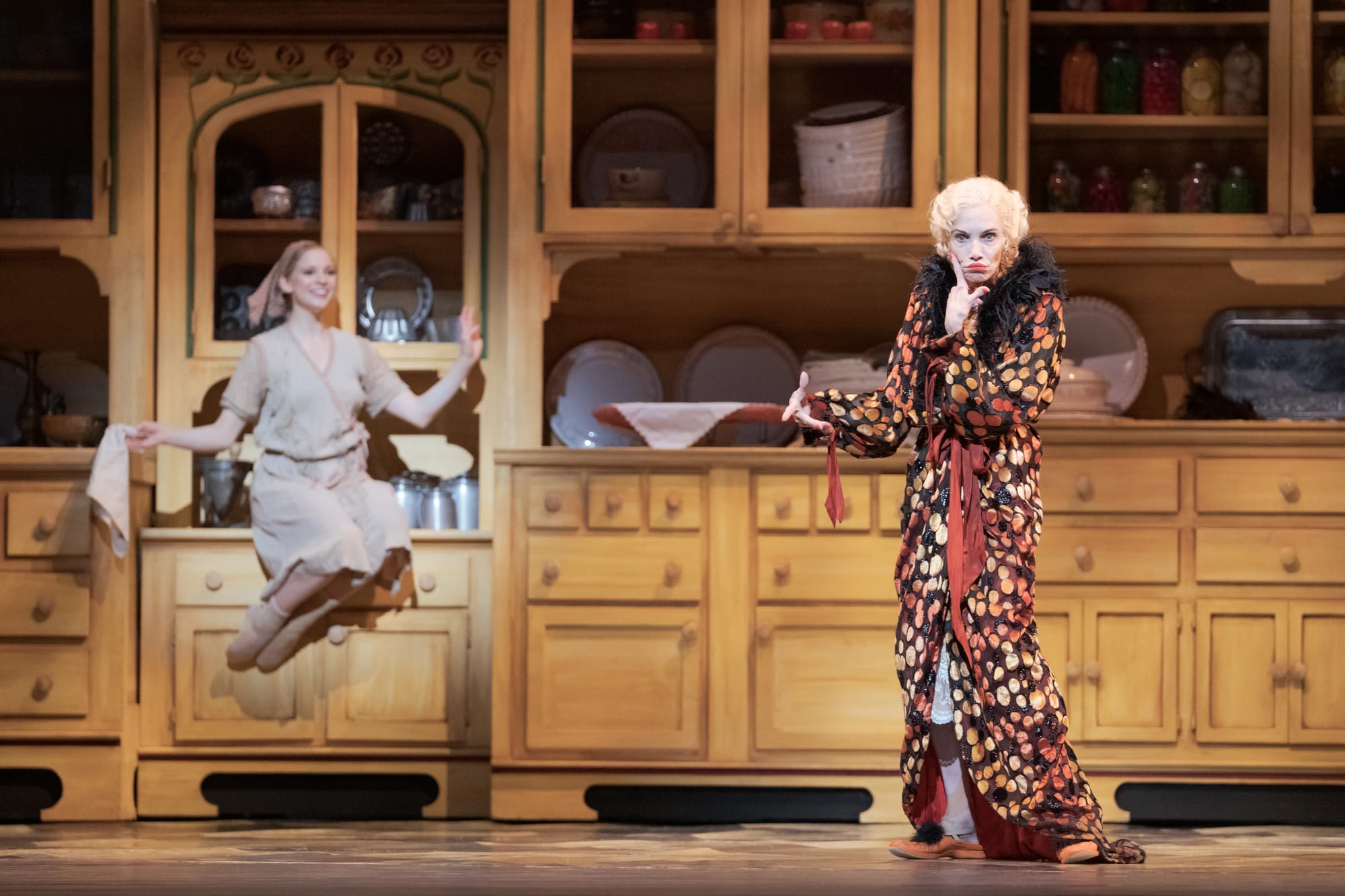
Canadian ballet legend Evelyn Hart made a surprise guest appearance as the alcoholic stepmother. Any chance to see Hart perform is a privilege, and she totally embodied the role right down to the slouching posture and staggering gait.
The around the world sequence, where the Prince searches for Cinderella, is one of the weaker sections of the ballet. The quick allegro steps performed by the prince and his friends (Albjon Gjorllaku, Kota Sato, Peng-Fei Jiang and Trygve Cumpston) dashing from country to country are fiendishly difficult. Any differences in amplitude, speed or extension are highlighted as the men dance side by side and en manège. Having seen this ballet several times over the years, no cast in memory has been able to hit this section and it just looks messy. As for the women they encounter, the costumes and choreography present caricatures of different ethnicities (Spanish, Indian, Inuit, Japanese, Dutch). Certain stereotypical gestures, such as the geisha’s repetitive giggling, have been thankfully omitted this time. The company has also wisely enlisted Bharatnatyam-trained dancer Nova Bhattacharya as a choreographic consultant for the short Indian section. These changes perhaps reflect some recent work that the NBoC has been doing to improve equity, diversity and inclusion in their performances.
Otherwise, the production has aged well with Prokofiev’s richly complex score, David Boechler’s imaginative art deco sets and costumes, and Kudelka’s modern reframing of the fairytale’s message. Rather than wishing to be rescued by a man who will provide wealth and social status, this Cinderella eschews social climbing in favor of a simple and authentic connection with a kindred spirit.
copyright © 2023 by Denise Sum



