A Very Mixed Bill
“Allegro Brillante,” “Easy,” “Carousel (A Dance),” “La Sylphide”
New York City Ballet
David H. Koch Theater
New York, New York
September 29, 2018
To say that Saturday evening’s New York City Ballet program was varied would be an under- statement. It ranged from “La Sylphide,” a nineteenth century romantic tragedy, to Justin Peck’s “Easy,” a rambunctious contemporary dance party. As it turned out, the new tended to overshadow the old.
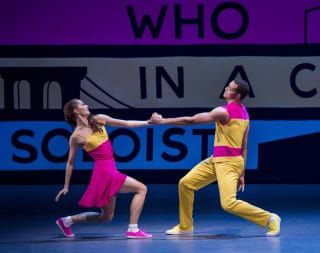
“Easy,” which was premiered last spring as part of the company’s Jerome Robbins centennial, is set to Leonard Bernstein’s “Prelude, Fugue and Riffs,” a bow to the composer, also celebrating his centennial year. The work features six dancers, in this performance Preston Chamblee, Sean Suozzi, Peter Walker, Claire Kretzschmar, Unity Phelan and Indiana Woodward. The set by Stephen Powers is a splash of bright colors and words, including the amusing question, “Who is the boss, the soloist or the conductor?” The costumes by Reid Bartelme and Harriet Jung are in cartoon colors, which together with the set, echo the light-hearted mood of the dance.
Since “Easy” was originally part of the Robbins festivities, it is natural to consider it in relationship to the Robbins ballets the company has been dancing over the past year. In works from “Fancy Free” to “West Side Story Suite” Robbins drew on vernacular gesture to set the tone for his contemporary ballets. He was deeply sensitive to everyday gestures and how they communicate meaning. Peck, on the other hand, places nearly all his emphasis on purely dance movement, even when meaning is clearly gestural, such as a boy inviting a girl to dance. “Easy” is a wonderful, idiosyncratic compilation of squiggles, jumps and kicks (the dancers wear sneakers) that reminded me of 1930s cartoons. The movement is angular one minute, loose and curvy the next, with fast changing dynamics and tempos. The ballet is informal but virtuosic, humorous and fun, and it shows yet another facet of Peck’s remarkable talent.
Peck won this year’s Tony award for his dances in the Broadway revival of Rodger’s and Hammerstein’s “Carousel.” However, it is not his choreography that is in the repertory of NYCB. Rather it is Christopher Wheeldon’s “Carousel (A Dance),” which was created in 2002 to celebrate Rodgers’ centennial. Wheeldon created a ballet centered on the romantic heart of “Carousel,” using the “Carousel Waltz” and other music from the show, particularly “If I Loved You.” The ensemble dances reflect the ebb and flow of the waltz as well as the turning of the carousel, while the central duet is both passionate and poignant with little of the violence of the couple’s relationship that is shown in the play. Lauren Lovette and Tyler Angle danced with freedom and urgency, and were at the same time touching in the knowledge that their love was doomed.
The evening’s program also included Balanchine’s “Allegro Brillante,” led by Tiler Peck and the young corps member, Roman Mejia. Mejia has been in the company less than a year but has already earned a good deal of attention for both his technical prowess and his authority on stage. “Allegro Brillante,” though, is really the ballerina’s ballet and Peck carried off the hurricane of movement as if it were a mild summer breeze. How anyone dances this ballet is beyond me. Its demands seem to go on forever without respite. But if anyone could do it, it would be Peck, and she danced with her usual musicality and lucid execution. Mejia, whose primary task in the ballet is to partner, showed his lack of experience by not always giving Peck the firm support she needed. This caused several mishaps, which both dancers quickly covered, but which nonetheless is the kind of thing that jolts audiences out of the dream world of the stage and reminds them they are seeing real life.
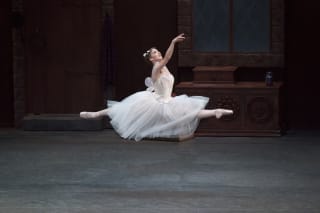
Peter Martins’ staging of “La Sylphide,” with choreography by Bournonville, should have been the centerpiece of the evening, but it was not given the best performance, perhaps because Andrew Veyette, who was scheduled to dance the leading role of James, was replaced at the last minute by Anthony Huxley. The Sylph, as scheduled, was Ashley Bouder, with Megan LeCrone as Effie, Marika Anderson as Madge the witch, and Harrison Ball as Gurn.
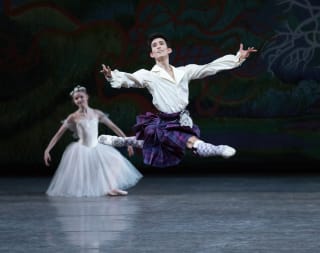
Martins, who originally set the work for Pennsylvania Ballet in 1985, compressed its two acts into one, which makes it seem extremely rushed. There is hardly room for character development when the performers are dashing from one scene to the next. Still, much of the problem on Saturday had to do with the casting. Bouder was a very earthly Sylph. Her realm is one of extroverted, full out virtuosity. The sweetly diaphanous Sylph didn’t suit her well. Huxley was an interesting, introspective James several years ago, but here he looked wooden, although technically as pristine as ever. Megan LeCrone was fine as James’ fiancée Effie, but she towered over Huxley, and would have been much better suited to the taller Veyette. Harrison Ball played Gurn, who loves Effie, for laughs, which is perhaps not the best way to interpret the role of a man steadfastly devoted to a young woman. After all, in Bournonville’s philosophy Gurn is the one who deserves to be loved, not James. Marika Anderson made a rather glamorous Madge, certainly different from the usual portrayal of this character as an ancient hag. Performances of this program continue through Wednesday before the company moves on to other repertory.
copyright © 2018 by Gay Morris



