A Trio to See Again
"Lacunae" "Shutter" "Unlocking/Elpis"
Amy Seiwert's Imagery
ODC Theater
San Francisco, CA
June 28, 2018
Amy Seiwert, until recently Choreo- grapher in Residence with Smuin Contemporary Ballet and founder of her own Imagery company, started a summer program she called Sketches eight years ago. She has explained the project as a way to allow her the kind the risk taking for which commissions are not always the best vehicle. More than anything, she feared falling into established, even successful, dance patterns. Sketches, she decided, would offer her and colleagues in similar positions, an opportunity to be daring, not to worry about the final outcome by pushing their work ahead into new territory. For each series, Seiwert chose a common theme; this year’s was “Origins.”
To what extent the invited choreographers Gabrielle Lamb and Jennifer Archibald, both from New York City and making their Bay Area debut, actually achieved their goals would be intriguing to learn. For an audience unfamiliar with the invited guests’ track record these performances, at the very least, opened new vistas from outside the Bay Area. It was a good experience. Seiwert is now the new Artistic Director of Sacramento Ballet. She plans to keep the Sketches series going.
Sketches 8 mostly impressed with the quality of the performances by what is essentially a pick-up company with dancers from all over the country. Skill, imagination and a sure choreographic touch also made these premieres more than a novelty. Were there weaknesses? I am sure there were, but some of the uncertainties may have had as much to do with my lack of familiarity with the two choreographers’ past than with these works' lacking something. (Without trying to push the analogy too far, sketches have a noble tradition from Leonardo to Jerry Garcia) But I for one would look forward to see other pieces of theirs in the context of the current one. Certain is that Seiwert has an excellent eye spotting quality choreographers. It should stand her in good stead in Sacramento.
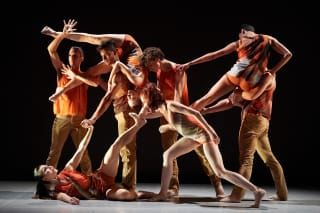
According to Lamb’s program notes her “Lacunae,” to a hauntingly mesmerizing score by Estonian folksinger/instrumentalist Maarja Nuut, explores spaces that seem, but are not, empty. Good enough. The smart and fresh-looking “Lacunae” balanced strict formal constraints with a lush sense of freedom and exploration. The opening step forward-step back circle formation slowly disintegrated as dancers joined Aidan DeYoung into a duet, trios and finally a quartet. The dissolution felt given, much like the ebb and flow of natural processes. Individuality coalesced into a diagonal stack that collapsed domino-like. DeYoung’s blowing a breath at a robust looking interlocking tutti blew it apart. Floor work included falls and rolls and two dancers jauntily displaying themselves on their backs with scissoring arms and legs. Dancers repeatedly made contact with short, tentative touches. Throughout, Lacunae felt tight but not constrained.
Archibald’s “Shutters” got its name from the idea, common to many cultures, that taking somebody’s picture would steal their soul. The choreography, to music by Anna Thorvalsdottir Seskamal and Angus MacRae, suggested time passing through gradually softening single piano notes. The dancers seemed to be looking for something, perhaps their souls, as they were searching among each other but often directing their glances upwards. They pushed themselves onto the stage through an apparently tiny opening as DeYoung tried to keep them out. At the end they went off as they came.
“Shutters” showed off individual dancers beautifully in choreography that was airy and luminous; odd athleticism worked in tandem with more traditional moves. In a duet, a foot might end around a partner’s neck, or push against a belly. Kicks, drops and falls looked as natural as whipping turns and over-the-head lifts. Small configurations — a duet for Beth Ann Maslin and eighteen-year old Austen Meiteen; another for DeYoung and the brilliantly dancing Sarah Cecilia; a male trio and solos for Alysia Chang — highlighted the versatility and consummate professionalism of these Imagery dancers.
Even though “Lacunae” and “Shutters” explored different emotional contents, the pieces suggested enough similarity in terms of kinetic energy and use of spatial patterns that I would like to see them again — on different programs.
Unable to follow viola player Christen Lien’s narration of Seiwert’s “Unlocking/Elpis,” I had to rely on colleagues for the information about the Greek myth in which Elpis (Hope) is unable to escape Pandora’s box. In her ballet, Seiwert and Lien portrayed Elpis’ (Kelsey McFalls) struggle to break out of her confinement. Joseph A. Hernandez’s sheer physical presence made you accept him as mighty Zeus, asserting himself over lesser divinities.
Seiwert has said that in this work she attempted narrative. I have often felt a tad of story in the duets that she so often favored in her more “abstract” work. “Unlocking” works on many levels. The struggle between Zeus and Elpis was fierce yet he carried her almost tenderly. The ensemble’s clawing fingers just about eviscerated Elpis’ torso in the manner of revengeful Erinyes. A long dark veil that ensnared the poor girl didn’t quite work dramatically. But finally, in a splendidly dramatic gesture, McFalls exploded out her confinement and leapt into freedom -- on pointe. Rarely have I seen the pointe shoe make such a short but dramatic statement about the power of the thusly-shoed foot.
Lien, in a black coat, revealing a leather-clad leg, was a splendidly dramatic commentator with both words and the simple but electronically complexified music. Next time, I’ll make sure to also better catch her narration.
copyright © Rita Felciano 2018



