A Tasting Menu
The Bournonville Legacy
"La Sylphide, Act II", "A Bournonville Square: pas de trois from 'The King's Volunteers on Amager', Jockey Dance from 'From Siberia to Moscow', the street singer from 'Napoli', pas de deux from 'Kermesse in Bruges', pas de six and tarantella from 'Napoli'
Members of the Royal Danish Ballet
Joyce Theater
New York, New York
July 9, 2019
Ulrik Birkkjaer, formerly with the Royal Danish Ballet and now dancing with the San Francisco Ballet, has put together a group of thirteen dancers (including himself) from the Royal Danish Ballet to perform excerpts from some of August Bournonville's works. That great nineteenth century choreographer made story ballets with large casts and elaborate settings, so the evening could only hint at the magic of those glorious works, but those hints were imaginatively chosen. Even with recorded music, a bare stage, and no corps, Bournonville's variety and pure joy of movement shown through.
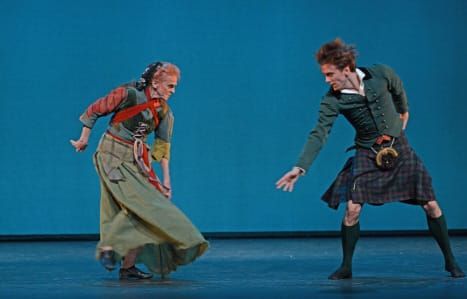
"La Sylphide" is Bournonville's best known work, and six dancers performed a much scaled down version of Act II; they were in costume, but the only set was a cauldron and a tree stump, plus that scarf. The performance was anchored by the power of Sorella Englund's vicious, vindictive Madge. Englund, a famous sylph of the 1970s, was no wizened crone auditioning for Hansel and Gretel's stepmother. She walked proudly, her clear, open face beaming with malevolence. She gave a concentrated, devastating illustration of the power of simplicity, with a few, powerful moves; hatred in its purest form. As James lay on the ground that fire seemed to consume her too, as if once she had her revenge she had no more reason for existing; it was like watching someone turn into smoke.
Birkkjaer was her hapless victim, blinded by his love and trapped by his desire to own the sylph. His James had a slightly dangerous edge, as he greedily wrapped the fatal scarf around the sylph; he loved her but he didn't want her to be free. Even in this Reader's Digest Condensed version, Bournonville's complexity comes through, as the two different worlds meet so tragically. Ida Praetorius was a light, youthful sylph with springy, effortless jumps. Despite the bare stage, she managed to conjure up her forest kingdom, and her acting was unaffected and clear; sad one moment when she thought James had deserted her, but happy the next when she remembered that she was queen of the forest. Her death scene, as she groped through her growing darkness and dropped the wedding ring she had stolen into James' hand was powerful and effective, as her thoughtless innocence destroyed her.
The second half was a Bournonville travelogue, with scenes from Italy, Denmark, Bruges, and England, with most of the women in Spanish costumes (from the Bournonville ballet "La Ventana"). The selection from "Napoli" is the Danish Ballet's calling card, an evergreen explosion of joy, but the other selections are more rarely seen, and all the more welcome. The cast, in their multicolored costumes, were grouped around the stage watching the dances, which gave the proceedings a cosy feel, as if friends were hopping up to entertain each other.
The men, by and large, were more successful than the women; the current Danish women tended to be taller and rangier (with more extravagant extensions) that the older Bournonville dancers, which made getting around those quick, small beats look a bit breathless and brittle. Tobias Praetorius (Ida's brother) was a wonderfully pompous Italian singer convinced of his brilliance, in the mimed role from "Napoli", an unusual selection which showed that mime is not a completely lost art, and he flew through his variation in the final tarantella. The Jockey Dance, a duet from Bournonville's last ballet, "From Siberia to Moscow", is a satirical take on the British love of horse racing, danced with spirited enthusiasm by Marcin Kupinski and Alexander Bozinoff. Jan Axel Fransson was an impeccable stylist with soft, juicy jumps and a generous stage presence -- if only we could have seen more of him in some complete works! But a tasting menu is certainly better than nothing.
Copyright © 2019 by Mary Cargill



