A Silver Anniversary
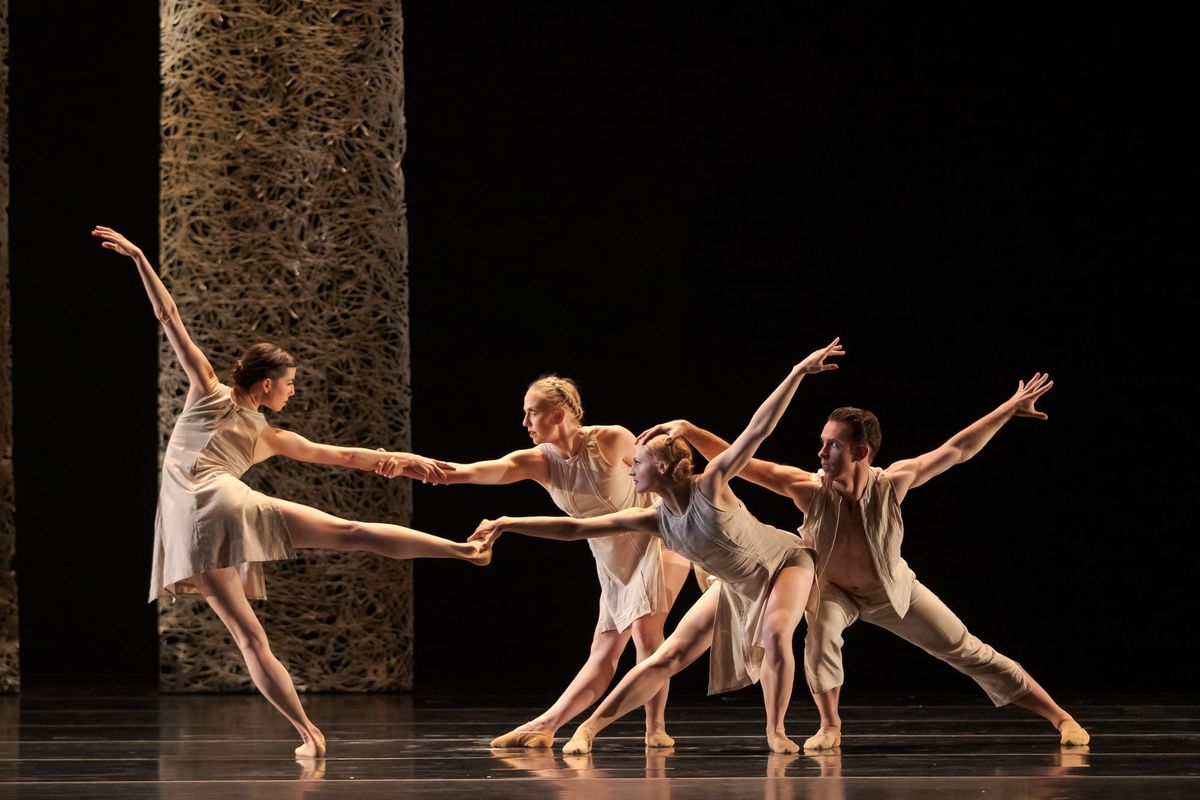
"Renaissance" "The Best of Smuin"
Smuin Contemporary Ballet
Yerba Buena Center for the Arts
San Francisco, CA
April 26, 2019
Last year Smuin Contemporary Ballet (formerly known as Smuin Ballet) changed its name to the current one; this year they celebrate the twenty-fifth anniversary of Michael Smuin’s finally having his own troupe. Remarkably right from the start, Smuin could count on a sizable, faithful audience who appreciated his showmanship and the breadth of his musical tastes. He died quite unexpectedly in 2004. With this anniversary concert the company paid a non-sentimental look to a choreographer who could make (most) his audiences smile. Long-time company dancer Amy Seiwert, now Artistic Director of Sacrament Ballet, respected Smuin’s artistry. She became the company’s first Choreographer in Residence. The world premiere of her “Renaissance” opened evening; “The Best of Smuin” looked back at the choreographer’s work.
For inspiration, Seiwert went to the Bay Area a cappella Kitka Women’s Vocal Ensemble. Their ethereal voices have made East European music familiar to audiences way beyond its home turf. Just listening to the intricate rhythms of this non-vibrato female singing in unfamiliar languages mesmerizes. Seiwert put her own stamp on this music. She put her dancers into simple neutral beige (by Kaori Higashiyama) and opened the piece with four women inviting the lone Terez Dean Orr into tight companionship. While “Renaissance,” with its many ensemble unisons, stressed equality between the sexes in best ballet tradition, the men did the heavy lifting. Women soared either by their own power or by the group raising one of their own. Elastic lines tested tensile strength but simple touches or holding of hands also suggested togetherness.
Seiwert fondness of gestures — rolling hips, shivering torsos, pointing fingers — focused on the complex expressivity of the dancing body. Small ensembles, though almost always pulled back into the ensemble, enlivened “Renaissance”. The unison double duet for Tess Barbour/Peter Kurta and Lauren Pschirrer and Ian Buchanen had an amusing bobbing quality to it. In what must have stood for the pas de deux, Dean Orr and Ben Needham flowed in and out of their shared space. They challenged each other athletically, but did so with a sweet spirit. Later, Needham-Wood, probably the company’s most accomplished dancer, melted into a women’s trio as if into his natural habitat.
After intermission “The Best of Smuin” presented more than a dozen excerpts from Smuin’s choreography, inspired by classical, ethnic/world and popular music. Whether this was some of his best, I have to take on faith. It was certainly covered the wide spectrum of music to which he was drawn.
Gratifying to see was how often Smuin put his women on point, something that many choreographers today seem to avoid like a disease. The short excerpts received their due through excellent individual and company performances. Still, hearing works like Bach’s Prelude in F Minor, Symphony of Psalms and even Verdi in choreography in which the choreographer clearly heard the heard harmony and rhythms but seemed tone deaf to its context, is almost nauseating. However, some of what may have felt “inappropriate” at the time, the overt, even crude sexuality, the preponderance of upside lifts — which have become so ordinary —have lost their “offensiveness”. They just look silly. The dancers — good for them — brought the necessary perspective the works.
Smuin also, maybe uniquely at the time, paid his dues to Broadway. Some of his early company works still entertain. Eric Felsch’s red-hot “Fever” was so over top as to be hilarious; Dean Orr and newcomer Max van der Sterre honored “Georgia”; and Elvis Presley just might have approved of Needham-Wood’s “Heart Break Hotel.”
Today under the guidance of Artistic Director Celia Fushille, the company, eighteen strong, dances better and performs a wide variety of new repertoire while still paying its respect to the founding director. In September, Smuin Contemporary Ballet will also move into it own, mortgage-free home in San Francisco’s Mission district.
copyright © Rita Felciano 2019



