A Mixed Bill -- Indeed
"Rodeo: Four Dance Episodes" "Die Toteninsel"
Bjork Ballet"
San Francisco Ballet
War Memorial Opera House
San Francisco, CA
March 29, 2019
The last of this season’s triple bills includes the premiere of Liam Scarlett’s “Die Toteninsel”; Justin Beck’s 2015 “Rodeo: Four Dance Episodes”, new last year for SFB; and Artur Pita’s “Bjork Ballet”, a delirious costume phantasmagoria with a bit of a dark underbelly. Well performed, this last program leads up to the final two that will bring back all-evening works: John Neumeier’s “The Little Mermaid” and Alexei Ratmansky’s “Shostakovich Trilogy.” It’s probably not too early to say that programming a challenging season is an admirable skill; Helgi Tomasson has not lost his touch. He still is practical but also good and at it.
Arnold Boecklin’s painting Die Toteninsel was such a success in 1880 that he created four other versions and a counter panel, Island of Living, that nobody has ever heard of. Scarlett, apparently, was first influenced by Rachmaninoff’s score of the same name which, of course, itself was influenced by Boecklin’s hit. Despite the popularity of the visual reference, Scarlett clearly took his cue from the music that begins on the softest of shimmering passages and builds into a fierce drama only to fade away. Just in case you need a reminder of the composer’s thematic intent, he also threw in one of his inevitable Dies Irae.
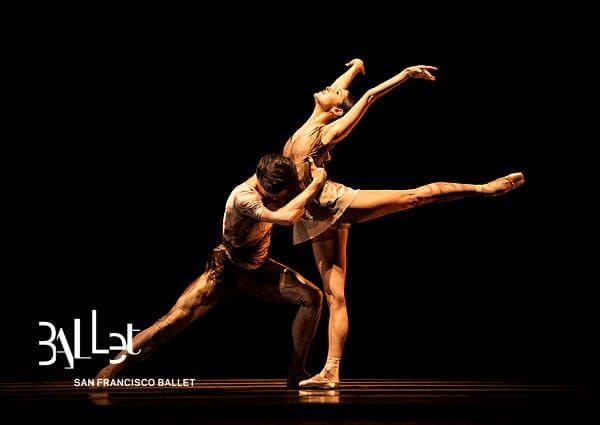
Despite its simple structure, Scarlett’s ballet becomes hauntingly mesmerizing; it is both subtle and dramatic. He gave the thrust of “Toteninsel” to three primary figures: Esteban Hernandez as Death -- both frightening and alluring — and his current victims, James Walsh and Lauren Strongin as lovers. The inevitability of death, of course, has been dealt with much more frequently in the visual arts. Scarlett’s time-based Memento Mori recalls, perhaps, that of Bill Viola and Ingmar Bergman.
A group of twelve dancers and a trio for Vitor Luis, Dores André and Wei Wang (mirrored by Walsh and Strongin) suggest something along a ghostly afterlife. The choreography of stretched bodies, broken and huge lines at times looks entangled but not without losing momentum. Strongin –- still a soloist -- gave a star-making performance, delicate and precise on point, she also has an overall powerful technique enlivened by subtly modulating phrasing.
In addition to the orchestra’s fine rendition of an unfamiliar score, designer David Finn’s double contribution of flickering globes in a suspended glass sphere, and a black backdrop with vertical slits for dancers to appear and be sucked away, was much appreciated.
The program opened on a much happier note. Peck’s “Rodeo” pays tribute to Copeland’s splendid score with another bit of Americana: a sport’s obsessed male youth, not the high-money one but a high-spirited and disciplined one that the British once believed “had won the battle of Waterloo.” The male bonding, group identity, competition, togetherness and a camaraderie are all there in Peck’s first choreography for New York City Ballet.
Charming one more time were the three youngsters, Hernandez, Wei Wang and Hansuke Yakamoto, training to become big boys. Despite having been part of SFB for some years, it took Jaime Garcia Castilla a while to find his place, now as a mature dancer he has done it.
Sofiane Sylve is everything the boys in “Rodeo” are not: Alone, self-absorbed with a hauteur that won’t be easy broken. Sylve here uses her impressive limbs with remarkable authority. Carlo Di Lanno — is he an outsider to that tribe? — partners her with verve and enthusiasm but ultimately, he has to let her go.
Pita’s “Bjork Ballet”, with Carmen Mayo in Maria Kotchekova’s tinsel ball role, again showed Dores André in fine form. Walsh played the fisherman, whose dream perhaps this silliness is. Yet I kept wondering why on earth someone would want to spend the time and energy on this spectacle. The audience was gracious but surely, this must have in gratitude for the dancers.
copyright © Rita Felciano 2019



