Where Butoh Lives

"Void and Vessel," "Mogari," "Hildergardis”
The New York Butoh Institute Festival 2019
Theater for the New City, New York
October 19, 2019
Butoh is an art form that rose from the ruins of the atom bombing of Japan – an event that recalled the Big Bang at the beginning of time, and presaged the Resurrection of the Dead. Both were evoked last night at the second annual New York Butoh Institute Festival.
This year’s festival features 14 performers, all female, from all over the world. While Butoh is a Japanese art form, it lacks the strict formal traditions of Kabuki or Noh theatre. Instead it has a spirit, available to any culture that has survived destruction. New York, which constantly destroys and rebuilds itself, is a perfect venue.
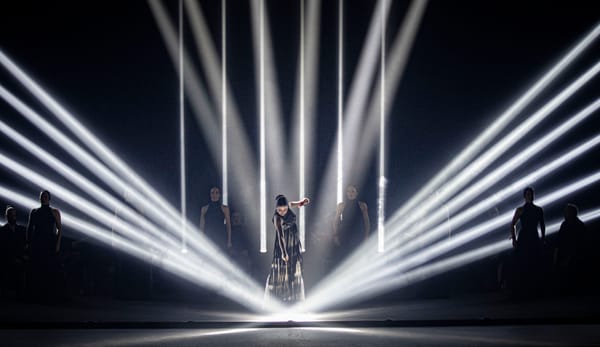
Melissa Lohman’s solo “Vessel and Void” was a New Yorker’s take on the beginning – when a light shone in the darkness, and became flesh. In an empty black space with a spotlight above, she lay white and prone on what looked like a thick black duffel bag, over which she humped and crawled until she was seated on the floor and it was standing on its end, like a thick black phallus. Rising to her feet, showing mostly her back and sides, she made much of the body’s bilateral symmetry. Her back flowed as if in parallel columns, to the sound of a single column of air, something like a Japanese bamboo flute. Her minimal script repeated the polarity of something and nothing – asking “what is this?” Toward the end her movements became more expansive, and the score switched to what sounded like wind chimes – more columns of air but with a greater incidence of chance and play. This was a creation story without a fall, more like Hindu scripture than the Bible, a dance of mischief and joy. Bowing at the end, she patted her duffel like a fellow performer. Thanks, bro.
Eri Chian, from Japan, offered a classic Butoh resurrection. In a black kimono with her face painted ghostly white and a sprig of nature in her hair, she began on her knees, head bowed to the ground. Slowly and painfully she rose to her toes, and came to life. At the climax her arms regained their power, pumping slowly at the sky like pistons.
Butoh is so minimal and radical that it can easily slip into self-parody – and this was the case in an homage to the medieval genius nun, Hildegard of Bingen. In German performer Sindy Butz’s tribute, Hildegard rises from her tomb, in a yellow shroud and purple polka-dot underwear, to become a feminist rock star. Twitching like a zombie, she jerks to her feet as an angry anthem demands “peace and compassion.” It reminded me of the tribal love-rock musical “Hair,” which Hildegard might not have enjoyed. But who knows.
The Butoh Institute Festival runs through next weekend in the East Village. It is curated by Institute founder Vangeline, a French dancer who will perform her own take on this far-out form of art and protest.
Butoh lives, in New York.
copyright 2019 by Tom Phillips