Vintage 1894
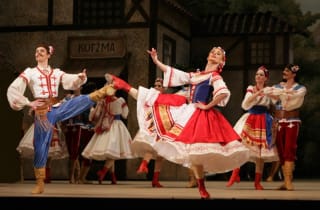
"Coppélia in HD"
Bolshoi Ballet
Empire 25 Theater
New York, NY
June 10, 2018
There was no more joyous place to be in New York on a gray damp Sunday than inside a standard issue (vertical) multiplex in wildly overcrowded Midtown. The reason? Sergei Vikharev's staging, for the Bolshoi in 2009, of "Coppélia" based on that of Marius Petipa and Enrico Cecchetti for the Imperial Russian Ballet in 1894. The production is – even on film – proof of the magic of the theater. For, before anyone has danced a step, the music and sets have transported the audience to the world of Swanhilda, her beau Franz and the dollmaker Doctor Coppélius.
Léo Delibes score begins on a note of wonder and enchantment which escalates with a crescendo to a long held note full of anticipation – almost with bated breath – until the tension is broken by the first surging bars of the mazurka. It's like being shot into orbit. Within the first two minutes of the ballet, Delibes has laid out its themes: the social versus individual, the pragmatist versus the dreamer, ideal and real, love and infatuation, all the contrasts, tensions and aspirations which motivate the ballet's central characters.
The curtain then rose on a trio of half-timbered houses, with a painted drop of a more refined structure with a wide arch and a cupola at the rear, framed by trees around the proscenium, all bathed in the warm but pale light of an early summer morning, a village out of time in a Galicia of the imagination. The costumes saturated colors leavened with white burst with the brightness and vigor of the summer sun, leaving Times Square far and completely behind.
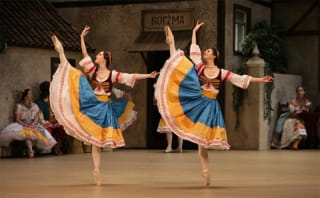
Perhaps because he knew this production would provide deluxe support, perhaps to give the world a taste of his take on the future of the Bolshoi, company director Makhar Vaziev, cast this revival with only one principal dancer, Artem Ovcharenko, as Franz. A veteran of the part, Ovarchenko knows which moments tell and how to put them across. He sniffed the brew handed to him by Coppélius, grimaced but swallowed it down, his curiosity overcoming his instincts and his good sense. Swanhilda was danced by Margarita Shrainer, still listed in the corps de ballet though she danced Kitri in "Don Quixote" in 2016 at the age of 22 and has since added the lead in "Flames of Paris" to her repertory. Here, she had the steps down, but was at her best when exploring Coppélius' workshop: curious, cautious and sensibly, since Swanhilda is guilty of breaking and entering, never without fear. She hasn't found the right balance between the choreography, her take on the character, and how her own way of moving can illuminate the two.
Alexei Loparevich has. His Coppélius was neither mad nor senile. Rather he was a citizen of the village and a prosperous one if the luxuriously appointed dolls in his studio are an indication, never mind the wall paintings, who likes to end his work day at the pub opposite. (This set was the equally successful opposite of the village outside.) Unsurprisingly, he treated Coppélia with tenderness but the tenderness one lavishes on a masterpiece. Only when he realized that Franz had fallen in love with his creation did Coppélius believe that the doll could be made human. The deception discovered, Coppélius was understandably angry, but not broken. One of the pleasures of this broadcast was watching Loparevich mark his mime scene with Franz during an onstage interview just before the second act.
Equally wonderful were the 'Czardas', full of life and of weight, led by Kristina Karasyova and Vitaly Biktimirov with every indication that is was an honor rather than demeaning to be a character dancer, and the 'Waltz of the Hours' whose corps of twenty-four women showed just how beautiful superlative corps work can be.
The only enduring disappointment were the third act variations, 'Dawn', 'Prayer', 'Work' and 'Folly' danced by Anastasia Denisova, Antonina Chapkina, Daria Bochkova and Elizaveta Kruteleva respectively. The steps were all present but anonymous, but none of the variations had a particular perfume. Antonina Chapkina looked morose rather than devout. To be fair, she was saddled with the only unattractive costume of the evening, with rows of large dots across her long torso. It was also a bit confusing that the actual music for the 'Folly' variation was danced by a quartet while the soloist danced to music from Delibes' "Sylvia" best known in New York as that used for the man's solo in Balanchine's "Sylvia Pas de Deux" and reused for the man's solo in act three of his "Coppélia". This is where one wished for dancers of more experience. Fortunately, with Delibes leading the way the ballet built to its climax, joy restored.
copyright © 2018 by Carol Pardo