Trisha Brown at BAM
“Ballet,” “Pamplona Stones,” “Working Title”
Trisha Brown Dance Company
BAM Fisher
Brooklyn, New York
October 10-13, 2018
Carolyn Lucas and Diane Madden, who are the directors of the Trisha Brown Dance Company, seem to be making all the right decisions on how to proceed after the founder’s death eighteen months ago. Last year the company presented a splendid concert of late Brown works at Jacob’s Pillow, and at BAM Fisher this week the group showed earlier pieces with the same exactitude and sense of joy.
Brown’s presence was evoked throughout Wednesday’s performance, not only through her choreography, but also in film, and in program notes that documented the roles she had taken in each of the dances. Lucas and Madden listed the three works presented as “reconstructions,” which stresses the fact that the dances are not the originals, but those dances recreated with the aid of archival materials and through the lens of memory.
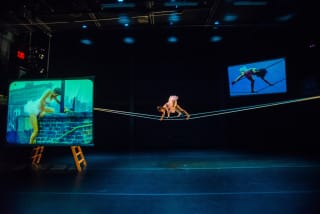
The evening began with “Ballet” (1968), which falls into the category of Brown’s equipment cycle, works she made with props, often aerial ones, beginning in the later 1960s after she had left Judson Dance Theater. “Ballet,” as reconstructed at the Fisher, included large screens at each side of the stage, one showing slides, the other a film. The film depicted Brown in the original “Ballet,” while the slides clicked through a variety of images relating to the dance.
In the film, Brown, dressed in a pink ballet tutu, crawls along parallel ropes stretched across a New York rooftop, and then struggles from the ropes to a raised structure to which the ropes are attached. These shots are interspersed with others of the same dance done out-of-doors among trees and vegetation. Meanwhile, as part of the live performance, company member Cecily Campbell crawled along similar ropes stretched across the stage. As she reached the rope’s end, she disappeared behind one of the screens, then appeared beneath it, descending a ladder to the floor. The work as a whole was both funny and scary, an amusing comment on the demands and dangers of putting yourself out there in any kind of performance, whether of the high variety or low.
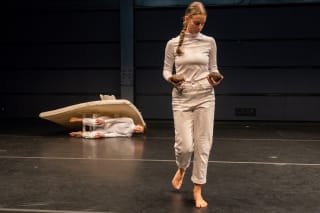
Brown’s humor was also apparent in “Pamplona Stones” (1974), which introduced speech, another element Brown explored, especially in the 1960s and ‘70s. Once again, there were props, in this case a mattress, two chairs, a large white sheet suspended from above, and two medium size stones. The work was originally danced by Brown and Sylvia Palacios Whitman; here it was Leah Ives and Amanda Kmett’Pendry. The women, dressed in white jeans and shirts, asked each other questions (“Why did you get that out?” “Can we talk this over?”), and made comments (“Now I have you cornered,” “Leave no stone unturned”), while they shifted the various objects and interacted with them. Some of those actions ended with a dancer finding herself pinned beneath the mattress or unceremoniously sliding to the ground. These activities were interspersed with sections of movement using a dance vocabulary. But while I make a distinction between a dance vocabulary and everyday movement, for Brown the entire work constituted dance: that was the point. Tasks, speech, formalized rhythmic movement, it’s all dance.
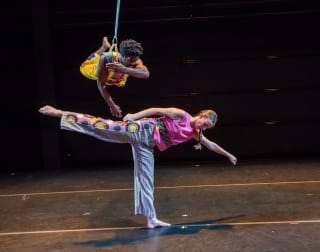
“Working title” (1985) is a lovely piece that further builds on Brown’s interest in aerial elements. As opposed to “Ballet,” however, the aerial aspect does not emphasize the perilousness of being above the ground, but rather the freedom from gravity. Oluwadamilare Ayorinde was suspended on wires that allowed him to float above and among the other seven dancers. The live musical accompaniment consisted of selections from Peter Zummo’s suite, “Six Songs,” played by his orchestra. The score combined percussion, accordion, trombone, marimba, tabla and bass into a delightful amalgam that seemed to exist somewhere between jazz and Indonesian gamelan. The music perfectly suited Brown’s free flowing movement and Elizabeth Cannon’s colorful costumes.
Brown derived her vocabulary from release techniques, so it looks relaxed and swingy but, in fact, is refined and precise. Brown was a master at extending that vocabulary in what seems like endless invention. You never get tired of watching it because just when you think you have it figured out, she surprises you with something new.
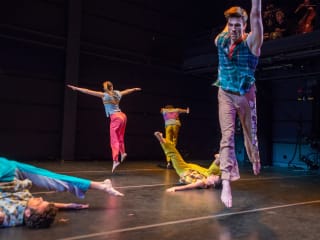
The dancers throughout the evening were superb. They included – in addition to Ayorinde, Campbell, Ives, and Kmett’Pendry – Kyle Marshall, Patrick McGrath, Kimberly Fulmer, and Jacob Storer. The BAM Fisher run ends tonight, but it is to be hoped the program finds its way to other New York venues before too long. These dances are not just historical artifacts; they look altogether fresh and intelligent, and they deserve to be widely seen.
copyright © 2018 by Gay Morris