Too Much
"Anna Karenina"
The National Ballet of Canada
Four Seasons Centre for the Performing Arts
Toronto, Canada
November 10, 2018
The National Ballet of Canada has taken a liking to John Neumeier's full-length dance dramas over the past decade with performances of "The Seagull", "Nijinsky", and "A Streetcar Named Desire". His latest work to enter the repertoire, "Anna Karenina", is a new commission and a joint effort between the NBoC, Hamburg Ballet, and Bolshoi Ballet. Leo Tolstoy's epic story needs no introduction. However, audiences should not expect a literal translation of the famous tragedy set in imperial Russia. Rather, Neumeier places "Anna Karenina" in a contemporary setting while preserving the original characters, events and themes. The production is theatrical and determined, but ultimately uneven, confusing and needlessly long.
Unlike Neumeier's stream of consciousness style in works such as "Nijinsky", "Anna Karenina" flows in a more or less chronological order. It begins strongly, with a striking opening tableau of Alexei Karenin, reimagined as a modern day St. Petersburg politician on the campaign trail. There are crowds waving huge placards, paparazzi, balloons, security personnel and at his side, his seemingly devoted wife, Anna, and their son, Seryozha. It makes for a lively, vibrant scene that effectively conveys the stifling pressure Anna lives under. The couple is danced by Svetlana Lunkina and Piotr Stanczyk. In the public eye, they are picture-perfect, their steps calculated and their expressions rehearsed. Then it cuts to their home where weariness is palpable. They have nothing left to give each other.
Soon, we are introduced to Count Alexei Vronsky, a colonel and avid lacrosse player danced by the handsome Harrison James. In the book, he is a cavalry officer, but horseback riding is difficult to choreograph, hence the sensible change. What follows, however, is a drawn out string of scenes depicting Vronsky and his fellow lacrosse players. We see them cross training in the gymnasium. We see them practicing, all bulging muscles and sweaty brows. Finally we see them at a match. Where there is a point to be made, Neumeier drills it repetitively. We get it. Vronsky's virility and physicality stand in contrast to Karenin's buttoned up formality and focus on rhetoric. His magnetism awakens a dormant passion in Anna. Nonetheless, the gratuitous flexing and excessive number of squats in the choreography is puzzling.
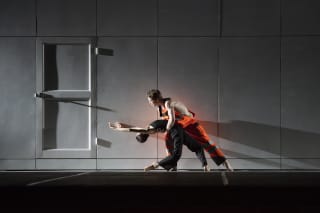
Anna's first encounter with Vronsky in the train station is marred by witnessing a worker's accident and death on the tracks. Despite the romance that develops when they meet again at a party, their relationship is ill-fated from the start. In case this ominous association between their first meeting and the railway accident is missed, the worker or "mushik" (Kota Sato) dressed in a neon orange jumpsuit, repetitively appears at key moments to show that -- spoiler-alert -- their love is doomed. In a heavy handed extension towards the end of the ballet, Karenin and Vronsky reappear in the worker's outfit, suggesting their moral transformation.
A secondary narrative centres on the unhappy marriage of Anna's philandering brother, Stiva (Naoya Ebe), and his wife, Dolly (Xiao Nan Yu). Clichés abound here. Dolly comes home from the supermarket to find Stiva in bed with the nanny. Her choreographed gestures are overdone and obvious. She stomps her feet and angrily throws produce at him, as the children hide under the bed. While they eventually reconcile, a later scene reveals Stiva flirting with Bolshoi ballerinas backstage, just in case his wandering eye was not clear.
Another thread is that of the aristocrat Levin, who shuns the corruption of big cities in favour of a highly romanticized version of country living. Perched on a haystack wearing brown leather pants, a plaid flannel shirt and cowboy hat next to his vintage tractor, while Cat Stevens "Moonshadow" plays in the background -- it is all very on the nose. The partnership of Levin and Kitty is presented in stark contrast to the other two couples. While they get off to a rocky start with her initial rejection of him, their love grows steadily from a foundation of honesty and devotion. It also helps that when she has a mental breakdown, Levin visits her in the sanatorium. The extended overwrought depiction of madness (set here to Cat Stevens "Sad Lisa", naturally) is a familiar staple of Neumeier ballets. Kitty's thrashing about is reminiscent of scenes in "Nijinsky" and of Blanche in "A Streetcar Named Desire." Kitty's makeunder from belle of the ball to farm girl is pretty exaggerated. She looks ethereal and elegant in her wedding gown, while Levin shows up to the ceremony in galoshes and a hastily half buttoned shirt. The next time we see her, she's driving the tractor in a plaid shirt and denim overalls with a baby in one arm. What is left out though are Levin's political leanings and spiritual struggles, which are a major part of his character in the novel. At the end of the ballet, there is a scene where he looks up to the heavens, arms outstretched. He has found God, presumably, but it comes out of nowhere.
Despite the modern day setting, there are some curious anachronisms. While Anna travels with a cell phone and rolling luggage, Dolly seems to be of a different era with an old fashioned trunk. The train station is smoky as if from steam-engined trains. Levin and his comrades cut their crops using scythes. Another awkward inconsistency is the casting of an adult dancer as the young Seroyzha (Spencer Hack), while Stiva and Dolly's children are played by actual children. Hack is taller than Lunkina and despite his rocking horse and teddy bear, he does not look like her child. There are multiple scenes showing Anna playing with her son. He crawls between her legs and plays under her dress. Later they are rolling around on the floor. It reads very Oedipal.
Another major challenge in this ballet are the frequent, fast-paced scene changes with 28 scenes in total! Revolving panels and multipurpose props are used to good effect, but there is so much coming and going that the stage gets cluttered at times and scenes often overlap. The set changes also require various characters to remove props on their way out, which is distracting. The sudden switches in music from Tchaikovsky to Alfred Schnittke to Cat Stevens are also quite jarring.
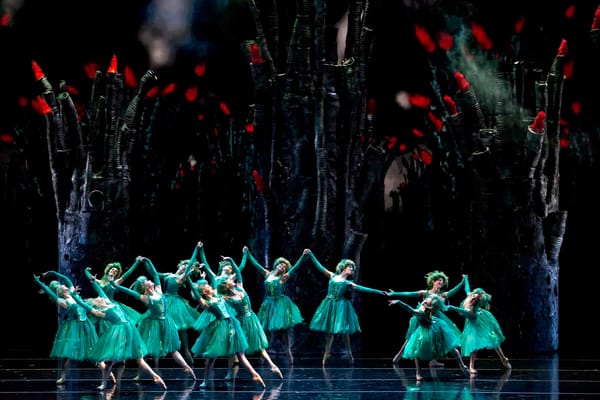
The costumes are timelessly chic, however. At Kitty's engagement party, the female corps members are each dressed in exquisite cocktail dresses in shades of green and turquoise. In a scene where Anna attends the opera, they are in stunning, dramatic, red evening gowns. The costumes are designed by Neumeier, except for Anna's runway ready wardrobe, designed by Albert Kriemler of A-K-RI-S.
This production leaves much to be desired. However credit must be given to the excellent ensemble cast that committed to the intensity and drama of the narrative. Lunkina danced brilliantly and full out, clearly showing the trajectory of Anna's romantic journey and eventual tragic demise. James was a dashing and sympathetic Vronsky, who showed real affection to Anna but could not understand or support her as she spiralled into doubt and despair. Felix Paquet and Antonella Martinelli had great chemistry together as Levin and Kitty.
copyright © 2018 by Denise Sum