The Weight We Carry
"death"
Fact/SF
CounterPulse Theater
San Francisco, CA
Sept, 27, 2018
Sometimes a show leaves you slightly dissatisfied because it didn’t quite hit its target. Yet with choreographer/Artistic Director Charles Slender-White’s “death” chronological and imaginative time, the examination of the audience/performers’ relationship, the ingenious use of Counter Pulse’s physical space, and the slippery topic of this inquiry, you couldn’t help admire the endeavor's complexity. FACT/SF’s three male (Slender-White, Keanu Brady and Kegan Marling) and six female dancers (Michaela Burns, Morganne Mazeika, Catherine Newman, LizAnne Roman Roberts, Isabel Rosenstock and Amanda Whitehead) brought "death" to life They gave powerful individualized performances. Each of them ultimately had a double: a transparent plastic body cast of themselves. They became potent images of the question about what we live with after a substantial loss.
With the audience looking down a steep rake onto the stage, “death” Slender-White, helpfully explained in the beginning, is less concerned with who or what is gone than with what is left: grief, memories, pain, longing, anger etc. A recording of Mozart’s "Lacrymosa" from his Requiem set a tone of participatory solemnity that increased in intensity as the piece progressed. I have always been suspicious of what passes as “ritual” in performance. This one almost worked.
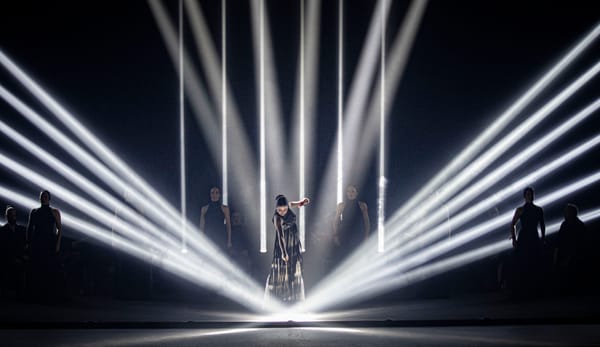
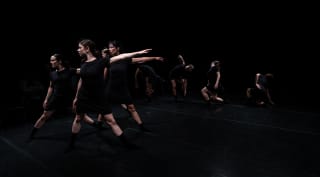
Audience members immediately were invited to recall a personal loss and turn on a tiny flashlight in its memory. Together these small lights became an “offering” in a water-filled urn. The set looked like a moving diorama (Bill Viola came to mind), with the in-black dressed dancers making their way across, mostly, one by one. Unseen forces and ticking clocks kept them going. Left to right, left to right, left to righ they kept coming. Some appeared as silhouettes, others tried to make eye contact. Flailing and stretching arms, bodies collapsing and rising, contorted legs and folding torsos kept morphing. Common was a stiff-limbed gait. At the same time, ushers lead audience members one-by-one out of the theater, down several stairs into a basement stage area. The sense of our own inevitably diminishing presence grew, while the dancers' trajectory appeared never-ending
Before assembling around the stage periphery downstairs, each person sat in a long hallway, facing a dancer at the other end. Loud noises periodically intruded. I couldn’t help but think of the Bardo.
The last section featured everyone in highly physical, extraordinarily disciplined combinations of an octet’s possibilities. At one point the dancers circumnavigated the floor in carefully measured steps, making eye contact with individual audience members. “You are one of us,” they seemed to suggest. You might also get Slender-White in a precarious balance; Marling staring at the sea of bodies in front of him; and Newman assertively breaking out of a contemplative pose. The group divided into ever shifting yet clearly design combinations. A sense of doom and inevitability became suffocating. It simply became too hard to watch. Towards the end we were left with one sound: the breath of these exhausted dancers collapsed on the floor.
And yet “death” ended on a lyrical note. The dancers returned, carrying their transparent body cast, now illuminated from within by those tiny lights.
While it is not true that “every dance could be shorter,” this one could.
copyright © 2018 Rita Felciano