The Next Generation
The 13th International Competition for The Erik Bruhn Prize
Four Seasons Centre for the Performing Arts
Toronto, Canada
March 23, 2019
The Erik Bruhn Prize is a unique competition, geared towards young dancers between the ages of 18 and 23 who are already dancing professionally. Established by Bruhn in his will to recognize emerging talent, participants come from companies with which he was affiliated during his distinguished career. Each company's artistic director selects one male and one female dancer to compete. Because of the small number of participants, the event feels more like a gala showcase. In 2009, a Choreographic Prize was added. Since then, each work in the contemporary round is a newly commissioned piece. Unlike the dancer age requirement, the choreographic competition does not stipulate specific criteria for who can participate, except that the choreographer must be affiliated with one of the participating companies. This thirteenth competition was hosted by principal dancer Harrison James. In both the classical and contemporary portions of the evening, the young dancers showed tremendous talent and range.
American Ballet Theatre's Catherine Hurlin and Aran Bell started the evening with a bang, holding nothing back in the grand pas de deux from "Don Quixote". They showed good rapport and appeared extremely well rehearsed. Every movement was polished and clean with a keen attention to details and flourishes. This pas de deux is a gutsy and technically demanding choice and they both rose to the challenge. Hurlin showed off excellent balances in the adage and infused her variation with Spanish flair. In the coda, she snapped her fan open and close during the fouettés and kept a good momentum throughout. Bell is a strong dancer with a commanding presence. He made the one arm overhead lifts look easy and in his solo, took his time, using accents and changes in speed and levels to create a dynamic variation. Unfortunately, he lost some steam towards the coda and struggled with the tours à la seconde. He tried to salvage them by ending with a tour en l'air but landed off balance and had to put a hand down.
In the contemporary repertoire, Hurlin and Bell performed an upbeat piece by Jessica Lang, "Let Me Sing Forevermore". The pas de deux was set to Tony Bennett crooning jazz standards. The work showed their playful sides while paying tribute to The Great American Songbook. It is always a treat when participants present a piece that represents their company or region and nothing could be more New York than this. The choregraphy was fun, musical and fitted with the lyrics in a straightforward and literal way. For "Fly Me to the Moon", as Bennett sang "hold my hand" or "darling, kiss me", Hurlin and Bell did just that in a sweet and romantic duet. "I've Got Rhythm" provided opportunity for them to dance individually and show their personalities. It was not the most inventive choreography, but it used a reliable formula that works.
The National Ballet of Canada was represented by Jeannine Haller and Siphesihle November. In the classical round, they performed the pas de deux from "La Sylphide", showing sensitive mime and precise technique. November is a natural James, with incredible height in his jump, beautifully arched feet (especially notable in his batterie), and ease in the upper body that belies the intricate footwork below. Haller was similarly well-suited to the role of the Sylph. Her dancing was filled with an airy lightness and steady breath. For the contemporary round, they danced "The Other Side" by NBoC choreographic associate Alysa Pires. The choice of music was unfortunate. "Heroes", a remix of the David Bowie song by electronic music artist Aphex Twin, features a lot of echoing, distorted sounds that became distracting rather than adding to the piece. Haller and November were dressed in soft shoes and simple white and khaki outfits. The ballet opens with the pair swaying together in silence, continues with them dancing together and separately, and ends with them in an embrace. Her movements were somewhat more classical, while he showed more fluidity and freedom in his. There is a lot of leaning and pulling. November displayed a remarkable ability to push himself off his axis yet still maintain control. However, as this work required more partnering, it was evident that Haller is a tad too tall for November, which affected the overall impact of their partnership.
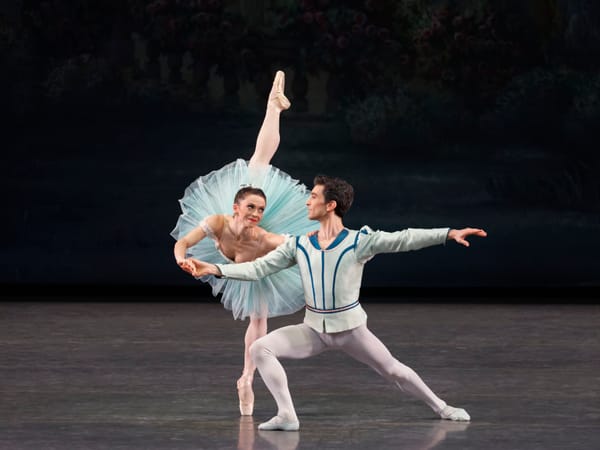
The Royal Danish Ballet sent Emma Riis-Kofoed and Mattia Santini. They danced the sunny pas de deux from "The Flower Festival in Genzano" with gusto. Their performance was clean and they brought a lovely ebullient energy to the coda. It was unlucky timing that they followed immediately after the NBoC dancers. Santini has a good ballon and lands softly without a sound, but he certainly gets less air time in his jumps than November. This being a competition, it is hard not to compare. He also had some difficulties with his turns. Riis-Kofoed held her own, showing confidence and control with a delicate touch. In the contemporary round, they did their best with an uninspired new work, "Code" by Nathan Compiano. The curtain opened to reveal a digital clock front and centre, counting down for 10 minutes. The dancers sat on the ground, motionless for 1 minute at the beginning and at the end, wearing minimal white unitards and with Riis-Kofoed in pointe shoes. The music was a hypnotic yet and repetitive keyboard study by American composer Bruce Brubaker. The dancers have practically no interaction with each other or facial expression for their 8 minutes of dancing. They execute series of turns from corner to corner, run around, and do repetitive deep squats in parallel. The significance of this is unclear, except to demonstrate the dancers' impressive stamina. Whatever code the title refers to, it remains to be cracked.
The Hamburg Ballet's Sara Ezzell and Matias Oberlin performed last. Their classical work was the pas de deux from John Neumeier's "The Nutcracker". Ezzell and Oberlin were the tallest and most mature looking dancers, but their performance was weak and less polished in comparison to the other classical pas de deux. The pair lacked rapport and appeared dazed and half-hearted as they went through the motions of Neumeier's fussy, jam packed choreography. This pas de deux certainly had the most difficult partnering with several big lifts, but they felt rushed which took away from their impact. The coda lacked the speed and vigour it demands; steps seemed to just blend into one another. The dancers fared better in their variations. Oberlin had a refined elegance and executed crisp double tours en l'air, although he could use a bit more plié to get more power. Ezzell's varation was set to a different piece of music, not the usual Sugar Plum Fairy music with the celesta. She appeared more confident here, using sharp port de bras to create a dramatic effect.
The Hamburg pair looked like completely different dancers in the contemporary round, where they danced the premiere of "An intimate distance" by Kristian Lever. The force and conviction that they lacked in "The Nutcracker" were fully present here. Ezzell and Oberlin gave an emotionally intense performance that showed a different kind of virtuosity. Lever's choreography was the most challenging and contemporary in approach, with lots of floor work and intertwined partnering. Dressed in loose street clothes, they pulled together and apart, a tormented couple. The music composed by brothers Kellen McDaniel and Marshall McDaniel, "Broken Bridges", set a dark and tense tone. Ezzell and Oberlin showed groundedness, power and articulation that would have put them in serious contention for prizes if not for their poor showing in the classical round.
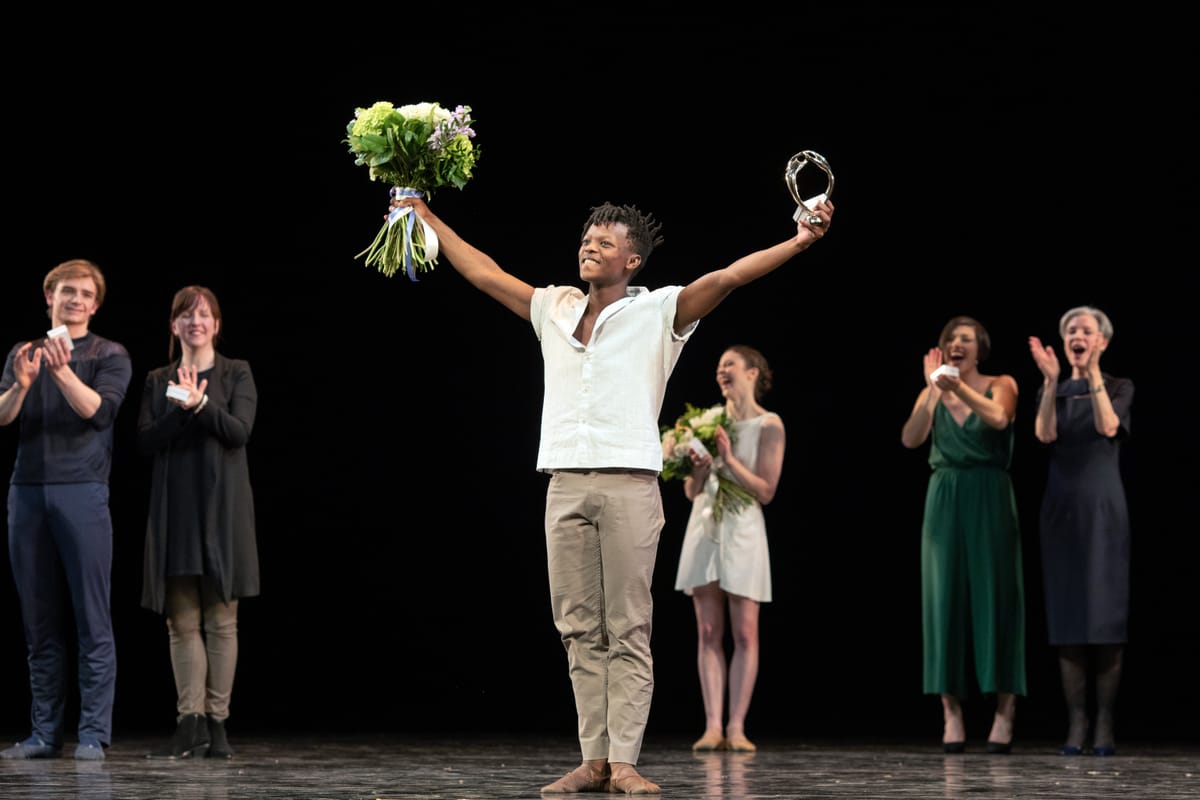
While the judges (artistic directors of each company, or in The Hamburg Ballet's case, their principal ballet master Kevin Haigen) tabulated their scores, the NBoC performed Julia Adam's "Night". The prizes for female and male dancers went to ABT's Catherine Hurlin and NBoC's Siphesihle November respectively, while the choreographic prize went to The Hamburg Ballet's Lever.
copyright © by Denise Sum 2019