So Familiar and Yet So New
"The Nutcracker"
Oakland Ballet Company
Paramount Theater, Oakland
December 22, 2018
Even if you are not a dance aficionado, you can’t miss “Nutcracker” floating through the holidays in a way the “Messiah” and “A Christmas Carol” never will. Bay Area audiences’ choices of this Tchaikovsky masterpiece are almost unlimited. San Francisco Ballet’s is super elegant, Smuin Ballet’s both sentimental and saucy, while Mark Foehringer Dance Projects’ finely articulate one-hour version boasts of a small live orchestra. Each of the good dozen or so showcases for students from Marin to San Jose, Daly City to Walnut Creek has its own charm. But none delights the way Graham Lustig’s “The Nutcracker” does. Oakland Ballet’s Artistic Director introduced himself with it nine years ago. The company has since undergone an impressive rejuvenation, making it again a major local presence not all that unlike it was years ago with a much different repertoire.
Lustig had to overcome a difficult past, but he has done so confidently and on his own terms. From the beginning he wanted Oakland Ballet be “part of the community.” His “Nutcracker” proved that yes, you want excellent classical dancing but this is a capacious ballet that has room for many different talents.
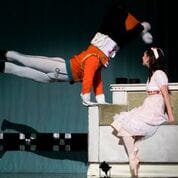
Brilliantly, he set his “The Nutcracker” in early twentieth century Vienna, at the time, a center for artistic innovation and, often called, the birthplace of modernism. Lustig’s first act has a quasi-contemporary feel to it, Zack Brown’s period costumes not withstanding. Gone is any trace of a musty Victorian comme-il-faut. A floor to ceiling window opens a view into a winter landscape that allows for snowball fights, ice-skating tumbles and that plot-setting suggestion of Marie’s (an exquisite Ramona Kelley) cousin Vera (Jackie McConnell) being courted by a Cadet (Thom Panto).
The set was simple, the atmosphere relaxed, and all the guests brought lots of quite rambunctious kids, including a rat-throwing girl (Shannon King). Mean-spirited Fritz (Brandon Perez) had plenty of company in doing his mischief. Marie had friends, much the way Juliet had. I couldn’t see any grandparents but doddering aunt Edith (Katherine Stewart) made up for them. The party choreography consisted of lively, overlapping round dances.
Lustig’s production also included over fifty student performers to make up for the company’s lack of a substantial corps. The stage began to look almost like a stylized reflection of the audience packed by parents and children in party outfits and in a celebratory mood.
In the second act the supernumeraries became attendants to the main characters, pastry chefs, candy canes, and cupcake-stealing mice—saved by Marie’s generous interference. They excellently embedded the divertissements that can look so isolated in their splendid grandeur.
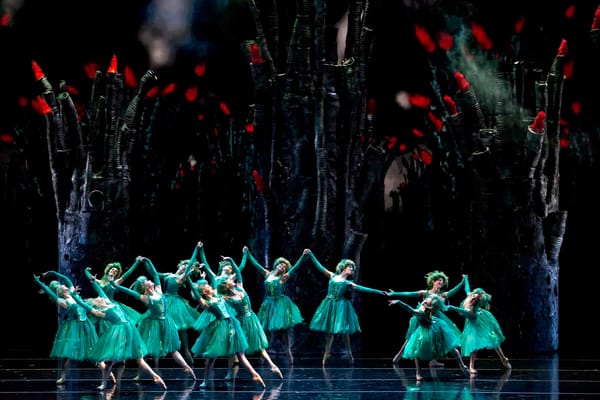
In the Arabian, Christopher Dunn and Constanza Murphy’s quasi-erotic undulations finally disappeared behind a chaste curtain. In the Chinese, Nina Pearlman’s lovely grand jetés set her Nightingale free from her handlers. Graham set the Mirlitons music as a rather heavy-footed German quartet. Maybe the score here is simply too problematic. I have yet to see satisfying choreography to it. The Waltz of the Flowers, with only eight dancers, started with tendril-like arms growing up from behind a wall. Maybe Lustig was telling us that he needed to grow more.
Our heroine, Kelley’s Marie, is a beautifully nuanced light-on-her feet dancer. On the cusp of adulthood she anticipates her own future, watching and shadowing her cousin’s courtship. Giddy with excitement she opens her arms like a flower kissed by the sun when the courteous Cadet partners her for a turn. Yet, she still cries her heart out about a broken toy. Leading up to her first pas de deux with her strongly dancing, but softly landing, Nutcracker prince Seyong Kim, she spins off an exquisite series of musically timed, tiny trembling-heart bourrées. A fresh idea was Vincent Chavez’ Drosselmeyer, a younger, much engaged, often dancing travel companion.
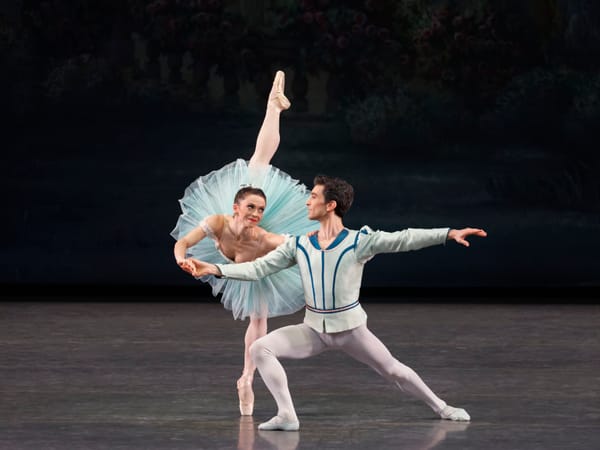
McDonnell and Panto — it made storybook sense — became the Sugar Plum Fairy and her Prince. The lanky Panto is a courteous and reliable partner and showed promise in his small variation. But McDonnell’s regal calm and expansive use of space, her tiny hops, floor caressing point work and luscious arms opened a vision into another world. Even the squirmiest child in the audience became quiet entering this realm of pure beauty. I have never been so glad that Tchaikovsky had the celesta. Michael Morgan conducted; the Piedmont East Bay Children’s Choir vocalized. Beautifully.
copyright © Rita Felciano