Sisterhood
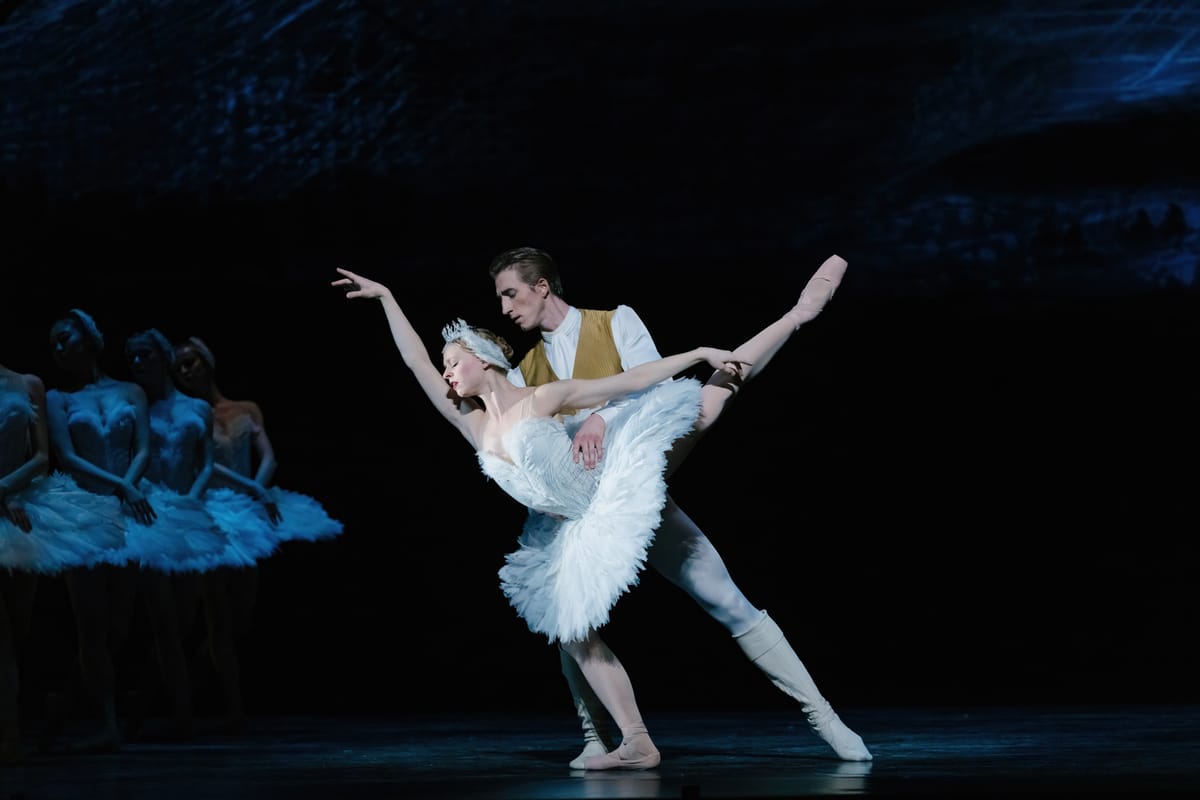
“Swan Lake”
The National Ballet of Canada
Four Seasons Centre for the Performing Arts
Toronto, Canada
March 8, 2025
“Swan Lake” is a measuring stick for any classical company, yet it is surprisingly difficult to find a definitive production without significant flaws. In the years since its 1877 Moscow premiere, different choreographers have changed the setting, cut and added variations and condensed it. It has been done with an all male cast, with and without a jester, with different guises of Rothbart and with both tragic and happy endings. The National Ballet of Canada has gone through multiple wildly different versions from Erik Bruhn’s 1967 production to James Kudelka’s 1999 interpretation to the current production directed and staged by Karen Kain (with choreography credited to Karen Kain, Christopher Stowell, Robert Binet after Erik Bruhn, Lev Ivanov and Marius Petipa). Kain’s “Swan Lake” was to be unveiled in 2020 but the premiere was delayed multiple times due to the pandemic before it finally opened in 2022. This is the first time since then that the NBoC is revisiting this seminal work. The run was completely sold out well in advance of its opening, which shows the power and appeal of “Swan Lake” in the imagination of the general public.
Before the curtain rose and the first bars of Tchaikovsky’s score began, though, music director David Briskin led the orchestra in an energetic performance of “O Canada”. While unexpected, it was certainly welcome; audience members quickly joined in and sang the anthem proudly. At a time when Canada is defending and celebrating its sovereignty, this served as a reminder that the NBoC is a national treasure belonging to the whole country, not just Toronto.
Kain’s “Swan Lake” is fairly traditional as far as productions go. The most familiar Petipa/Ivanov sections are largely preserved and it does not veer too Freudian (like Bruhn’s) or misogynistic (like Kudelka’s). If anything, the team has tried to modernize certain elements, for example highlighting the swans’ humanity. There are some brief same-sex partnerships in the corps de ballet in the act I waltz as well.
The role of Odette/Odile has been an important one for Genevieve Penn Nabity. She was a corps de ballet member when Kain first developed the ballet and a second soloist when she made her debut in the role in 2022. On her final performance during that run, she was promoted directly to principal dancer (bypassing the first soloist rank) on stage. Since then she has been cast in many leading roles, rapidly becoming the company’s leading lady.
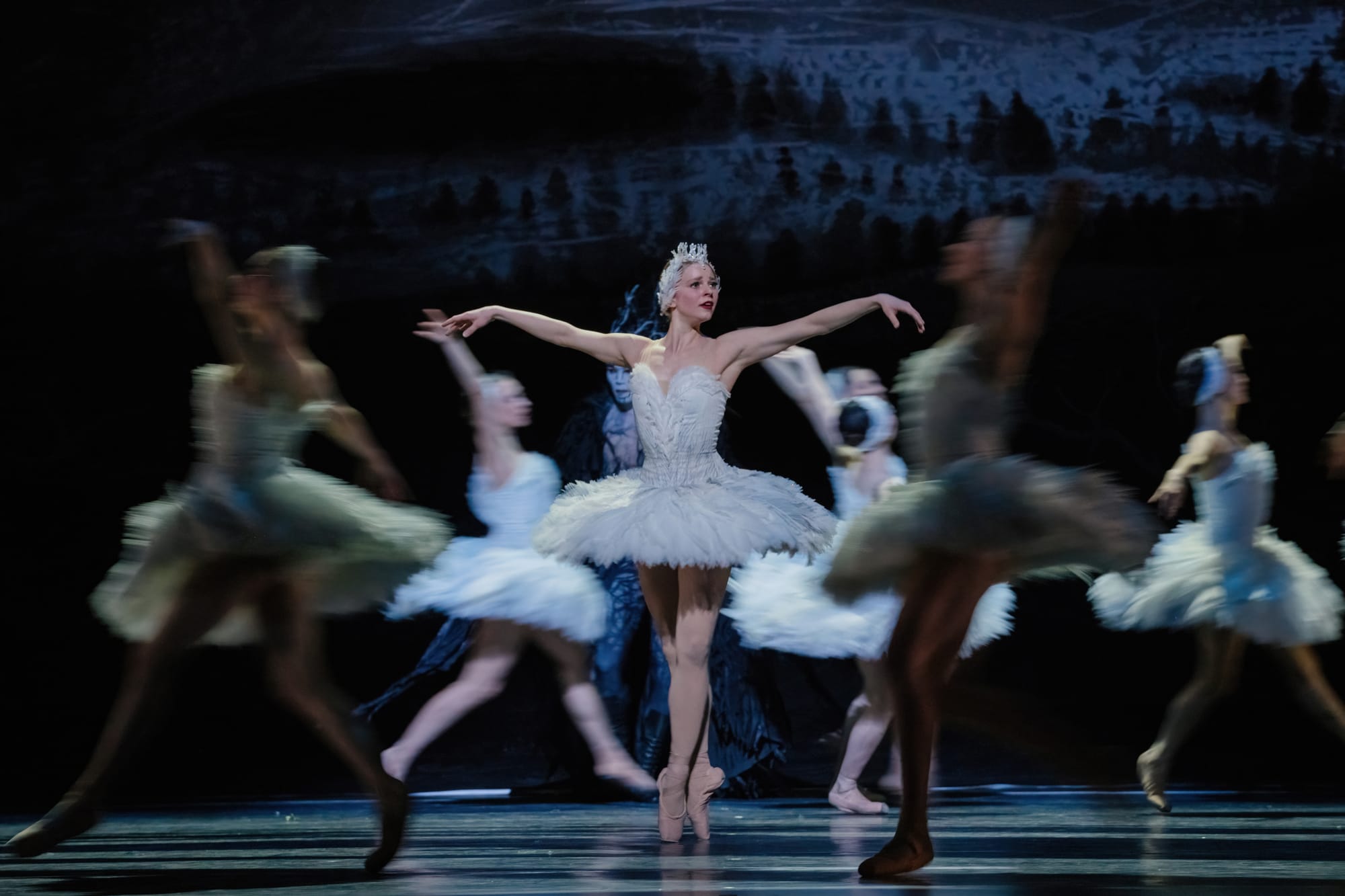
Revisiting Odette/Odile now, her performance did not disappoint. She could stand to be a bit softer as Odette and seemed slightly more at home as the confident and seductive Odile, but overall she gave a well thought through and balanced interpretation. She brought both yin and yang to the challenging dual role. She has remarkable balance and control, which were highlighted in both the white acts and the ballroom scenes. In this performance, she could not have possibly been more on her leg – she looked like she barely put any weight in her partner’s hand for balance. The security of her lower body allowed for a lovely freedom and airiness in her upper body, especially important for those undulating swan arms and back bends. In her act II solo, she made the manège at the end exciting as she turned with dizzying speed then slowed it down perfectly right at the end so she could stop on a dime right with the music. As Odile, she nailed the fouettés in the coda but also dazzled in her variation with a pirouette combination alternating en dehors and en dedans turns. It was more than a technical feat – she was casting a spell. Her expression of glee at deceiving Siegfried left no ambiguity. She was not Rothbart’s puppet; she herself was wicked. In the final act, her Odette was no passive victim. She fought Rothbart quite aggressively. In the end, she grieved her lost love, but also stood strong and resolute – a survivor.
Her Siegfried, Ben Rudisin, unfortunately seemed to be having an off day. He is capable of much more than the audience saw on opening night. His jumps were low and required more plié, while his turns were quite shaky throughout. In his act II variation, he fell out of a pirouette and then looked dejected as if just wanting the act to be over. In the ending pose on one knee, he struggled with balance and wobbled. He portrayed the Prince as a sensitive and conflicted introvert, not ready to marry yet also not wanting to disappoint his mother. He made the contrast between his disinterest in the women presented to him in the court and the genuine affection he felt for Odette clear. He partnered Penn Nabity well and helped her shine.
As Benno, Donald Thom was memorable for his clean, precise dancing. The choreography for this role is quite technical and he got through everything smoothly, with textbook fifth positions and carefully placed transitions. In the act I pas de trois, he danced with Miyoko Koyasu and Brenna Flaherty who played Siegfried’s sisters. Flaherty stood out with buoyant allegro steps from floaty jump fouettés to failli assemblés. She reappeared in act III and tossed off some gargouillades effortlessly.
Another standout performance was Calley Skalnik in the Russian dance with delicate hops en pointe contrasting with larger, sweeping gestures. In the Spanish dance, Selene Guerrero-Trujillo brought dramatic tension and energy. Peng-Fei Jiang made his debut as Rothbart. In this production, Rothbart is less omnipresent compared to Kudelka’s. Still, Jiang was appropriately menacing and brought commanding stage presence to the moments he was on stage.
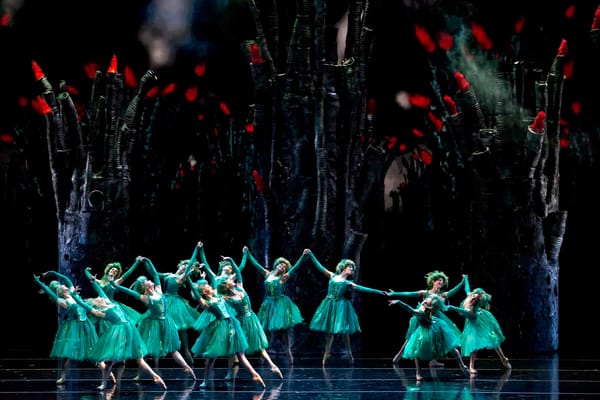
But the night truly belonged to the 24 female corps de ballet members who anchored this “Swan Lake”, nailing all the iconic lake scenes. Their movements were in perfect harmony with each other and their formations were exact. In the prologue, we see four women (friends of Odette) venturing together into the woods, a reminder of their previous lives and adventurous spirits. In Kain’s production, they are still women, just trapped in the bodies of swans during the daylight hours. While their entrapment is tragic, the lakeside scenes show the small comfort they take in their togetherness and sisterhood. Their bare legs (this production is notable in that the corps de ballet do not wear traditional pink tights) further underscores that these are real women rather than supernatural beings. In act IV, they initially turn against Siegfried, as if spurning their dear friend’s toxic ex-boyfriend.
The final characters in “Swan Lake” worth noting are the sets and costume designs by Gabriela Týlešová. While memorable and grand, they sometimes work well but at other times detract from the overall production. While Týlešová has worked with ballet and dance companies in the past, she has also worked extensively in theatre, opera and film. It seems a lot of the costumes sacrifice movement for visual impact. Especially in act III, which is a masked ball, there are large and elaborate headpieces and masks that seem to impede movement (a particularly large unicorn mask comes to mind). Some masks are held on sticks, which means that the dancers have to hold one arm stationary for long stretches of time. In the Neapolitan dance, the men wear oddly restrictive corset style tube tops. Rothbart wears a giant headpiece and enormous wings, which limit his range of motion as well. In the first act, there are cumbersome flower garlands that are used briefly and then tossed aside.
Overall, however, Kain’s “Swan Lake” is effective in communicating the timeless story of love, betrayal and redemption. The company looks great in it and it certainly will serve the NBoC well for many years.
copyright © 2025 by Denise Sum