Separately United
Catherine Galasso
"Of Iron and Diamonds V3: Alone Together"
ODC Theater
San Francisco, CA
December 7, 2018
In 2011 Catherine Galasso finished a residency in San Francisco with the ODC Theater’s commissioned “Bring on the Lumiere”, an intricately structured evocation of the Lumiere brothers and their innovative working with light. It’s a piece that engaged with wit, imagination and some Gallic charm rarely seen on our stages. Then Galasso left for greener pastures. Now she has returned with the world premiere of ‘Alone Together, the third section of “Of Iron and Diamonds V3”, apparently inspired by Boccaccio’s “Decameron”. Looking for one of the poet’s deliciously naughty tales guaranteed disappointment. Instead Galasso offered a smart look at the interdependence between, perhaps, a book and its reader, a storyteller and his/her listeners or, as in this case, performer and audience. She dissected this theatrical convention with a fine sense of timing, sometimes-dark humor and spirited performers elicited from local artists Arletta Anderson, Eric Garcia, Cookie Harrist, Hien Huynh, Phoenicia Pettyjohn, Karla Quintero and Galicia Stack Lozano. With this new ODC Theater’s commission, 'Alone' closed OCD Theater’s 2018 season on an ebullient note.
For this one-hour show the audience was arranged in three horizontal rows on the stage while the dancers took over the seating area. My first reaction, I have to confess, was “what a gimmick. “I couldn’t have been more wrong.
'Alone' started tongue in cheek. Together, in one row halfway up the steep rake, the dancers just sat. They stared at us; we stared at them. Becoming restless, they began to wiggle, look around, and clap tentatively — wanting the “show” to start. The tension between “audience” and “performers” became thicker and thicker until Galasso’s cameo gave the signal to start even as a dark bundle of something or other rolled off the stage. Her choreography transformed the theater’s seating area into a place of common endeavor and individuality. Two dancers rhythmically started a hopping unison pattern up the center stairs; others joined until the orderly procession exploded into the seats. Arms played a prominent role — wide open ones to stepping in place, angular stretches, or hands surging up from behind seats with floreo fingers.
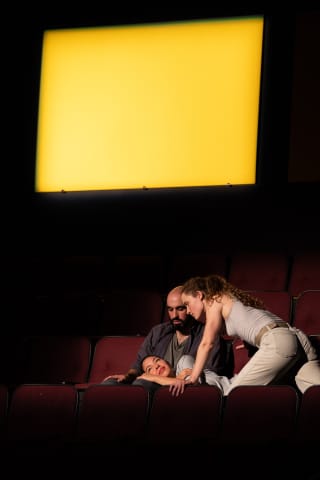
Some sections looked two-pictorial, others suggested narratives. Garcia cradled Harris’ head on his lap when Quintero stepped in to check, and the picture froze. Twelve-year old Stack Lozano cartwheeled on to the stage across as if blown in accidentally. A popcorn-eating woman suggested a half-empty movie theater while below her a swimmer certainly seemed at the very least in a pool. One blew bubbles; another played the guitar.
Transformations often looked ambiguous; Ghostly heads popped up and sank; scurrying feat suggested panic; a dancer tumbling over a number of rows could have been dead. Humor came in a number of shades. Seated widely apart, six dancers filled the auditorium with rhythmic breathing. It was evocative yet eerie. Not all the mini-scenes worked equally well but as a totality they created a rich tapestry of moments that flew by like some film editor’s work on speed.
The end charmed by its generosity: Huynh’s wide-open arms invited us to join the dancers in the seating area even as some of them joined us. The final image suggested harmony and balance. Alone had become a Together. But then that ominous black bundle rolled back in.
With Dave Cerf’s original music/sound design, and Grisel GG Torres' Lighting, Galasso had superb collaborators. But what about those empty luminous video screens that stared at us all the way through the show?
copyright © Rita Felciano 2018