Robbins Goes Solo
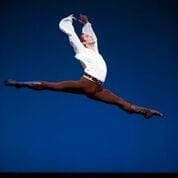
Pacific Northwest Ballet Jerome Robbins Centennial Celebration: Jerome Robbins' Male Solos
Works & Process
Peter B. Lewis Theater
Solomon R. Guggenheim Museum
New York, NY
October 3, 2018
Jerome Robbins' centenary is being celebrated in many different ways in many different places.( In homage, the Paris Opera Ballet will perform Robbins most explicitly American ballet "Fancy Free" set specifically on a side street of New York City on a hot summer night in 1944.) But one of the most intriguing events was presented by Pacific Northwest Ballet and its artistic director Peter Boal at home in Seattle late last month: male solos once danced and now coached by the boss, from "Opus 19: The Dreamer" and "Dances at a Gathering" as well as a solo intended for "Ives Songs" but dropped before the premiere, and seemingly lost over time. Tantalizing stuff, for many reasons. Someone at Works & Process must have thought so too, and brought it to New York, with an unexpected addition, which expanded our view of the choreographer to include actor, coach and mentor.
The evening opened not with a solo by Robbins, but with the solos from Balanchine's "Prodigal Son". Robbins, not known for taking on ballets other than his own, taught Boal the ballet in a week. In Boal's recollections, the rehearsal started as did so many with Robbins: the dancers' first step on stage, frozen by a loud clap. Something had gone wrong and needed to be rectified. Robbins, that son of Stanislavsky, then asked the twenty year old Boal, "What did you have for breakfast?" Boal, in an aside, admitted to stopping at McDonald's that morning, answered "An Egg McMuffin." Robbins re-phrased the question and pelted Boal with more about the Prodigal's father and sisters. When did he arrive for breakfast, where did they clean up afterward? He also made it very clear that the family prayed together in the same place every day and that that place on stage was sacred ground. Robbins knew that there's a world beyond counts, that every ballet creates its own world, and that it is the dancer's responsibility to project that world to the audience.
The program then turned to Robbins the choreographer, beginning with the opening solo from "Dances at a Gathering". Again Boal brought out the importance of a sense of place to the choreographer, and of this particular place in the dancer's memory, for everything that follows flows from that sense of the present swept away by the past. In place of Proust's madeleine, Robbins invoked the Battle of Normandy, and a veteran removing his uniform from a closet and being taken back in time. To find such violent imagery behind the pastoral "Dances at a Gathering" was startling. Boal also supplied background information on two often perplexing moments in the solo. At one point, the dancer bends to the ground and noodling his arms. It's actually called "the doodle", the change in texture intentional -- the grain of sand contrasting with the pearl -- though, unexplained, often irksome from the audience side of the footlights. In the final second, the dancer turns and raises his arms as if confronted by a robber with a gun. It's not a thief but the siren song of memory stunning him and calling to him one last time.
Ghosts, nowhere near as benign and certainly more persistent, plague the protagonist of "Opus 19: The Dreamer" which from Boal's retelling should be called "Opus 19: The Nightmare". Every turn of the head, every change in direction seems in response to the taunting of an unseen malevolent spirit. There's even a moment when the dancer reaches down as if "opening a crypt". Boal recounted one of the most moving moments of his career. After a performance of "Opus 19" Robbins appeared backstage, speechless, tears in his eyes and kissed the dancer on the forehead. Boal also recounted that after his final performance of the ballet (with Wendy Whelan) he received a phone call from the choreographer with notes "She's taking the ballet away from you. Take it back."
The final offering of the evening was the solo made for Boal but cut from "Ives, Songs" and resurrected via film and memory. A man moves from downstage left to upstage right with small steps slowly and inexorably. Expression is all in the fluidity of the arms ("There are no legs" said Robbins.) The solo evokes the words of the song (by Lord Byron) about a sailor in view of shore, drifting out to sea and certain death, but also, once again, the theme of memory and letting go. Perhaps, as Boal said, the piece does not merit a place in the permanent repertory, but it fits right in with a celebratory moment like this, and with any luck, won't be lost again.
The performances were uniformly clean, clear and scrupulous. Lucien Postlewaite seems to have already synthesized everything he has been told and learned about "Dances at a Gathering"; watching him, you don't think about anyone else you've seen do the part. James Moore was serenity and concentration personified in the outtake from "Ives Songs", petulant and high-flying in "Prodigal Son". Corps member Dylan Wald stood like a colossus at the edge of the (very) small stage, shrinking as he tried to fend off the ghosts of "Opus 19 : The Dreamer". Finally, kudos to pianist Christina Siemens who not only played Prokofiev and Chopin but played and sang Ives. Come back soon and bring the full ballets.
copyright © 2018 by Carol Pardo