Return
“Tracings”
Dana Tai Soon Burgess Dance Company
Kogod Courtyard
National Portrait Gallery
Washington, DC
May 4, 2019
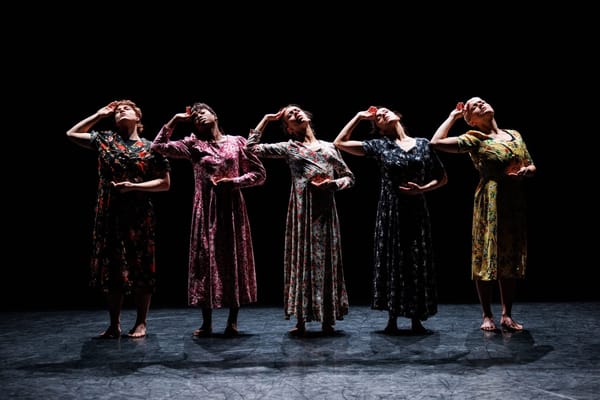
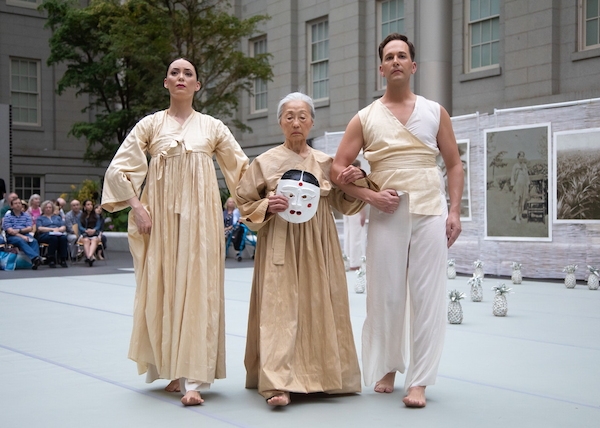
This time Dana Tai Soon Burgess didn’t make a new dance but restaged his 2003 work. If memory serves, it emerged with fresh bravura and with a lyric thrust from start to stop. Apparently the current version, with a duration of 43 minutes, is a bit shorter than the original that was shown at Kennedy Center. Aspects of ritual and of a legendary reality distill from the choreography, music and visuals. The story is about people, indentured Korean immigrants to American-dominated pineapple plantations on Pacific islands. Burgess shows the fate and transformations of these migrants from 1903 to now – three generations in 116 years. There is an Ancestress who witnesses and presides over the action. Four other women and five men convey currencies and the passage of time. One of the men (Kelly Moss Southall) seems a leader of the Koreans, perhaps dealing with the absent Americans and safeguarding the Ancestress. One of the women (Christin Arthur) experiences the lives of these immigrants in concentrated form and expresses herself impressively. It is this role and Arthur’s performance of it that give “Tracings” unexpected links to some historic pieces of dance history.
As a strong modern dancer with a balletic line, Christin Arthur tackles Burgess’s step clusters and spools them out melodically and with dramatic emphases. This touches off in “Tracings” a whiff of exotic ballets like “La Bayadere” and “Le Corsaire”. Burgess doesn’t resort to divertissements and yet there is a sense of play as well as of myth as the woman Arthur represents does more than persist. She labors in the fields and perhaps in childbirth. She grows as a person and proves to be productive. The mask she sometimes wears and sometimes hides has multiple lives.
Music for the production by Aaron Leitko and Jason Kao Hwang seemed a wind tossed, yet unified score that went well with the silken pastels of Judy Hansen’s costumes and with the sets and blanched props (pineapples, luggage) by K. Moss Southall. In the role of Ancestress, Anna Kang Burgess (visual artist and mother of the “Tracings” choreographer) stood, walked, sat and watched not with a Martha Graham hunger but stoically.
copyright 2019 by George Jackson