Resurrection Time
Denishawn
Dances by Ruth St. Denis & Ted Shawn
The Theatre at St. Jean's, New York
October 2, 2021
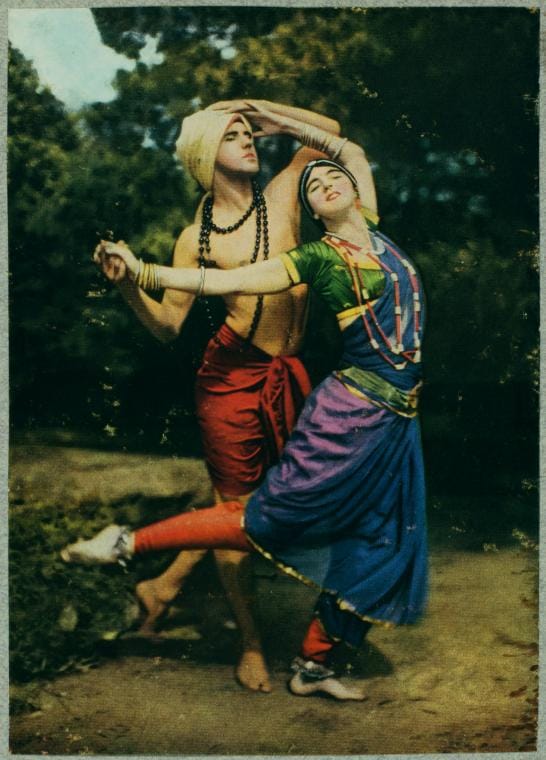
Ted Shawn and Ruth St. Denis are known as the "mother and father of American Modern Dance," but the works they choreographed and performed have been lost for years. All that remained were dusty photographs and flickering, black-and-white films. It was a case study in the ephemeral nature of dance--- until it all began again.
The idea originated with veteran dance publicist Audrey Ross -- once a dancer -- who recruited an all-star cast of friends, supporters, students and protegees to excavate the attic of the past, and re-create the the dawn of Denishawn. Several years in the making, the project was put on hold by the pandemic. It finally went up in the last few days: from a theater in a church basement, a 21st-Century resurrection.
It began at the beginning, with a new generation of dancers. Seven nubile nymphs from the Limon2 company performed Shawn's "Floor Plastique," a heretical piece in 1916 in which the dancers never rise from the floor. As recreated by choreographer Henning Rubsam, the piece contains the fundamental gestures of a new era – contraction and release, shifting weight and momentum. Denishawn dancers Martha Graham, Charles Weidman and Doris Humphrey would elaborate these gestures into new styles and schools of movement. In the bodies of the Limon apprentices, 1916 and 2021 came together – two violent turning points, vortexes of desire and despair.
Shawn and St. Denis looked far and wide for different ways to move, and found them in exotic places -- India, Java, Japan. Ballet legend Valentina Kozlova re-created St. Denis's "Incense," based on Hindu ritual, with actual incense and authentic feeling. Antonio Fini brought the Hindu god of destruction Shiva off his pedestal and into motion, ending with the deity's signature delicate balance. Bradley Shelver performed Shawn's "Japanese Spear Dance" with the controlled rage of ritual fighting. And Peiju Chien-Pott seduced the entire audience in a slinky silk gown, in St. Denis's version of a court dance from Java.
A lively post-performance chat centered on an objection to Denishawn's cultural appropriations. Dancers defended the work – this was not hootchy-kootchy Orientalism but anthropological adventure, an attempt to give western dance a global vocabulary. The most subtle talkback came from Puerto Rican Nuevayorker Arthur Aviles, who performed Shawn's "Danse Americaine." The piece makes fun of a small-time dude, who like Frank Zappa's "Dancing Fool," thinks he's really something. Such characters can be seen in in el barrio. But even in a too-shiny green suit, Aviles gave the character dignity – OK, he's a naive narcissist, but he's trying to be his "best self."
The program ended with a solo waltz, a piece that originated when Ruth St. Denis spontaneously began to dance at a party, and the pianist couldn't stop playing, going seamlessly from Brahms to Lizst, extending the moment. The dancer was former Graham great Christine Dakin, the pianist Jonathan Howard Katz. The performance was inspired, alive, authentic. As Faulkner wrote--- the past isn't dead. It isn't even past.
copyright © 2021 by Tom Phillips