Reprise and Repeat, If Not Reimagine
“From You Within Me,” “Variations Pour Une Porte et Un Soupir,” “Mystic Familiar”
New York City Ballet
David H. Koch Theater
New York, NY
January 29, 2025
New York City Ballet's "New Combinations" program proved that while anything old can feel new again, the new can just as easily feel like a rehashing of the old. Along with Christopher Wheeldon’s dreary 2023 ballet “From You Within Me” and George Balanchine’s experimental 1974 work “Variations Pour Une Porte et Un Soupir,” the main event was the world premiere of Justin Peck’s "Mystic Familiar." That ballet – a product of a reunion of the creative team behind the wildly successful "The Times Are Racing" – showed that even with the right constellation of elements, artistic magic is elusive.
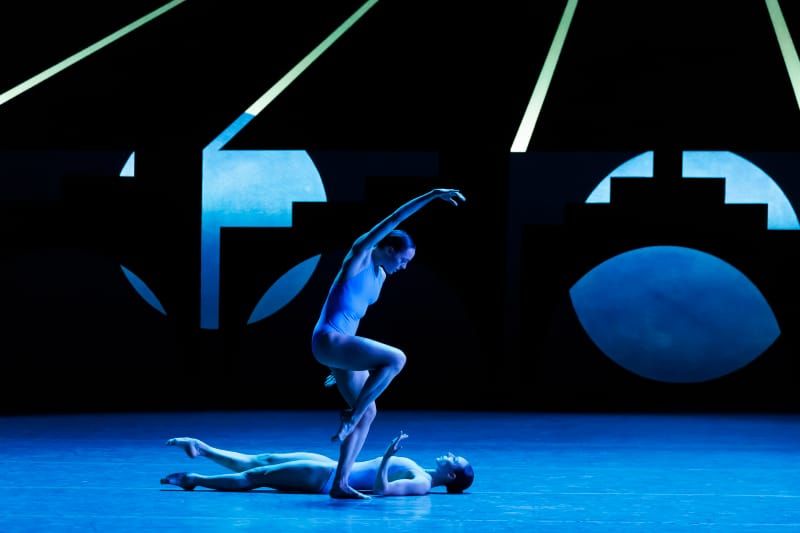
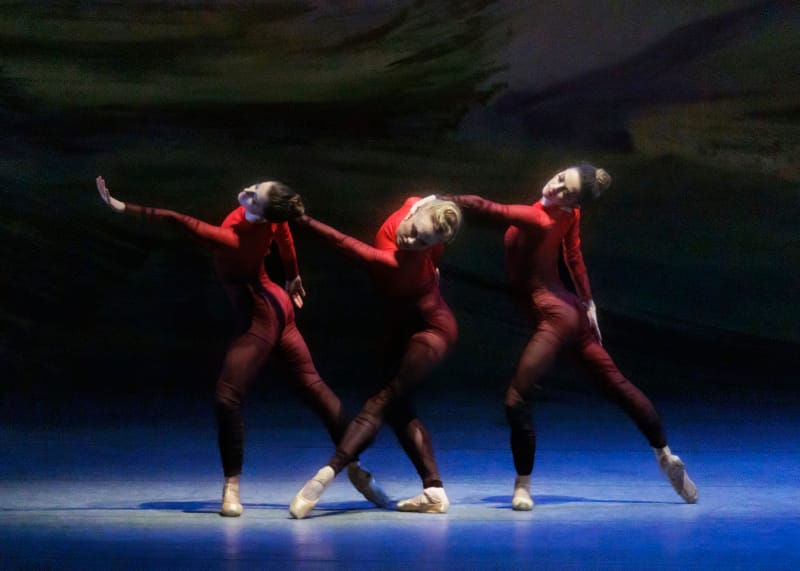
Wheeldon's work opened the program and largely felt like a free-for-all for the dancers trying to find their footing within its many intertwining sequences and poses, and subdued Arnold Schoenberg score. The notable exception was its lead, Sara Mearns. The tortured lilting theme is this dancer's wheelhouse, and she found plenty to sink her teeth into within the material. The rest of the cast fared less well, with Megan Fairchild and Indiana Woodward dancing with oddly pained facial expressions, while others in the twelve-dancer cast opted for a colder presentation. Toward the end of the ballet, the use of backlit silhouettes achieved a beautiful effect, though one that has become increasingly cliché in contemporary choreography. While lovely at times, this ballet did not offer anything we have not seen before.
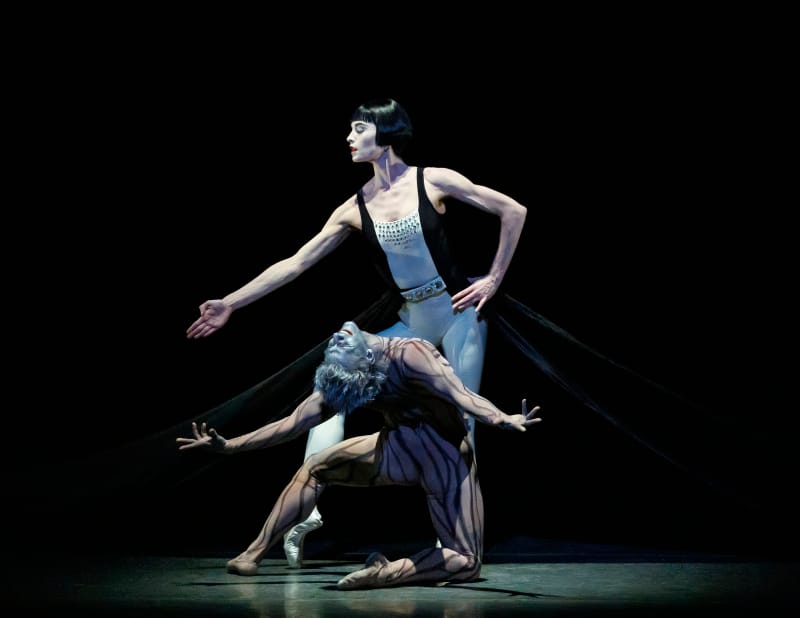
After intermission, Miriam Miller, days from her promotion to Principal, debuted as the cold and regal Door opposite Daniel Ulbricht's veteran virtuoso treatment of the Sigh in “Variations Pour Une Porte et Un Soupir.” Though shaky in a few spots where her poses missed fixation in extensions, Miller’s character was equal parts diva and ice-maiden, taking advantage of her tall and slender physique and using it to dominate the stage amid the demure movements of Balanchine’s choreography. Ulbricht was superb, delivering both comedy and precise execution, although his familiar interpretation made one wonder who else in the company might bring fresh perspective to the role. At over fifty years old, this often-divisive ballet felt oddly refreshing and perhaps just as experimental as it did half a century ago.
The world premiere of "Mystic Familiar" was clearly the evening's main draw, assembling all the promising ingredients that combined so perfectly in 2017 with “The Times Are Racing.” There was the music by Dan Deacon (and as a bonus, the man himself, performing vocals and on electronic instruments), the costumes by Humberto Leon, and of course Peck and plenty of sneakers. A sectional breakdown with titled themes of Air, Earth, Fire, Water and Ether, with costumes changes for each, seemed intended to provide structure to relative effect.
Opening with the entire company moving across the stage from right to left in leotard costumes with poofy sleeves, “Air” was immediately too on the nose. Not much happened in it choreographically, besides simple steps, and all too quickly the section yielded to “Earth” – a solo for Taylor Stanley – which dragged. In many ways, “Earth” can be termed a typical Stanley solo at this point, as it echoed the many sections created for this dancer by many choreographers (Kyle Abraham’s work comes to mind most acutely). There were the back-and-forth movements, repetition, and not much salient phrasing.
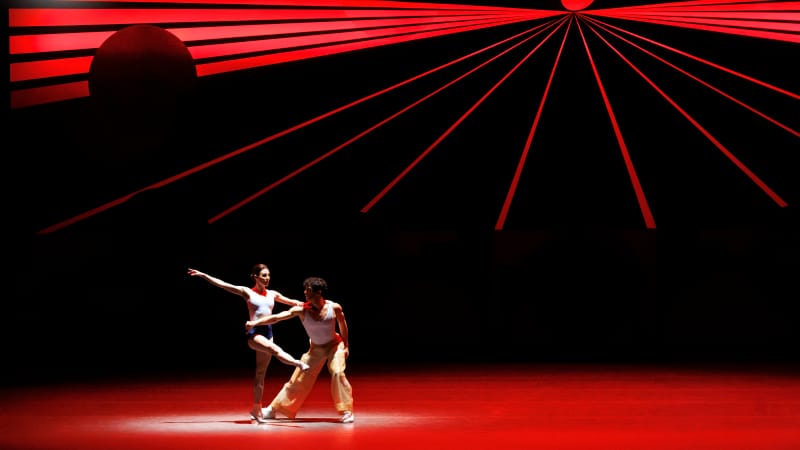
Relief arrived when a group of dancers rushed to center stage for the "Fire" section, beautifully illuminated by warm colors seeming to emanate from within their midst. Accompanied by Deacon's autotuned vocals, this proved perhaps the strongest section and most evocative of "The Times Are Racing," though its energetic build-up led to no climax, and its anthemic flair to no actual anthem. Even the inventive lifts that emanated from jumps could not fully realize what seemed to be the goal here. The "Racing" nostalgia then deepened again, with a duet for Tiler Peck and Gilbert Bolden III that mimicked the lingering lifts and even the costumes (she in leotard and tight shorts) of the 2017 blockbuster.
Next came “Water,” in the form of a barefoot duet for Naomi Corti and Emily Kikta, which mostly had the dancers’ movements, many of them on the floor, echo and replace each other, and here Kikta stood out by looking elegant and fluid. At last, with “Ether,” another sneaker section where KJ Takahashi electrified the dance by leading it off and largely carrying the section toward the ballet’s conclusion, the work ended, along with the hope for what it could have been.
While I very much like this new style of dance created by Peck and explored in “The Times Are Racing,” “Illinoise,” and to a lesser extent, “Partita,” it would have been good to see Peck unleash it more freely, without trying to stay so close the same themes of this now growing body of sneaker works. That is, of course, if he does have a vision for more with it.
copyright © 2025 by Marianne Adams